

What You Need to Know Before Submitting an Auto Loan Application
An auto loan application is your first step toward driving away in the car you want — and the good news is that the process is simpler than most people think.
Here’s a quick overview of how it works:
- Check your credit score and set a budget
- Gather your documents (ID, proof of income, insurance)
- Compare lenders — banks, credit unions, and dealerships
- Get preapproved before you visit a dealership
- Finalize your loan and sign off on your vehicle
Most lenders can give you a decision in minutes, and preapprovals are typically valid for up to 90 days — giving you real shopping power before you ever set foot on a lot.
Whether you have perfect credit, no credit, or something in between, there are financing options available to you. The key is knowing what to expect and how to prepare.
I’m Marcos Bravo, a South Florida automotive professional with over 25 years of experience in the luxury and exotic car market, where guiding clients through the auto loan application process has been a core part of helping them drive home in their dream vehicles. In the sections below, I’ll walk you through everything you need to know — step by step.
Understanding the Auto Loan Application Process

An auto loan application is the form and verification process a lender uses to decide whether to finance your vehicle purchase. It helps the lender answer three big questions:
- Can you afford the loan?
- Are you likely to repay it on time?
- Is the vehicle acceptable collateral for the loan?
Because an auto loan is usually a secured loan, the vehicle itself backs the financing. That means the lender cares about both you and the car. Your credit, income, employment, down payment, debt-to-income ratio, vehicle age, mileage, title status, and insurance can all matter.
Basic eligibility requirements often include:
- Being at least 18 years old
- Having a valid driver’s license or accepted government ID
- Having a verifiable income source
- Providing a residential address
- Having a Social Security number or taxpayer identification number, depending on lender requirements
- Meeting the lender’s credit, income, and debt guidelines
- Choosing an eligible vehicle
- Carrying required auto insurance before final funding
Some lenders may also limit which vehicles they finance. For example, lenders may set rules around model year, mileage, commercial use, salvage titles, branded titles, or private-party purchases.
If you are just starting your research, a general auto loan preapproval guide can help you understand how lenders approach applications before you shop.
Prequalification vs. Preapproval
Prequalification and preapproval sound similar, but they are not the same thing. This is one of the most important parts of the process to understand.
Prequalification is usually an early estimate. You provide basic information, and the lender gives you an idea of what you may qualify for. In many cases, this uses a soft credit inquiry, which typically does not affect your credit score.
Prequalification is helpful when you are:
- Estimating your budget
- Comparing potential monthly payments
- Checking whether financing may be available
- Shopping without committing to a full application yet
Preapproval is more formal. The lender reviews more complete information and may run a hard credit inquiry. A hard inquiry can affect your credit score, although credit scoring models often treat multiple auto loan inquiries within a short shopping window as one inquiry for scoring purposes.
Preapproval is helpful because it may give you:
- A clearer borrowing limit
- A more realistic rate estimate
- A stronger negotiating position
- A defined shopping window
Many auto loan preapprovals are valid for a set period, sometimes up to 90 days. Some lenders also offer a shorter rate-lock window. The exact timing depends on the lender, the vehicle, your credit profile, and whether the final loan details match the original application.
Think of prequalification as asking, “What might be possible?” Think of preapproval as saying, “I am ready to shop seriously.” Both are useful, but preapproval carries more weight.
How Lenders Evaluate Your Auto Loan Application
Lenders do not look at one factor alone. Your credit score matters, but it is only one piece of the puzzle. We have seen many buyers focus only on the score and forget the other details that can make or break an approval.
Here are the main factors lenders usually review:
Credit history
Lenders look at your payment history, open accounts, recent inquiries, credit utilization, collections, bankruptcies, and overall credit depth. A strong history of on-time payments can help you qualify for better terms.
Income verification
Your lender wants to know that your income can support the payment. This may include wages, self-employment income, retirement income, disability income, or other documented sources.
Debt-to-income ratio
Your debt-to-income ratio compares your monthly debt payments to your monthly income. A lower ratio generally tells lenders you have more room in your budget.
Employment stability
A steady work history can help. If you recently changed jobs but stayed in the same field or increased your income, that may still be viewed positively.
Down payment
A down payment lowers the amount you need to finance. It can also reduce lender risk, improve approval odds, and help lower your monthly payment.
Vehicle details
The lender may review the vehicle identification number, mileage, model year, title status, condition, and value. Older vehicles, very high-mileage vehicles, commercial vehicles, and vehicles with title issues may be harder to finance.
Loan-to-value ratio
Loan-to-value, often called LTV, compares the loan amount to the vehicle’s value. A lower LTV is usually better. A trade-in or down payment can help reduce this number.
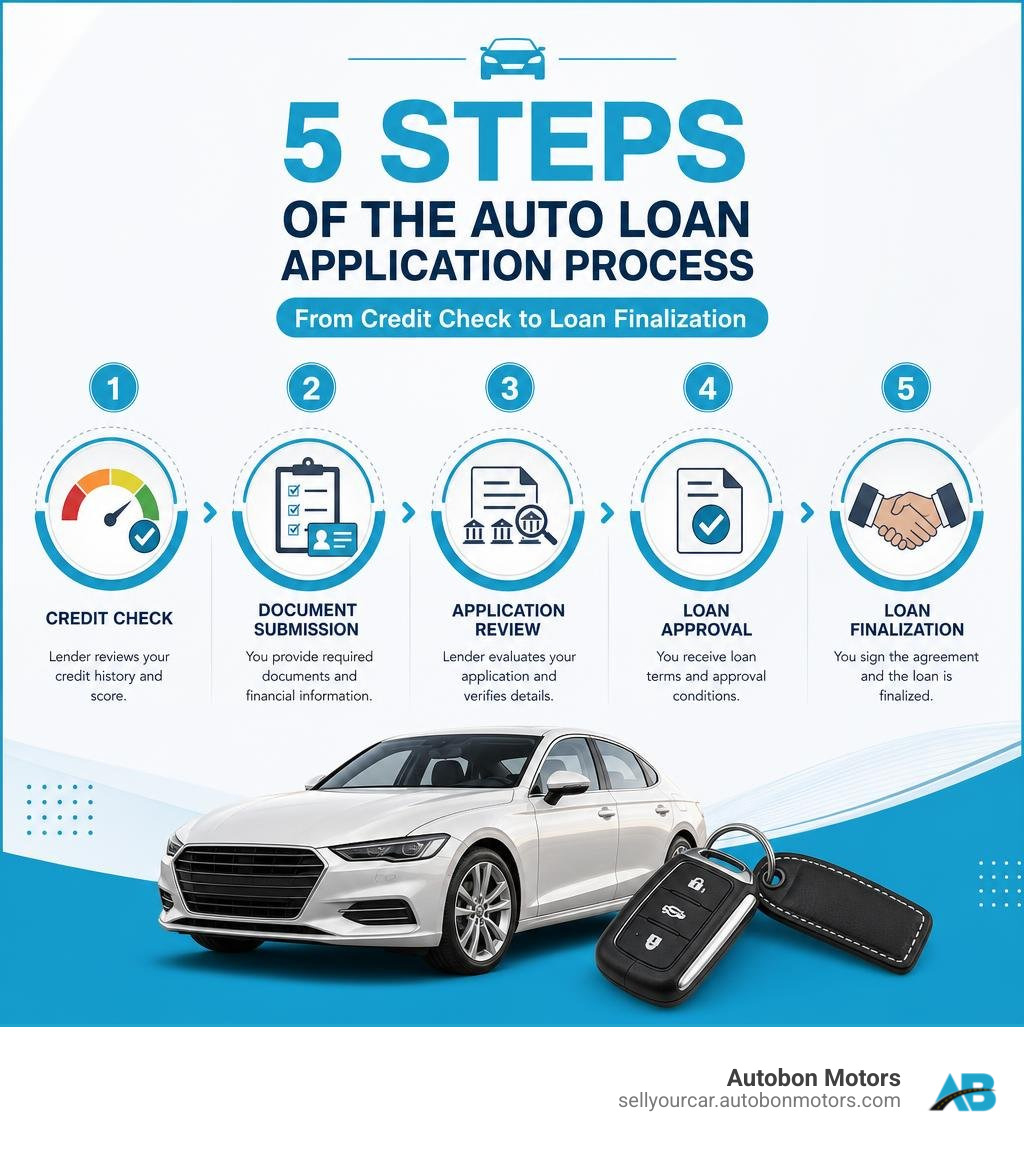
The 5 Steps to Apply for an Auto Loan

The auto loan process is easier when you break it into steps. Instead of walking into a dealership and hoping everything works out, prepare ahead of time. Your future self will thank you, and your wallet may too.
Here is the complete process from start to finish.
Step 1: Check Your Credit Score and Budget
Before you submit an auto loan application, check your credit reports and understand your budget.
Start by reviewing:
- Your credit score
- Your credit reports for errors
- Your current monthly debt payments
- Your income after taxes
- Your housing costs
- Your insurance estimate
- Your expected fuel, maintenance, and registration costs
A car payment is not the only cost of owning a vehicle. In South Florida, you should also consider insurance, fuel, tolls, parking, maintenance, and repairs. A beautiful vehicle becomes less fun if the monthly payment makes dinner feel like a luxury sport.
A good budget should include:
- Monthly payment
- Insurance premium
- Fuel or charging costs
- Maintenance
- Registration and title fees
- Emergency savings
You should also think about the relationship between loan term, interest rate, and monthly payment.
| Loan Choice | Monthly Payment | Total Interest | Best For |
|---|---|---|---|
| Shorter term | Higher | Lower | Buyers who want to pay off the loan faster |
| Longer term | Lower | Higher | Buyers who need more monthly flexibility |
| Lower rate | Lower | Lower | Buyers with stronger credit or better offers |
| Larger down payment | Lower | Lower | Buyers who want to finance less |
| Smaller down payment | Higher | Higher | Buyers preserving cash upfront |
The important lesson: a lower monthly payment is not always the cheapest loan. Stretching a loan over a longer term can reduce the payment, but it may increase the total interest paid over time.
Step 2: Gather Documents for Your Auto Loan Application
Having your documents ready can make the process much smoother. Many online applications take only minutes, but missing paperwork can slow things down.
Common documents and information include:
Personal identification
- Driver’s license
- Government-issued ID
- Social Security number or taxpayer ID, if required
- Date of birth
- Contact information
Residence information
- Current address
- Previous address, if you recently moved
- Housing payment amount
- Rent or mortgage status
Income and employment
- Recent pay stubs
- Employer name and contact information
- Job title
- Length of employment
- Tax returns, especially if self-employed
- Bank statements, if requested
- Proof of other income, if applicable
Vehicle information
- Year, make, and model
- VIN
- Mileage
- Purchase price
- Dealer or seller information
- Buyer’s order or purchase agreement
- Trade-in information, if applicable
Insurance
- Proof of insurance
- Insurance company information
- Policy details, once the vehicle is selected
For refinancing
- Current loan statement
- Payoff amount
- Current lender information
- Vehicle registration
- VIN
- Mileage
If you are self-employed, prepare extra documentation. Lenders may ask for tax returns, profit-and-loss statements, or bank statements. The goal is simple: prove that your income is real, reliable, and enough to support the loan.
Step 3: Compare Lenders and Rates
Not all auto loan offers are created equal. A smart shopper compares multiple options before signing.
Common lender types include:
| Lender Type | Potential Benefits | Things to Watch |
|---|---|---|
| Banks | Convenient if you already have an account; broad loan products | Credit standards may be stricter |
| Credit unions | Often member-focused with flexible service | Membership may be required |
| Dealership financing | Convenient one-stop process; may access multiple lenders | Compare carefully so you understand the full cost |
| Online lenders | Fast applications and quick decisions | Review fees, terms, and lender reputation |
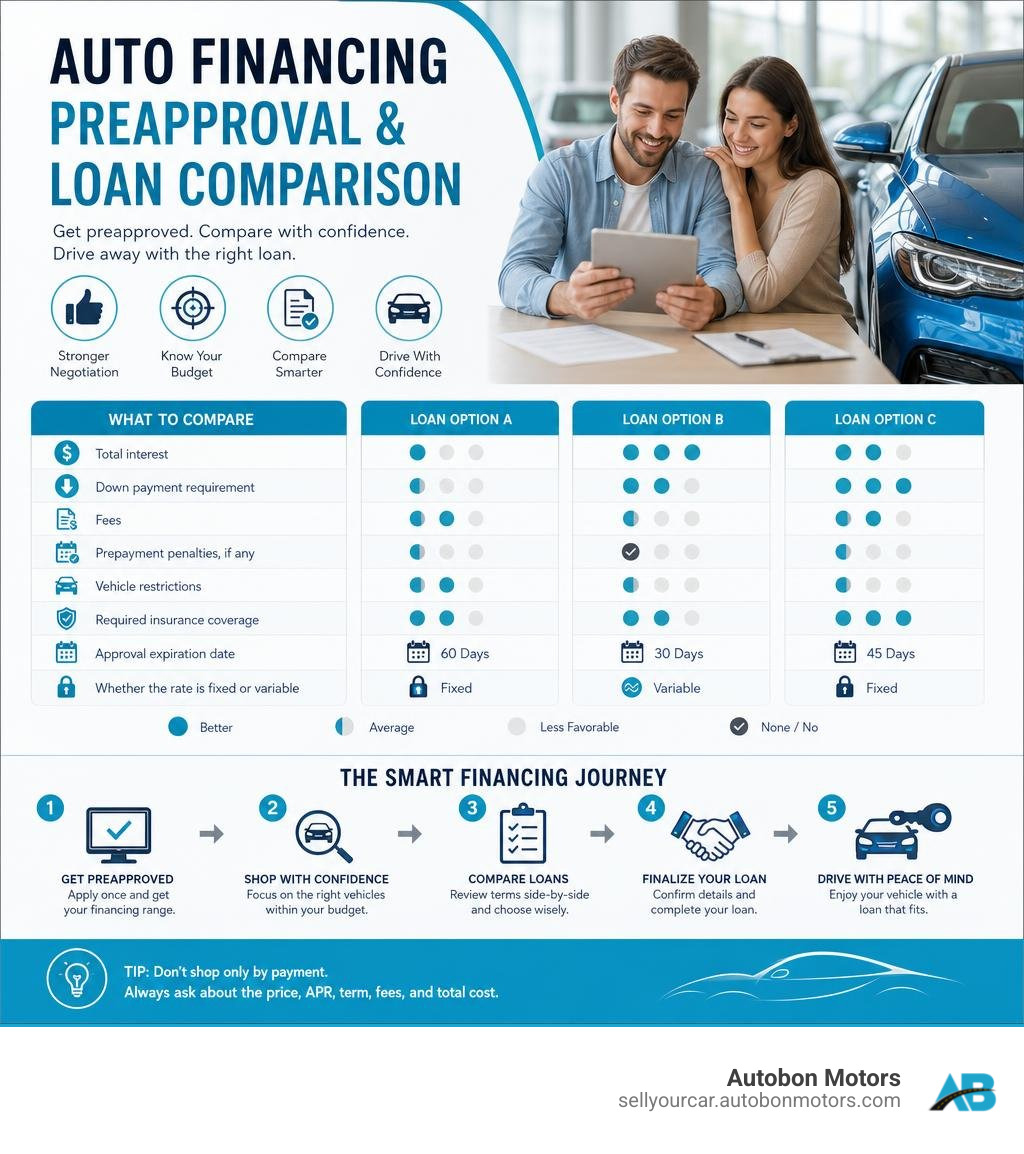
When comparing offers, look beyond the monthly payment. Compare:
- APR
- Loan term
- Total interest
- Down payment requirement
- Fees
- Prepayment penalties, if any
- Vehicle restrictions
- Required insurance coverage
- Approval expiration date
- Whether the rate is fixed or variable
APR is especially important because it reflects the cost of borrowing as a yearly rate, including interest and certain finance charges. A lower APR generally means a lower borrowing cost, assuming the same loan amount and term.
You can also review general auto loan information from a Florida-based lender to see examples of how lenders explain terms, refinancing, protection products, and application requirements.
Step 4: Get Preapproved Before You Shop
Preapproval can change the way you shop for a vehicle. Instead of asking, “Can I afford this?” after falling in love with a car, you begin with a clear financing range.
That matters because the dealership experience is easier when you already know:
- Your maximum loan amount
- Your estimated APR
- Your preferred loan term
- Your monthly payment comfort zone
- Whether you need a down payment
- Whether you may need a co-signer
A preapproval may also help you negotiate more confidently. You can focus on the vehicle price, trade-in value, and total deal instead of getting distracted by monthly payment gymnastics.
Here is a simple tip: do not shop only by payment. A payment can be lowered by stretching the term, increasing the down payment, or changing the structure of the deal. Always ask what the vehicle price, APR, term, fees, and total cost look like.
Step 5: Finalize Your Loan and Select Your Vehicle
Once you choose a vehicle, the lender finalizes the loan using the exact vehicle details. This is where the preapproval becomes a completed loan.
The final step may include:
- Confirming the VIN
- Verifying mileage
- Reviewing the buyer’s order
- Confirming purchase price
- Reviewing taxes, title, and registration details
- Providing proof of insurance
- Signing loan documents
- Completing title and lien paperwork
- Setting up your first payment
- Choosing automatic payments, if available
Your first payment is often due after the loan is finalized, typically within a set window determined by the lender. Before you sign, confirm:
- Payment due date
- Payment amount
- APR
- Loan term
- Total finance charge
- Total amount financed
- Whether there is a prepayment penalty
- What happens if you pay extra toward principal
Read everything. Yes, even the boring parts. Especially the boring parts. That is where the important details like fees, late charges, and payoff rules live.
Evaluating Loan Terms, Rates, and Add-On Protections
Once your loan offer is in front of you, take a step back and review the full package.
The three biggest numbers are:
- Loan amount – how much you borrow
- APR – the annual cost of borrowing
- Loan term – how long you take to repay
These three work together. If the loan amount stays the same:
- A lower APR usually lowers the payment and total interest
- A shorter term usually raises the payment but lowers total interest
- A longer term usually lowers the payment but raises total interest
- A bigger down payment usually lowers both payment and total interest
Longer terms can be useful when you need payment flexibility, but they may also increase the risk of negative equity. Negative equity means owing more than the vehicle is worth. This can become a problem if you want to sell, trade, or refinance the vehicle before the loan balance drops enough.
You may also be offered add-on protections. Some are useful for the right buyer, but none should be accepted automatically.
GAP insurance
GAP coverage may help if your car is totaled or stolen and your insurance payout is less than your loan balance. This can be worth considering if you make a small down payment, choose a longer loan term, or finance a vehicle that may depreciate quickly.
Extended warranty or vehicle service contract
This may cover certain repairs after the manufacturer’s warranty ends. Review what is covered, what is excluded, the deductible, where repairs can be made, and whether the cost is worth it for the vehicle you are buying.
Payment protection
Some products may help cover payments in certain situations such as job loss, disability, or death. These products vary widely, so read the terms carefully.
Tire, wheel, key, or appearance protection
These can be convenient, but compare the cost to your actual risk. If you rarely lose keys and avoid potholes like a professional race driver, you may not need every add-on.
Before accepting any add-on, ask:
- Is it optional?
- What does it cost?
- Is it financed into the loan?
- Does it increase my monthly payment?
- Can I cancel it?
- What exactly is covered?
- What is excluded?
- Is there a deductible?
The best loan is not just the one with the lowest payment. It is the one that fits your budget, protects you where needed, and avoids unnecessary extras.
When to Consider Refinancing Your Auto Loan
Refinancing means replacing your current auto loan with a new one. The new lender pays off the old loan, and you make payments under the new terms.
Refinancing may be beneficial if:
- Your credit score has improved
- Interest rates available to you are lower
- You want to reduce your monthly payment
- You want to shorten your loan term
- You want to remove or add a co-borrower
- You want to change lenders
- You need a cash-out refinance, if available and appropriate
A refinance can help reduce payments, save on interest, or sometimes access cash from vehicle equity. But it is not always the right move.
Be careful if refinancing:
- Extends the loan too long
- Increases total interest
- Adds new fees
- Leaves you with negative equity
- Restarts the repayment clock without a clear benefit
Before refinancing, gather:
- Current loan statement
- Payoff amount
- Current APR and term
- Vehicle registration
- VIN
- Mileage
- Proof of insurance
- Income documents
Then compare the new loan to your current loan. Do not just compare monthly payment. Compare total remaining cost. A lower payment can still cost more if the term is much longer.
Refinancing can be smart when it improves your financial position. It can be risky when it only delays the pain. We prefer the smart version. It comes with fewer headaches.
Frequently Asked Questions about Auto Loans
Below are the questions we hear most often from buyers preparing for an auto loan application in Fort Lauderdale, Broward County, Miami, and throughout South Florida.
Can first-time buyers with no credit qualify for an auto loan?
Yes, first-time buyers and people with limited or no credit may still qualify for financing. Credit score is important, but lenders may also consider income, employment, residence stability, down payment, vehicle choice, and whether a co-signer is available.
Ways to improve approval odds include:
- Make a larger down payment if possible
- Choose a practical vehicle with a realistic payment
- Show stable income
- Keep existing debts low
- Avoid applying for too many unrelated credit accounts
- Add a qualified co-signer or co-buyer
- Provide complete documentation
- Consider a first-time buyer program if available
A co-signer is someone who agrees to be responsible for the loan if the primary borrower does not pay. This can help a first-time buyer qualify, but it is a serious responsibility. Missed payments can affect both people.
If you are new to credit, start with a payment that feels comfortable, not heroic. The goal is to build a strong payment history, not win a monthly payment weightlifting contest.
How long does it take to get approved for an auto loan?
Many lenders can provide online decisions in minutes, and some decisions may come back in seconds when the application is complete and easy to verify. More complex applications can take longer.
Approval may be delayed if:
- Income needs manual verification
- Credit history is limited
- The vehicle details are missing
- The down payment changes
- A co-signer is added
- The lender needs proof of residence
- The vehicle has title, mileage, or valuation concerns
- Your credit file is frozen
To speed things up, prepare your documents before applying and make sure your information is accurate. A small typo in your income, address, or Social Security number can create a big delay.
What vehicle age and mileage restrictions do lenders have?
Vehicle restrictions vary by lender. Many lenders set limits on:
- Model year
- Mileage
- Vehicle condition
- Title status
- Commercial use
- Salvage or rebuilt titles
- Exotic or specialty vehicles
- Private-party purchases
- Loan amount compared with vehicle value
Some lenders are comfortable with newer used vehicles but may be more cautious with older, high-mileage vehicles. Others may have special programs for electric vehicles, accessible vehicles, or refinance loans.
Before you fall in love with a vehicle, confirm that your lender will finance it. A car can be beautiful, clean, and perfect for you, but if it does not meet lender guidelines, the loan may not be approved.
Conclusion
Submitting an auto loan application does not have to be stressful. When you understand the process, prepare your documents, compare offers, and get preapproved before shopping, you put yourself in a much stronger position.
Here is the simple version:
- Check your credit and budget
- Gather your documents
- Compare lenders and loan terms
- Get preapproved
- Finalize the loan after choosing the right vehicle
At Autobon Motors, we believe car decisions should feel clear, fair, and pressure-free. While financing helps many people buy their next vehicle, selling or trading your current vehicle can also strengthen your position by increasing your down payment or reducing how much you need to borrow.
Our car-selling process is simple:
- Book your appointment online
- Bring your car
- Get an instant offer from one of our advisors
- Get paid on the spot
We are based in Fort Lauderdale and proudly serve Broward County, Miami, and South Florida. If you are preparing to buy your next vehicle and want to turn your current car, truck, or SUV into cash, start with a fast, transparent offer from our team.
Ready to move forward? Sell your car to Autobon Motors and get a strong cash offer before you shop.