What You Need to Know About Car Financing in 2026
Car financing is the process of borrowing money to purchase a vehicle, then repaying it over time — usually with interest.
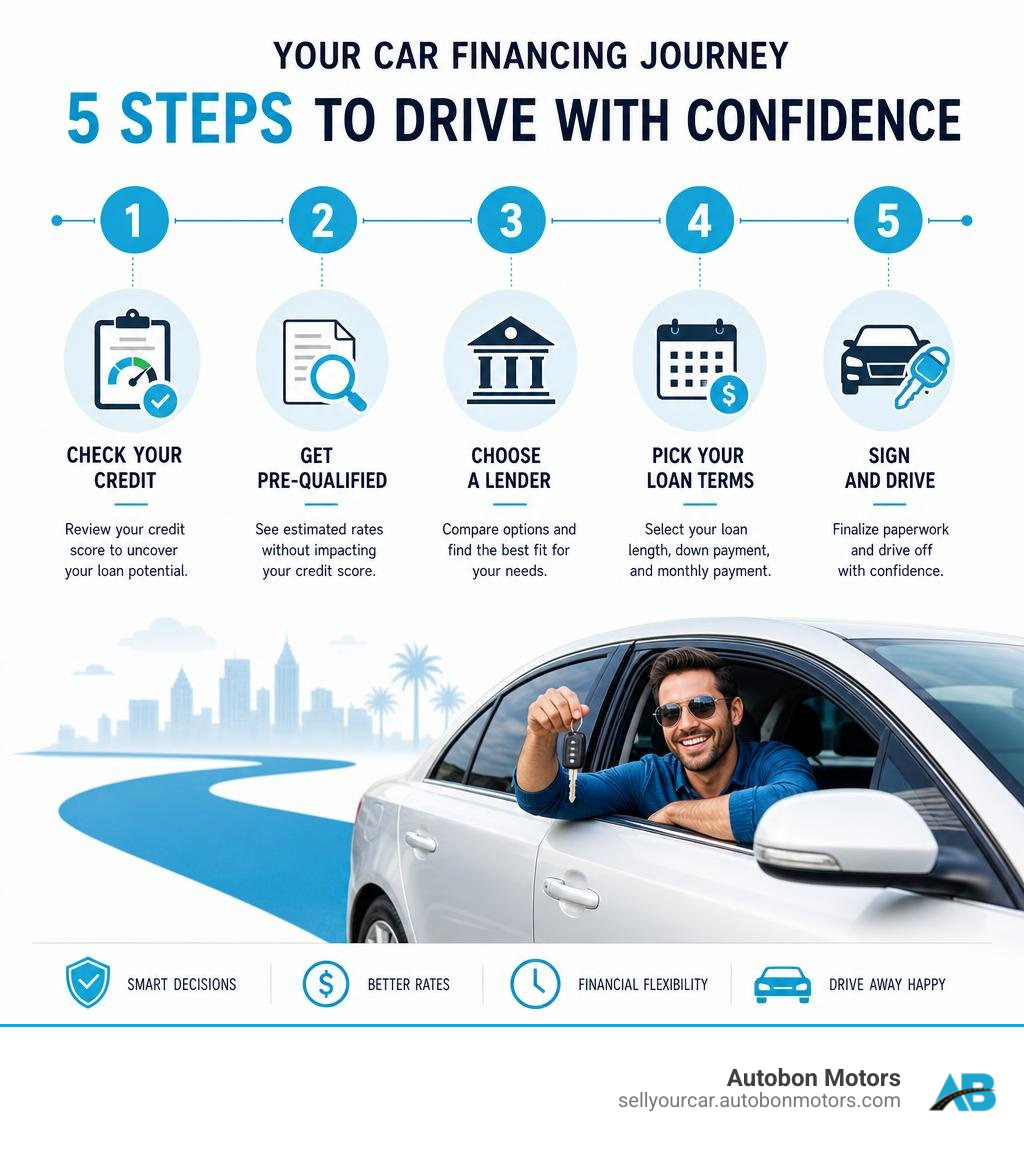
Here’s a quick overview of how it works:
| Step | What Happens |
|---|---|
| 1. Check your credit | Your credit score determines your interest rate and loan options |
| 2. Get pre-qualified | See estimated rates with no impact to your credit score |
| 3. Choose a lender | Compare banks, credit unions, dealerships, and online lenders |
| 4. Pick your loan terms | Select your loan length, down payment, and monthly payment |
| 5. Sign and drive | Finalize paperwork and take ownership of your vehicle |
Whether you’re buying new, buying used, or looking to refinance an existing loan, the financing path you choose has a big impact on what you actually pay over time. A difference of just a few percentage points in your interest rate — or a few extra months on your loan term — can mean thousands of dollars more out of your pocket.
The current average auto loan rate sits at 6.98% for a 60-month new car loan, though rates for well-qualified borrowers can be significantly lower. Understanding the landscape before you walk into a dealership is one of the smartest moves you can make.
This guide breaks down everything — from loan types and interest rates to pre-approval strategies and refinancing — in plain language, so you can make a confident decision.
I’m Marcos Bravo, a seasoned automotive sales and marketing executive with over 25 years of experience in the luxury and exotic car market across South Florida, where I’ve guided countless clients through the car financing process from pre-qualification to final purchase. From that hands-on expertise, this guide is built to cut through the confusion and put you in control of your next vehicle purchase.
Navigating Your Car Financing Options
When you begin looking at how to fund your next ride in South Florida, you will quickly find that there is no one-size-fits-all solution. The right path depends heavily on your budget, how long you plan to keep the car, and your driving habits.

To get started, we need to look at the primary ways people acquire vehicles: buying new, buying used, or leasing. Each has distinct financial implications that will affect your wallet for years to come.
| Feature | Leasing | Buying (Loan) |
|---|---|---|
| Ownership | You are renting the car; you must return it or buy it at lease-end. | You own the car outright once the loan is fully paid off. |
| Monthly Payments | Typically lower, as you only pay for the vehicle’s depreciation. | Higher, because you are paying off the entire purchase price. |
| Mileage Limits | Yes (usually 10,000 to 15,000 miles per year). | No limits; drive as much as you want. |
| Customization | Not allowed; the car must be returned in its original condition. | Fully allowed; it is your car to modify as you see fit. |
| Wear & Tear Fees | Yes, you may face charges for excess wear at the end. | No, though depreciation will affect your eventual resale value. |
New vs. Used Car Loans
Choosing between a new and a used car loan involves more than just comparing the sticker prices. The financing structures themselves behave differently.
New car loans generally feature lower interest rates. In June 2026, the best auto loan rates for highly qualified buyers on new cars start as low as 4.33% APR. Lenders offer lower rates on new cars because they are easier to value and represent less risk; if you default, the lender can easily repossess and sell a highly marketable, modern vehicle.
However, new cars suffer from rapid depreciation. A brand-new vehicle can lose 20% or more of its value within the first year. This means you run the risk of falling “upside down” on your loan—owing more than the car is actually worth.
Used car loans, on the other hand, typically carry higher interest rates. Lenders charge more because older vehicles carry a higher risk of mechanical failure, which increases the likelihood of default. However, because the previous owner already absorbed the steepest part of the depreciation curve, your total loan amount is much smaller. This can lead to a shorter amortization period and less total debt overall.
When weighing these factors, exploring options like Auto Loans: New, Used, Refinance can help you find a structured loan that balances vehicle age with competitive interest terms.
Leasing vs. Buying
Leasing is often described as a long-term rental. Your monthly payments are calculated based on the vehicle’s expected depreciation over the lease term (usually 36 months), plus interest and fees. Because you are not paying down the entire principal value of the car, leasing offers a much lower monthly payment than buying.
The downside? You do not build equity. At the end of the lease, you must return the car, purchase it for a predetermined “balloon payment,” or trade it in. You must also adhere to strict mileage limits and maintain the car in pristine condition to avoid hefty excess wear-and-tear fees.
Buying a car with a traditional auto loan means you are working toward complete ownership. Every monthly payment you make builds equity in an asset. Once the loan is paid off, you can drive payment-free for years. There are no mileage limits or customization restrictions.
While the monthly payments are higher, buying is almost always the more cost-effective long-term strategy if you plan to keep the vehicle for five years or more. To explore how different structures can fit your financial goals, you can look into Car Loans & Flexible Financing Options | TD Canada Trust for a detailed breakdown of amortization schedules and flexible terms.
How Auto Loan Interest Rates and Monthly Payments Work
Understanding the mechanics of your monthly payment is crucial to avoiding “payment shock.” Many buyers focus solely on whether they can afford the monthly payment, but looking at the big picture—including the total cost of ownership—is what keeps you financially secure.

How Credit Scores Impact Car Financing
Your credit score is the single most important factor determining your interest rate. Lenders use your credit score to place you into “credit tiers,” which dictate the APR you will be offered.
- Super-Prime (780+): These borrowers qualify for the absolute lowest promotional rates, sometimes starting as low as 4.33% APR in today’s market.
- Prime (660-779): Borrowers in this range still receive highly competitive rates, typically close to the national average of 6.98%.
- Non-Prime & Subprime (500-659): Borrowers in these tiers will face significantly higher rates, sometimes ranging from 10% to over 28% APR, as lenders price in the increased risk of default.
If you fall into a lower tier, you may need a larger down payment or a co-signer to secure approval. To see how your specific credit profile aligns with current regional lending standards, you can review the options at Apply for an Auto Loan | Florida Credit Union to understand the relationship between credit health and your final APR.
The Math Behind Your Monthly Payment
Your monthly payment is determined by three primary variables: the loan amount (principal), the loan term (length), and the Annual Percentage Rate (APR).
- Principal: The total amount you borrow. This is the purchase price of the car minus your down payment and any trade-in equity, plus taxes, registration, and dealer fees.
- Loan Term: The amount of time you have to pay back the loan, typically ranging from 24 to 84 months.
- APR: The interest rate plus any lender fees, expressed as a yearly percentage.
While extending your loan term to 72 or 84 months will lower your monthly payment, it significantly increases the total interest you will pay over the life of the loan.
To keep your monthly payments manageable without overpaying on interest, focus on these key strategies:
- Put more money down: Aim for a down payment of at least 10% to 20% of the vehicle’s purchase price. This immediately reduces your principal and can even unlock lower interest rates.
- Keep the term short: Opt for a 60-month term or shorter. This ensures you build equity quickly and avoid paying excessive interest.
- Improve your debt-to-income (DTI) ratio: Lenders prefer borrowers whose total monthly debt payments (including the prospective car payment) consume less than 45% of their gross monthly income.
The Road to Approval: Pre-Qualification vs. Pre-Approval
Before you set foot in a South Florida dealership, you should know exactly how much buying power you have. Getting your financing sorted out beforehand saves you time and protects your wallet.
The Pre-Qualification Process
Pre-qualification is an informal first step. You provide a lender with basic financial details—such as your income, housing costs, and estimated credit score. The lender then performs a soft credit inquiry, which does not affect your credit score.
Based on this self-reported data, the lender will provide you with a quick estimate of the loan amount and interest rate you might qualify for. These offers are typically valid for 30 days. Pre-qualification is an excellent tool for narrowing down your budget, allowing you to Go to the dealer with real rates in hand so you can shop with confidence.
Why Pre-Approval Gives You Leverage
While pre-qualification gives you an estimate, a formal pre-approval is a conditional commitment from a lender to grant you a loan up to a specific amount. This process requires a formal application and a hard credit inquiry, which may temporarily lower your credit score by a few points.
Walking into a dealership with a pre-approval letter completely changes the dynamic of your purchase:
- It sets a firm budget: You know your exact spending limit, preventing you from falling in love with a car you cannot afford.
- It streamlines the buying process: You can bypass the dealership’s lengthy finance office negotiations.
- It gives you negotiating leverage: If the dealer wants you to use their in-house financing, they have to beat the rate on your pre-approval letter.
To secure this leverage early in your shopping journey, you can apply for an Auto loan pre-approval | Apply for an auto loan | U.S. Bank to establish a firm financial baseline.
Comparing Lenders for the Best Car Financing Deals
Not all lenders are created equal. To find the best deal, you should compare offers across several different types of financial institutions.
- Banks: Traditional banks offer competitive rates to borrowers with established relationships and strong credit profiles.
- Credit Unions: Because they are member-owned, non-profit institutions, credit unions often offer the lowest interest rates in the market. For example, some credit unions offer rates as low as 3.24% APR for new cars if you use their auto buying services.
- Online Lenders & Marketplaces: Online platforms allow you to compare multiple customized offers within minutes. Some specialized online lenders cater to fair-credit borrowers (with minimum credit scores of 600) or offer unsecured personal loans for fast funding.
- Dealership Financing: Dealerships act as intermediaries, sending your application to a network of lenders. While convenient, dealers often add a markup to the interest rate to make a profit. However, they also have access to manufacturer-backed “captive lenders” who occasionally offer promotional 0% or low-APR financing on new models.
Comparing Lenders for the Best Car Financing Deals
To find the absolute best terms, we recommend submitting applications to at least three different lenders within a 14-day window. Credit scoring models treat multiple auto loan inquiries within a short period as a single inquiry, minimizing the impact on your credit score.
When comparing offers, look closely at the APR, the loan term, and any hidden fees. For a clear look at how structured finance agreements operate across different lender networks, checking out resources like AA Car Finance, Used & 2nd Hand Car Finance Company, Apply Online | AA Cars can give you a helpful framework for comparing direct loans, hire purchases, and personal contract plans.
What Documents Do You Need to Apply?
To ensure a smooth application process, gather the following documents before you apply:
- Proof of Identity: A valid driver’s license or passport.
- Proof of Income: Your two most recent pay stubs, W-2 forms, or tax returns (if self-employed).
- Proof of Residency: A recent utility bill or lease agreement matching your current address.
- Vehicle Information: The purchase agreement, bill of sale, and the vehicle’s VIN (Vehicle Identification Number) if buying from a private seller or dealership.
- Proof of Insurance: Lenders require comprehensive and collision insurance coverage before finalizing the loan.
Is Refinancing Your Auto Loan Worth It?
Refinancing means replacing your current auto loan with a new one, ideally with better terms. If interest rates have dropped since you bought your car, or if your credit score has improved significantly, refinancing can save you a substantial amount of money.
The Pros of Refinancing:
- Lower your APR: Securing a lower interest rate can save you hundreds or thousands of dollars in total interest over the life of the loan.
- Reduce your monthly payment: You can lower your monthly payment by securing a lower rate, extending the loan term, or both.
- Remove a co-signer: If your credit has improved, you can refinance to remove a co-signer from the original loan.
The Cons of Refinancing:
- Extending the loan term costs more: If you lower your monthly payment by extending your loan term, you may end up paying more in total interest, even with a lower APR.
- Risk of going “upside down”: Extending your loan on an older vehicle means the car may depreciate faster than you pay down the principal, leaving you with negative equity.
- Prepayment penalties: Check your original loan agreement to ensure there are no prepayment penalties for paying off the loan early.
Frequently Asked Questions About Auto Loans
What credit score is typically needed for a car loan?
While there is no official minimum credit score required to buy a car, most traditional lenders prefer a score of 600 or higher for standard auto loans. Borrowers with scores below 600 can still qualify for subprime loans, but they will face much higher interest rates and may be required to make a substantial down payment.
Does pre-qualifying for a car loan hurt my credit?
No. Pre-qualification relies on a soft credit inquiry, which does not affect your credit score or appear on your credit report to other lenders. It is an excellent, risk-free way to estimate your budget before shopping.
How much down payment should I put on a car?
We recommend putting down at least 10% for a used car and 20% for a new car. A healthy down payment lowers your monthly payment, reduces your loan-to-value (LTV) ratio, helps you secure a lower interest rate, and protects you from falling into negative equity as the vehicle depreciates.
Conclusion
Navigating car financing can feel overwhelming, but entering the market with real rates in hand and a clear budget puts you in complete control. By comparing lenders, understanding your credit score, and choosing the right loan terms, you can save thousands of dollars and drive away with absolute peace of mind.
If you are looking to upgrade your ride in South Florida, the easiest way to start is by unlocking the equity in your current vehicle. At Autobon Motors, we make selling your car simple, transparent, and completely stress-free. Located right here in Fort Lauderdale, we are South Florida’s premier car-buying service, offering a customer-first, no-pressure alternative to online corporate giants.
Forget the endless online forms, automated lowball offers, and complicated trade-in math. Our personalized, local process takes just four simple steps:
- Book your Appointment Online: Schedule a convenient time to visit us.
- Bring your Car: Visit our Fort Lauderdale location.
- Get an Instant Offer: One of our expert local advisors will inspect your vehicle and provide a fair, transparent offer in just 15 minutes.
- Get Paid on the Spot: We back our offers with a higher offer guarantee and lock your price for 3 days. If you accept, we pay you cash on the spot.
Ready to see how much your car is worth? Sell your car to Autobon Motors today and take the first step toward your next vehicle with real cash in hand!