
What Is a 3 Day Price Lock — and Do You Actually Need One?
A 3 day price lock is a paid feature that freezes a flight’s fare for 72 hours, giving you time to decide before committing to the full ticket price.
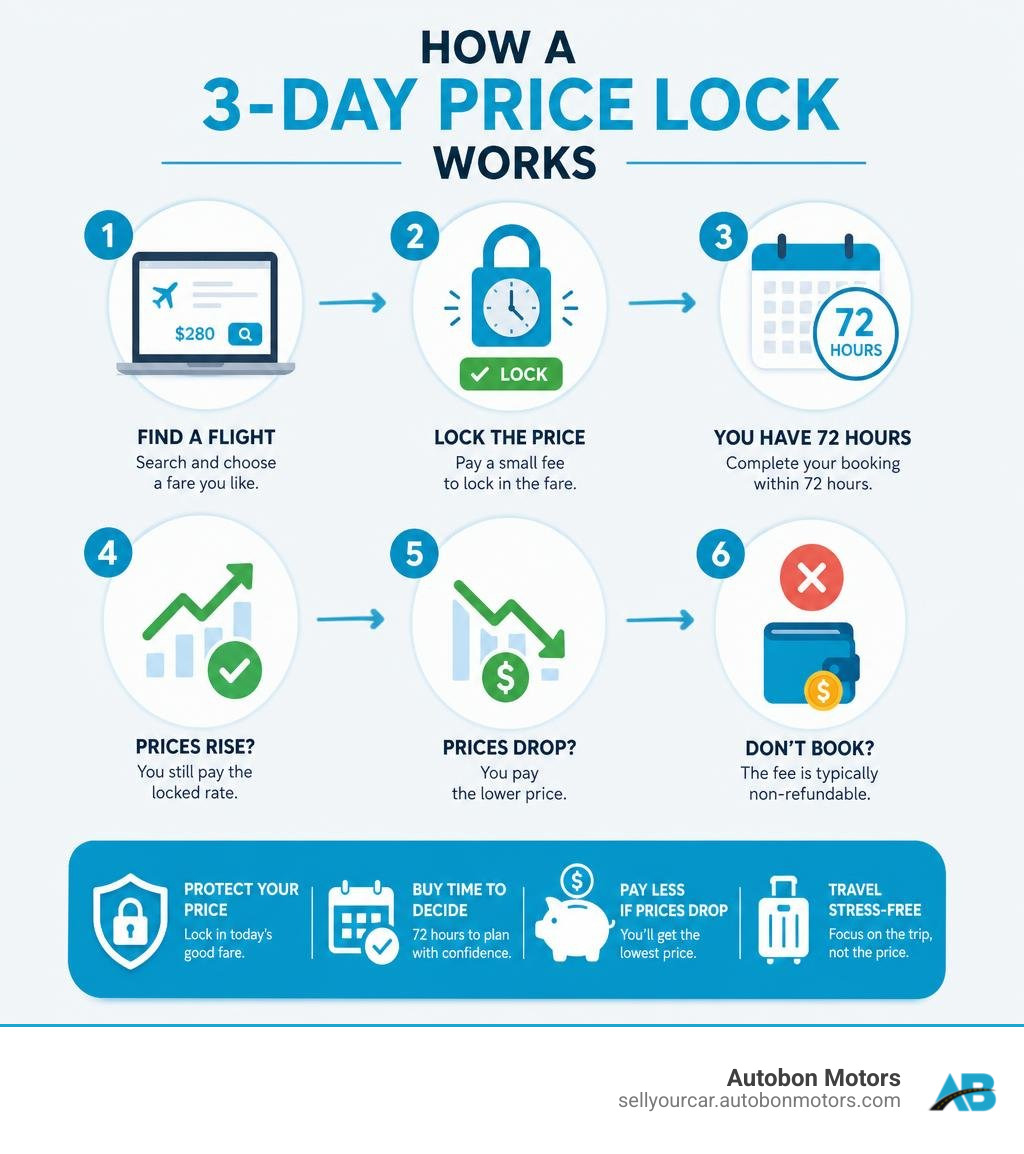
Here’s how it works at a glance:
- Find a flight at a price you like
- Pay a small fee to lock that fare
- You have 72 hours to complete the full booking
- If prices rise, you still pay the locked rate
- If prices drop, you pay the lower price
- If you don’t book, the fee is typically non-refundable
Flight prices move constantly. Airlines use dynamic pricing — fares can jump by 30% or more within a single week, and the 14 days before departure are often the most volatile. That creates a frustrating dilemma for travelers: book now and risk committing too early, or wait and risk paying more?
A 3 day price lock solves that problem. It gives you a short window to confirm plans with travel companions, check your schedule, or simply sleep on the decision — without watching that good fare disappear overnight.
The numbers back this up. According to data from Kiwi.com, 56.6% of travelers who use a price lock go on to complete their booking at the originally fixed price, saving an average of €24 per booking. And 74% of travelers say they’re more likely to travel when a hold option is available.
It’s a simple concept, but the details matter — and the fine print can catch you off guard if you’re not prepared.
I’m Marcos Bravo, a sales and marketing executive with over 25 years in the luxury and exotic automotive industry in South Florida, where understanding price protection — whether on a flight or a vehicle — is central to helping clients make confident, well-timed decisions. In this guide, I’ll walk you through exactly how a 3 day price lock works, where to find it, and the common mistakes that cost travelers money.
Understanding the 3 Day Price Lock: How It Saves You Money

To truly appreciate the value of a 3 day price lock, it helps to understand why travel prices fluctuate so wildly in the first place. Travel providers, particularly airlines, rely heavily on sophisticated dynamic pricing algorithms. These systems continuously monitor supply, historical booking trends, search volume, and competitor pricing to adjust fares in real time. Fares can spike dramatically during high seasons—sometimes by up to 50%—and the sharpest increases almost always occur during the final two weeks leading up to departure.
This constant volatility creates immense decision anxiety. You find a great deal on a flight, but you aren’t ready to hit “buy.” Perhaps you need to clear the dates with your employer, check your bank account, or coordinate schedules with friends and family. In fact, research shows that 26% of travelers want price lock features specifically because they are waiting for friends and family to solidify their travel plans.
By securing a 72-hour price freeze, you purchase valuable decision-making time. When you utilize services like the Kiwi.com Price lock, you pay a small service fee to establish a ceiling on what you will pay for that specific itinerary. If the market fare skyrockets over the next three days, the booking platform absorbs the price increase. On the flip side, if the price drops, you aren’t locked into paying the higher rate; you can simply complete your booking at the new, lower price.
This dual-benefit structure is incredibly popular. When Kiwi.com introduced Price Lock, they revealed that more than half of all customers who use the feature complete their bookings. This high conversion rate proves that price locks are not just a gimmick; they are an essential tool for savvy travelers looking to navigate volatile markets without stress.
How Price Locks Work Across Different Industries (Flights, Mortgages, and Cars)
While short-term price locks are most famous in the travel industry, the underlying concept of price protection spans multiple sectors. Securing a rate or price offer is a standard risk-mitigation strategy used in real estate, travel booking, and the automotive market.
To see how these options compare, let’s look at how price locks function across different transactions:
| Feature / Industry | Travel & Flights | Real Estate & Mortgages | Automotive (Car Sales & Appraisals) |
|---|---|---|---|
| Typical Lock Duration | 1 to 3 days (up to 14 days on select OTAs) | 30 to 45 days (up to 120+ days for new builds) | 3 days (72 hours) |
| Primary Risk Protected | Spikes in dynamic airline ticket pricing | Sudden interest rate hikes before closing | Rapid market depreciation and lower trade-in offers |
| Upfront Cost | Small non-refundable service fee or 10% deposit | Often built into the rate or paid via extension fees | Free (provided by customer-first local dealerships) |
| Seat/Asset Guarantee | Holds the price only; does not guarantee a seat | Secures the loan terms; home purchase depends on contract | Guarantees the cash payout value for your vehicle |
In the airline sector, carriers and online travel agencies (OTAs) have developed distinct flavors of this tool. For example, legacy carriers like United offer United Airlines FareLock, which lets travelers hold a fare directly on their website. Newer, budget-friendly carriers have also embraced this trend; the Avelo Price Lock allows budget-conscious flyers to freeze fares directly on their booking platform.
In real estate, rate locks are much longer because mortgage transactions take weeks to close. According to the Mortgage Rate Lock Guide 2026, standard rate locks run between 30 and 45 days. In a volatile interest rate environment, missing your rate expiration by even a single day can cost you thousands of dollars over the life of a loan.
In the automotive industry, price locks serve as a shield against rapid market depreciation and shifting dealership valuations. When you get a cash appraisal for your vehicle, a locked price ensures that the dealer cannot lower their offer if you need a few days to think it over, clear out your personal belongings, or arrange alternative transportation.
How to Secure a 3 Day Price Lock on Flights
If you are booking air travel, securing a price lock is a straightforward process, though the exact steps depend on the platform you use.
When searching for flights on platforms like the ixigo Price Lock portal or using Traveloka Price Lock, you will typically see an option to freeze the fare on the payment screen. Depending on the provider, you will either pay a flat, non-refundable service fee or make a small upfront payment (such as 10% of the ticket price) to activate the hold.
Once activated, the platform monitors the flight price. If the ticket price rises during your 72-hour window, the platform covers the difference up to a pre-defined coverage cap. If the price drops, you benefit from the lower fare. To finalize your travel, you simply return to the platform’s “My Bookings” or “Manage Trips” section before the 72-hour countdown expires and pay the remaining balance.
Benefits of a 3 Day Price Lock When Selling Your Car
When it comes to selling your car, a price lock is your best defense against high-pressure sales tactics. Many dealerships will give you an appraisal but insist that the offer is “only valid for today.” This is a classic sales technique designed to force you into a quick decision before you can shop around or think it over.
A guaranteed 3-day appraisal offer changes the dynamic entirely. It gives you the freedom to go home, discuss the sale with your family, and review your options. Because used vehicle values can fluctuate based on local auction data and wholesale supply, having a locked offer protects you from sudden drops in market value.
At Autobon Motors, we believe in a transparent, no-pressure process. We offer a guaranteed 3-day price lock on all our cash appraisals. This means you can get a professional valuation, walk away to consider your options, and return within 72 hours knowing your cash offer is completely secure. To learn more about navigating this process smoothly, check out our guide on How to Sell My Car Online Instantly and read through The Complete Guide to Getting Cash for Your Car.
Common Mistakes to Avoid When Locking a Price

While price locks offer peace of mind, they are governed by strict rules. Failing to understand the fine print can result in lost fees or missed opportunities. Here are the most common mistakes travelers and sellers make:
- Watching the Clock Expire: A 72-hour lock is precise. If you lock a fare at 2:00 PM on Tuesday, it will expire at exactly 2:00 PM on Friday. If you fail to finalize the booking before then, the hold is automatically canceled, your service fee is lost, and you will have to pay the current market rate if you still want to travel.
- Assuming a Price Lock Guarantees a Seat: This is perhaps the biggest misconception. In the airline industry, a price lock is a price guarantee, not a seat guarantee. The airline does not actually reserve a physical seat for you until you pay the full ticket balance. If the flight completely sells out during your hold period, your lock will be canceled (though reputable platforms will refund your lock fee).
- Ignoring the Coverage Caps: Most third-party booking platforms place a limit on how much of a price increase they will cover. If a flight fare spikes beyond this coverage cap, the platform may cancel the lock and refund your service fee, leaving you without a ticket.
- Confusing a Quote with a Lock: Simply receiving an appraisal or viewing a fare quote does not mean the price is locked. You must actively complete the lock process—whether by paying the service fee on a travel site or receiving a written, signed appraisal guarantee from a car buyer.
If you are looking to sell your car quickly and want to avoid these common pitfalls, read our expert tips on How to Get Instant Cash for Your Car Today.
Frequently Asked Questions About Price Freezes
Is a 3-day price lock fee refundable?
In almost all cases, the fee you pay to lock a flight price is non-refundable if you choose not to complete the booking. This fee is the price you pay for the option to buy later. However, there are a few notable exceptions:
- Sold-Out Flights: If the flight sells out entirely during your 3-day lock period, the platform will refund your service fee.
- Airline Cancellations: If the airline cancels the flight or makes a major schedule change during your hold, you are entitled to a refund of the lock fee.
- Excessive Price Spikes: If the fare rises beyond the platform’s maximum coverage cap, the service fee is typically refunded to you.
Does a price lock guarantee my seat on a flight?
No. A price lock guarantees that if a seat is available when you return to book, you will pay the locked price. It does not pull a seat out of inventory or assign a seat to your name. To minimize the risk of a flight selling out during your hold, airlines and platforms generally do not offer price locks on flights that are close to departure or already near capacity.
What happens if the price goes down during the lock period?
If the market price of the flight drops below your locked rate during the 72 hours, you get the best of both worlds! You are not forced to pay the higher locked price. Instead, you can complete your booking at the new, lower market fare. The price lock acts as a ceiling, protecting you from price increases while still allowing you to benefit from price drops.
Conclusion: Lock Your Rate and Sell with Confidence
Whether you are trying to coordinate a family vacation without watching flight fares skyrocket, or looking to sell your vehicle for top dollar in South Florida, securing a price lock gives you the control, clarity, and time you need to make smart decisions.
At Autobon Motors, we bring this exact level of flexibility and peace of mind to the car-buying process. As South Florida’s premier car buying service, we serve sellers across Fort Lauderdale, Broward County, and Miami. We know that selling a vehicle can feel overwhelming, which is why we have completely eliminated the high-pressure, bureaucratic dealership experience.
We offer a fast, transparent, and personalized process that guarantees you get the best cash offer for your used car, truck, or SUV. Best of all, our professional appraisals come with a guaranteed 3-day price lock, giving you plenty of time to make your decision.
Selling your car to us is as easy as four simple steps:
- Book your Appointment Online: Schedule a convenient time to visit our Fort Lauderdale location.
- Bring your Car: Drive in for a quick, professional inspection.
- Get an Instant Offer: One of our expert advisors will provide a fair, transparent valuation in just 15 minutes.
- Get Paid on the Spot: Accept our offer and walk away with cash in hand immediately!
If you want to maximize your vehicle’s value without the stress of private listings or dealership games, learn more about how we make it easy to Sell My Car Today Cash and how to get a professional Sell My Car Appraisal Today.
Ready to see what your car is worth? Get the best cash offer at Autobon Motors today!