

Why Knowing Your Car’s Trade-In Value Before You Negotiate Changes Everything
A trade in car price calculator is a free online tool that estimates what your car is worth before you ever walk into a dealership. If you want a quick answer, here’s how it works:
How to get your trade-in value estimate in minutes:
- Enter your VIN or license plate (or year, make, model, and trim)
- Input your current mileage
- Rate your vehicle’s condition (Excellent, Good, Fair, etc.)
- Add any accident history or ownership details
- Get an estimated trade-in range and private-sale value instantly
Using reputable online valuation tools is a great starting point. Since different estimators use slightly different market data, checking two or three different calculators gives you the most reliable picture.
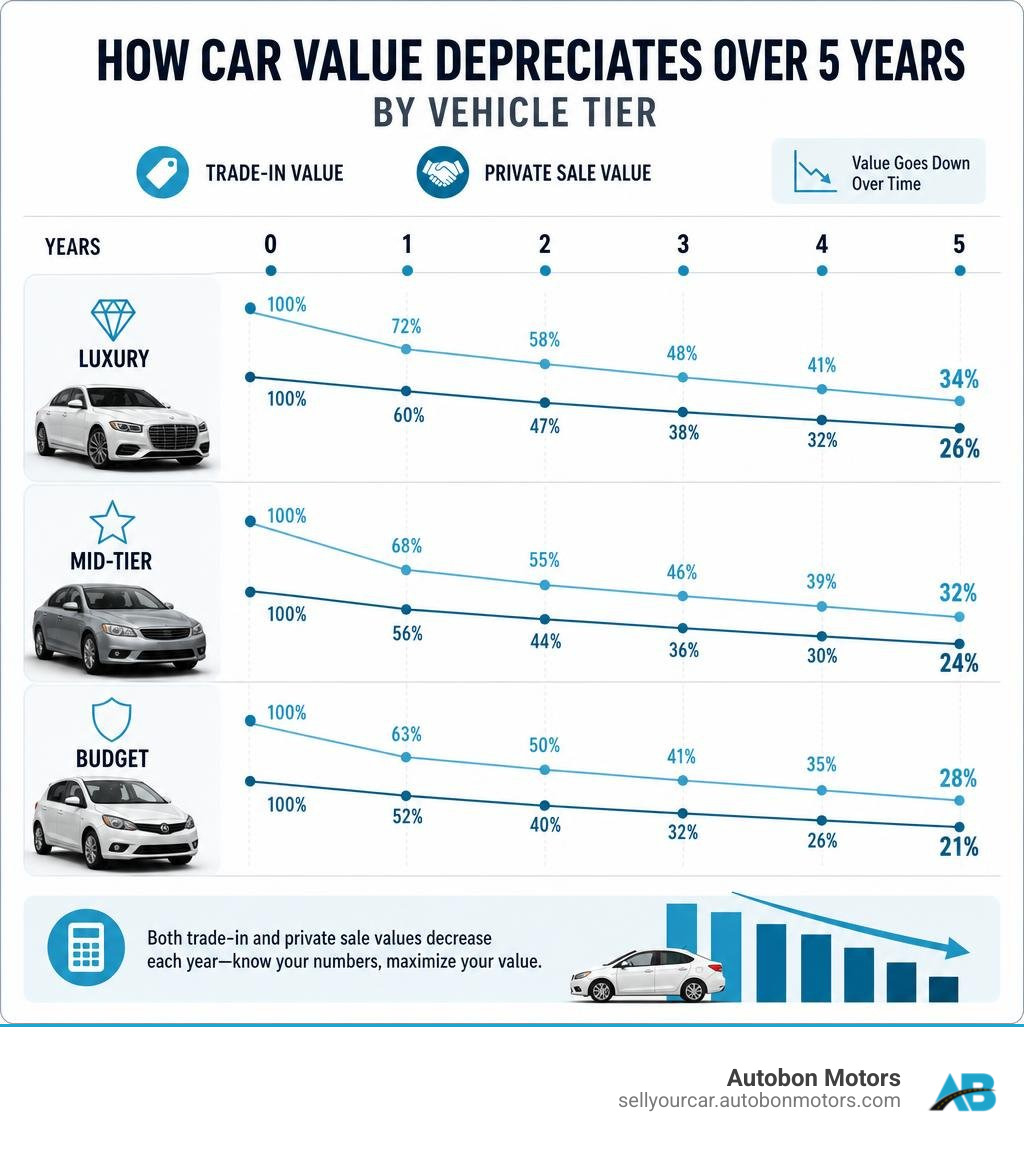
Most car owners don’t realize how much money they leave on the table simply by not knowing their number ahead of time. A new car loses around 20% of its value in the first year alone — and after five years, it may be worth only 40% of what you originally paid. That gap between what you think your car is worth and what a dealer offers can be thousands of dollars.
The good news? A trade-in calculator puts that knowledge in your hands before any negotiation begins.
I’m Marcos Bravo, a South Florida automotive sales professional with over 25 years of experience in the luxury and exotic vehicle market — and I’ve helped hundreds of clients use a trade in car price calculator as their first step toward getting a fair, confident offer. In this guide, I’ll walk you through exactly how these tools work and how to use them to your advantage.
What is a Trade In Car Price Calculator and How Does It Work?
At its core, a trade in car price calculator is a sophisticated data-crunching tool. Instead of forcing you to guess what your vehicle is worth, it acts as a bridge between your driveway and the broader wholesale market.
These digital tools function by scanning vast databases of automotive transactions. When you input your vehicle’s details, the calculator’s algorithm compares your car against thousands of similar makes and models that have recently sold at wholesale auctions, dealership lots, and private listings. By looking at real-time market data, the calculator determines a baseline value for your car.
Most calculators rely on industry-standard pricing databases. These databases are updated weekly to reflect rapid shifts in consumer demand, seasonal trends, and wholesale auction results. For example, if fuel prices spike in South Florida, the calculator’s algorithm will automatically adjust to show a higher value for fuel-efficient hybrids and a slight dip for gas-guzzling SUVs.
By utilizing a Free Vehicle Trade-In Value Calculator, you can see exactly where your vehicle stands in the current retail and wholesale market before you speak to an appraiser.
How to Use a Trade In Car Price Calculator
Using an online calculator is incredibly straightforward, but entering precise information is key to getting an accurate estimate. To get started, you will typically need to provide:
- Your Vehicle Identifier: You can input your 17-digit Vehicle Identification Number (VIN) or your license plate number. This is highly recommended because it automatically pulls your exact trim level, engine size, and original factory packages.
- Odometer Reading: Your current mileage is one of the most critical factors. Standard calculators assume an average annual mileage of about 13,500 miles. If you drive significantly more or less, the calculator will adjust your valuation accordingly.
- Condition Rating: You will be asked to rate your car’s condition, usually on a scale from “Excellent” to “Fair” or “Damaged”. Be honest here—most vehicles fall into the “Good” or “Very Good” categories, while very few truly qualify as “Excellent.”
- Postal Code: Because car values fluctuate by region, entering your local ZIP code ensures the calculator pulls data from South Florida auctions and dealerships rather than national averages.
For a deeper look into how professional appraisers evaluate these inputs, check out our Step-by-Step Guide to Car Appraisal and Value Estimation.
Understanding the Math Behind a Trade In Car Price Calculator
To understand the results of your calculation, it helps to understand the mathematical formulas running behind the scenes. Online estimators use specific depreciation curves tailored to different vehicle classes. For example, a luxury sedan depreciates at a much faster rate than a mid-size pickup truck or a highly sought-after sports car.
The calculator takes the vehicle’s original Manufacturer’s Suggested Retail Price (MSRP) and applies a depreciation curve based on the vehicle’s age. From there, it subtracts penalties for excess mileage (for instance, racking up an extra 25,000 miles over the average can easily drop a vehicle’s value by thousands of dollars) and physical wear.
To see how these depreciation curves differ by vehicle age and model type, you can test out different scenarios using the Used Car & Trade-In Value Calculator.
Understanding Car Valuation: Key Factors and Value Types
To get the most out of your trade-in experience, you need to understand the variables that dictate your car’s worth. No two used cars are identical, and even two identical models parked next to each other in Fort Lauderdale can have wildly different values based on their history and condition.
When dealerships or valuation algorithms calculate your vehicle’s worth, they look at several distinct pillars of data. To see how manufacturers structure these estimates, you can reference the tools provided to Determine the Trade-In Value of Your Vehicle.
Physical Condition and Mileage
Your vehicle’s physical state is the most visible factor in its valuation. Appraisers categorize vehicles into clear condition tiers, which directly correlate to how much money a dealer must spend to make the car ready for resale (known as reconditioning costs).
- Excellent: The vehicle looks and drives like new. It has a clean title, complete service history, no paint or bodywork repairs, and tires with plenty of tread.
- Very Good / Good: The car is free of major mechanical issues. It may have minor cosmetic blemishes, such as light scratches or tiny paint chips, but nothing that requires major body shop work. Most well-maintained South Florida daily drivers fall here.
- Fair: The vehicle has visible cosmetic defects, significant interior wear, or minor mechanical issues that need attention. It is still drivable, but a dealer will need to invest substantial money to recondition it.
- Damaged: The vehicle has severe mechanical problems, structural damage, or a salvaged title.
To see how different manufacturers define these condition categories, you can explore the Online Manufacturer Trade-In Estimators.
Vehicle History and Ownership
What’s under the hood matters, but what’s on paper matters just as much. A vehicle’s history report is a major driver of its real-world trade-in value.
- Accidents and Damage: A minor accident with light cosmetic damage can lower a vehicle’s retail value by roughly $500. However, if the vehicle sustained severe structural or frame damage, the impact jumps to an average of $2,100 or more.
- Service Records: A consistent, documented history of oil changes, tire rotations, and scheduled maintenance proves the vehicle was cared for, which minimizes the risk for the next owner.
- Number of Owners: Generally, vehicles with a single owner command a premium over cars that have passed through four or five different hands.
- Title Status: A rebuilt or salvage title typically slashes a car’s value by 20% to 40% compared to an identical vehicle with a clean title.
To learn more about tracking and projecting your car’s history-based worth, read our guide on How to Estimate Your Car’s Value Online.
Trade-In Value vs. Private Party vs. Dealer Retail
When you use a trade in car price calculator, you will notice different numbers for different transaction types. It is crucial to understand what these values represent:
| Value Type | What It Means | Pros | Cons |
|---|---|---|---|
| Trade-In Value | What a dealer offers to buy your car or apply toward another purchase. | Fastest transaction, zero hassle, significant sales tax benefits. | Typically lower than private party value due to dealer reconditioning costs. |
| Private Party Value | What you can expect to get if you sell the car yourself to another consumer. | Often yields the highest cash amount (typically $3,000–$5,000 more on a $20,000 car). | Requires listing the car, dealing with strangers, test drives, and title paperwork. |
| Dealer Retail Price | The price a dealership lists the car for on their lot after reconditioning it. | Includes dealership warranties, financing options, and certified inspections. | The highest price point; not what you will receive when selling. |
To calculate how these values impact your monthly payments if you are financing your next vehicle, you can use the Florida Auto Loan Calculator with Tax, Title, License.
The Financial Impact of State Sales Tax Credits
One of the biggest advantages of trading in your vehicle at a dealership in Florida is the state sales tax credit. In Florida, you only pay sales tax on the difference between your trade-in’s value and the purchase price of your new vehicle.
For example, if you buy a new car for $30,000 and trade in your old car for $10,000, you only pay Florida’s 6% sales tax on the remaining $20,000. That saves you $600 in taxes! This tax break is a major reason why many South Florida drivers choose to trade in their vehicles rather than dealing with the headache of a private sale.
You can easily estimate your net savings and plan your next transaction by visiting our main page to Calculate Your Florida Trade-In Tax Savings.
How to Maximize Your Car’s Trade-In Value
Once you have used a trade in car price calculator to establish a baseline, your goal should be to push your actual offer to the absolute top of that range. Getting the best deal isn’t just about luck; it’s about presentation and preparation.
To get the absolute most cash for your vehicle, we recommend checking out The Complete Guide to Getting Cash for Your Car.
Preparing Your Vehicle for Appraisal
Before you bring your vehicle in for a physical appraisal, take a few simple steps to maximize its curb appeal. You don’t need to spend thousands on major repairs, but small details can make a massive difference in how an appraiser views your car.
- Clean It Thoroughly: A clean car signals to the appraiser that the vehicle has been pampered. Wash the exterior, vacuum the carpets, wipe down the dashboard, and clean the windows.
- Fix Small Issues: If your car has cheap, easy-to-fix issues—like a burnt-out headlight, a blown fuse, or a missing plastic trim piece—fix them beforehand. Appraisers often deduct more for these minor issues than it actually costs to fix them.
- Gather Your Paperwork: Bring your maintenance records, owner’s manual, and both sets of keys. Having all your service records organized proves that you took mechanical care of the vehicle.
- Get Competing Offers: Getting a written offer from another local dealership or buying service can give you immense leverage. Having a concrete backup offer can help you negotiate an extra $500 to $2,000 on your final trade-in value.
If you are looking for a fast, guaranteed appraisal in South Florida without the typical dealership games, explore our guide on Sell My Car Appraisal Today: The Most Effective Solution for Instant Value.
Frequently Asked Questions about Car Trade-Ins
How accurate are online trade-in calculators compared to dealer offers?
Online trade-in calculators are highly accurate for establishing a baseline range, but they cannot perform a physical inspection. A digital tool cannot smell smoke inside the cabin, hear a ticking engine, or see the quality of a recent paint repair. The online estimate is your starting point; the final offer is determined once an expert inspects the vehicle in person.
Can I trade in a car if I still owe money on the loan?
Yes, you can absolutely trade in a vehicle with an active loan. The dealership will contact your lender to get the exact payoff amount. If your car is worth more than you owe, that “positive equity” is applied as a down payment on your next vehicle. If you owe more than the car is worth (known as negative equity), that remaining balance will need to be paid out of pocket or rolled into your new auto loan.
Does a car’s color or aftermarket modifications affect its value?
Yes. Neutral colors like white, black, gray, and silver have the widest buyer appeal and tend to hold their value best. Flashy or unusual colors might sit on a dealership lot longer, which can slightly lower their trade-in value.
When it comes to aftermarket modifications (like custom rims, exhaust systems, or lifted suspensions), they rarely add value. In fact, most dealerships prefer stock vehicles because they are easier to sell and qualify for certified pre-owned programs. Custom parts can actually lower your trade-in value if the dealer has to spend money to return the car to its factory specifications.
Conclusion
Using a trade in car price calculator is the smartest first step you can take when preparing to sell or trade your vehicle. It gives you the market data you need to negotiate with confidence and ensures you don’t leave money on the table.
But online calculators can only take you so far. When you are ready to turn that digital estimate into real, cold hard cash, we are here to help. At Autobon Motors, we provide South Florida’s premier car-buying experience. Located in Fort Lauderdale, we serve Broward County, Miami, and the surrounding areas with a fast, transparent, and completely stress-free process.
Unlike traditional dealerships that make you sit in a waiting room for hours while they run back and forth to a finance manager, we offer a personalized, non-bureaucratic approach. We back our appraisals with a higher offer guarantee, 15-minute in-person inspections, and a 3-day locked price.
Our Simple 4-Step Process:
- Book your Appointment Online: Pick a time that works for you.
- Bring your Car: Visit our comfortable Fort Lauderdale location.
- Get an instant Offer: An advisor will inspect your vehicle and hand you a fair, transparent offer in 15 minutes.
- Get Paid on the Spot: Walk out with your guaranteed payment immediately.
No pressure, no hidden fees, and no dealership games. Ready to see what your car is really worth? Get the Best Cash Offer in South Florida today!