

Most Car Owners Can Trade In at Any Franchise or Independent Dealership – Here’s What to Know
Dealerships that take trade ins are more common than most people think. Whether you’re driving a paid-off sedan or a financed SUV, most dealerships – from large franchise groups to independent used car lots – will accept your vehicle as credit toward your next purchase or as a straight cash offer.
Quick answer: Which dealerships accept trade-ins?
| Dealership Type | Accepts Trade-Ins? | Best For |
|---|---|---|
| Franchise new car dealers | Yes | New car buyers wanting to offset cost |
| Independent used car dealers | Yes | Flexible deals, any condition |
| Online car-buying services | Yes | Fast, no-haggle digital offers |
| Specialty dealers (luxury, exotic) | Yes | High-value or premium vehicles |
Here’s why this matters right now: roughly 70% of new vehicle buyers trade in their current car when purchasing a replacement. And with average trade-in values hovering around $17,000 in recent years, there’s real money on the table – money many South Florida drivers leave behind by accepting the first low offer they receive.
The process sounds simple. But between confusing appraisals, unclear loan payoff terms, and dealers who bundle your trade-in value into monthly payment negotiations, it’s easy to walk away with less than your car is worth.
This guide breaks it all down – so you know exactly what to expect, what your car is worth, and how to choose the right dealership.
I’m Marcos Bravo, a luxury and exotic automotive sales expert with over 25 years of experience helping South Florida clients navigate dealerships that take trade ins – and get the most from every transaction. At Autobon Motors, I’ve seen how the right process makes all the difference between a frustrating experience and walking away confident you got a fair deal.
How Do Dealerships That Take Trade Ins Value Your Car?
When you walk into a dealership with a vehicle you want to trade, the dealer doesn’t just pull a number out of thin air. The valuation process is a structured blend of real-time market data, historical auction trends, and a physical vehicle appraisal.
To determine how much your car is worth, dealerships look closely at several factors:
- Wholesale Market Demand: Dealerships evaluate what similar vehicles are selling for at dealer-only auctions. If your specific make and model is highly sought after in South Florida, its trade-in value rises.
- Retail Marketability: Can the dealer clean up your car and put it straight onto their used car lot? If so, they are often willing to pay a premium. If the car has high mileage or significant wear, they will likely send it to auction, which means they must factor in potential auction losses or transportation fees.
- The Physical Appraisal: A used car manager or appraiser will physically inspect your vehicle. They check the paint, body panels, interior condition, tire tread, and mechanical health. They will also run a vehicle history report (such as CARFAX or AutoCheck) to look for past accidents, title issues, or gaps in maintenance history.
To help you visualize how these different elements affect what you will be offered, we have put together a quick breakdown:
Trade-In Value Factors: High Impact vs. Low Impact
| Factor | High Impact on Value | Low Impact on Value |
|---|---|---|
| Mechanical Health | Engine issues, transmission slips, active warning lights | Minor scheduled maintenance items (e.g., an oil change due soon) |
| Cosmetic Condition | Frame damage, major dents, torn leather, smoke odor | Minor paint chips, light surface scratches, dusty interior |
| Vehicle History | Salvage title, odometer rollback, multiple moderate accidents | Single minor fender-bender repaired professionally |
| Market Trends | High fuel prices lowering large SUV values; seasonal convertible demand | Minor paint color preferences (unless highly unusual) |
Understanding these factors is the first step toward securing a fair price. Before you drive to a physical lot, you can always check your vehicle’s baseline market value using our digital tools. We recommend starting with the Value Your Trade with Autobon Motors tool to get a transparent look at where your car stands.
Key Factors Affecting Your Vehicle’s Trade-In Value
Let’s look closer at the specific variables that can cause two seemingly identical cars to have vastly different trade-in offers.
1. Mileage and Age
Mileage is one of the primary indicators of a vehicle’s remaining lifespan. As a general rule of thumb, vehicles see major maintenance expenses commonly occur between 90,000 and 120,000 miles. If your vehicle is approaching or has crossed these thresholds, its trade-in value will drop because the dealership must budget for potential repairs before reselling it.
2. Wear and Tear (Cosmetic & Mechanical)
While some buyers prioritize mechanical reliability over cosmetic imperfections, dealerships look at both. Dents, mismatched tires, cracked windshields, and stained upholstery all cost money to recondition. If a dealership has to spend a significant amount of money to make your car presentable, they will subtract those reconditioning costs directly from your trade-in offer.
3. Accident History
A clean vehicle history report is worth its weight in gold. Even if an accident was minor and professionally repaired, its presence on a CARFAX report automatically reduces the vehicle’s retail appeal. Buyers are naturally cautious, and dealerships must price accident-affected vehicles lower to get them to sell.
4. Regional Demand
Geography plays a massive role in what dealerships that take trade ins will offer. For example, here in South Florida, a rear-wheel-drive sports car or a fuel-efficient compact car is highly desirable year-round. However, a heavy-duty 4×4 truck with a snowplow attachment will get very little love in Fort Lauderdale compared to what it might fetch in the Northeast.
How to Get an Instant Online Estimate
Gone are the days when you had to drive from dealership to dealership just to find out what your car is worth. Today, over 80% of dealerships in the U.S. offer instant online trade-in appraisals or cash offers as part of their digital sales process.
To get an accurate online estimate, you will need to gather a few details:
- Your VIN (Vehicle Identification Number): This 17-character code is found on your driver’s side dashboard or inside the driver’s door jamb. It tells the valuation tool your exact trim level, engine type, and factory options.
- Exact Mileage: Don’t guess; look at your odometer. A difference of a few thousand miles can sometimes push your vehicle into a different valuation bracket.
- Honest Condition Assessment: Be realistic about your car’s flaws. If your vehicle has a few door dings and needs new tires, marking it as “Excellent” or “Like New” will only lead to a disappointing discrepancy when you visit the dealership in person.
To get started right now, you can Get an instant trade-in value from Autobon Motors in just a few clicks. If you want to gather multiple data points to strengthen your negotiating position, you can also check out national valuation platforms like Kelley Blue Book to get an instant, real-time market estimate.
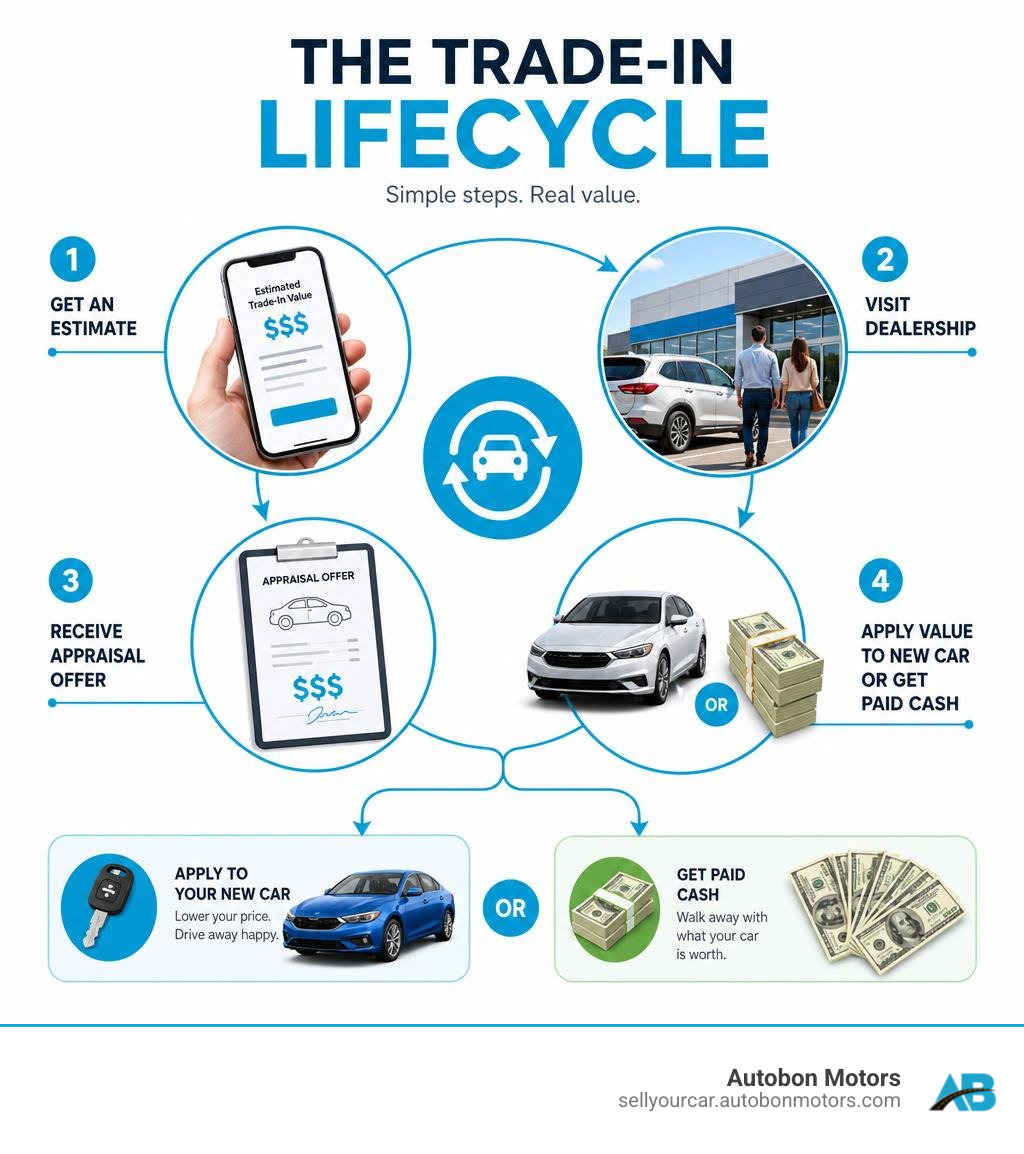
The Step-by-Step Process of Trading In Your Vehicle
Trading in your vehicle is a straightforward process, but knowing what happens at each stage will keep you in control of the transaction.
- Preparation and Cleaning: Before you head out, clear your personal belongings out of the glovebox, center console, and trunk. You don’t need to pay for a professional detail, but a quick wash and vacuum shows the appraiser that you took care of the vehicle.
- The Physical Appraisal: When you arrive at the dealership, you will meet with a sales representative or a dedicated acquisition specialist. They will take your keys and hand them to the used car manager, who will perform a 10- to 15-minute physical inspection and take the car for a short test drive to check the transmission, brakes, and suspension.
- The Offer Presentation: The dealer will present you with a written trade-in offer. This offer is typically valid for a set period (for example, some dealerships lock their offers for 7 days).
- Negotiation: You don’t have to accept the first offer. If you have done your research and have online estimates in hand, you can negotiate. Always negotiate the trade-in value of your car separately from the purchase price of the new car to keep the math clear.
- Paperwork and Title Transfer: Once you agree on a price, the dealership’s finance team will handle all the legal paperwork. They will draft a bill of sale, process the title transfer, and contact your lender to pay off any outstanding balance if your car is financed.
- Finalizing the Transaction: The trade-in value will be applied directly as a credit toward your new vehicle’s down payment, reducing the amount you need to finance. If you are doing a straight sale, the dealer will write you a check or initiate a electronic payment.
What Documents Do You Need to Bring?
To ensure your trade-in goes smoothly and doesn’t get delayed by administrative roadblocks, make sure you bring the following documents with you to the dealership:
- The Vehicle Title (Pink Slip): If you own the car outright, you must bring the physical title. All registered owners listed on the title should be present to sign it over.
- Current Vehicle Registration: Dealerships need this to verify that the vehicle is actively registered in your name and to transfer your license plates if necessary.
- A Valid Driver’s License: The dealer needs to verify your identity before entering into a legal contract.
- Proof of Auto Insurance: You will need your current insurance card, especially if you plan to drive a new vehicle off the lot.
- All Keys and Remotes: Bring every set of keys, fobs, and valet keys you have. Missing keys can cost hundreds of dollars to replace, and dealers may deduct that cost from your trade-in value.
- Service Records: If you have kept receipts for oil changes, brake jobs, or major repairs, bring them along. A well-documented service history proves you took excellent care of the car.
- Loan Payoff Information: If you still owe money on your vehicle, bring a recent statement from your lender that includes your account number and a 10-day payoff payoff amount.
What Types of Vehicles Do Dealerships That Take Trade Ins Accept?
A common misconception is that dealerships will only accept vehicles of the same brand they sell. In reality, most dealerships that take trade ins will accept almost any year, make, and model.
If you are looking to upgrade your ride, trade-up programs allow you to trade in your older vehicle of any brand for a newer, more reliable model.
Whether you are visiting an independent dealer or a major franchise, they are looking for inventory. If you have a well-maintained vehicle, a local dealership will gladly take it off your hands, pay off your remaining loan balance, and work with you to find a financing plan that fits your budget.
Some creative dealerships will even accept non-traditional trade-ins—like boats, ATVs, campers, or high-end lawn equipment—if they can easily assign a fair market value to them. However, for standard passenger vehicles, as long as the car is safe and has a verifiable history, you can expect a dealership to make you an offer.
Trading In a Financed Car: Positive vs. Negative Equity
Can you trade in a car that isn’t paid off yet? Absolutely. In fact, about 60% of all trade-ins involve vehicles with outstanding auto loans.
When you trade in a financed vehicle, the dealership will contact your lender, obtain the exact payoff amount, pay off the remaining balance of your loan directly, and obtain the title from the bank.
However, how this affects your wallet depends entirely on whether you have positive or negative equity.

If you want to dive deeper into the mechanics of how we handle outstanding auto loans, you can Learn more about selling your financed car with our expert financial advisors.
Handling Positive Equity
Positive equity is the ideal scenario. This occurs when your vehicle’s current trade-in value is higher than the amount you still owe on your auto loan.
For example, if your car is appraised at $20,000 and your remaining loan payoff is $15,000, you have $5,000 in positive equity.
When you complete the trade-in:
- The dealership pays off the $15,000 loan to your bank.
- The remaining $5,000 is applied directly as a down payment toward your new vehicle.
- This down payment reduces the total amount you need to borrow for your new car, lowering your monthly payments and saving you money on interest over the life of the new loan.
Dealing with Negative Equity and Upside-Down Loans
Negative equity—often referred to as being “upside-down” or “underwater” on your loan—occurs when your vehicle’s trade-in value is less than what you owe your lender.
For example, if your car is appraised at $25,000 but your loan payoff balance is $30,000, you have $5,000 in negative equity.
If you trade in your car under these conditions, that $5,000 difference doesn’t just disappear. You have two primary ways to handle it:
- Pay the Difference in Cash: If you have the savings, the cleanest option is to pay the negative equity balance directly to the dealership at the time of the trade. This prevents you from carrying old debt into your new vehicle purchase.
- Roll the Negative Equity Over: If you cannot pay the difference upfront, many dealerships can roll that negative equity into your new auto loan. This means your new loan will be for the price of the new car plus the negative equity from your old car. While convenient, this increases your new monthly payments and immediately puts you “upside-down” on your new vehicle.
Trade-In vs. Private Sale: Which Is Right for You?
When it’s time to part ways with your vehicle, you have two primary routes: trading it in to a dealership or selling it yourself to a private buyer.
While selling privately can sometimes yield a slightly higher purchase price, it comes with a major investment of time, effort, and safety risks. Let’s compare the two options:
Trade-In vs. Private Sale Comparison
- Convenience: Trading in is incredibly simple. You drive your old car to the dealership and drive home in your new one the same day. Selling privately requires listing the vehicle online, answering endless messages, dealing with “tire kickers,” and arranging test drives with strangers.
- Time Savings: A dealership transaction can be completed in under an hour. A private sale can take weeks or even months to find the right buyer who can secure financing.
- Tax Advantages: In many states, including Florida, you only pay sales tax on the difference between your new car’s price and your trade-in value. For example, if you buy a new car for $40,000 and trade in your old car for $20,000, you only pay sales tax on the remaining $20,000. If you sell privately, you lose this tax credit entirely.
- Paperwork and Liability: When you trade in, the dealership handles the title transfer, registration, and loan payoff. If you sell privately, you must navigate the DMV paperwork yourself and ensure the buyer correctly registers the vehicle to release you from liability.
If you want to skip the headaches of private listings and get a fair, competitive offer right away, you can Sell your car fast with Autobon Motors. We handle all the paperwork, title transfers, and loan payoffs for you, ensuring a seamless transition from your old car to your next adventure.
Maximizing Your Value at South Florida Dealerships
The South Florida automotive market is highly competitive, which works to your advantage. Because dealerships are always searching for quality used cars to keep their lots stocked, you have the leverage to secure a great deal if you know where to look.
To get the absolute most for your vehicle in South Florida:
- Get Multiple Appraisals: Don’t settle for the first offer. Secure a baseline digital offer, then visit a physical dealership to see if they will beat it.
- Keep Your Records Organized: Showing a dealer a neat folder of maintenance receipts from local Broward County service centers proves your car was cared for, which can justify a higher appraisal.
- Understand the Local Market: Convertibles, compact SUVs, and fuel-efficient vehicles are always in high demand in the Miami and Fort Lauderdale metro areas. Use this local demand to negotiate a stronger offer.
How to Choose Dealerships That Take Trade Ins in South Florida
Not all dealerships are created equal. Some will try to drag out the appraisal process, pressure you into a trade-in value that is lower than market rate, or bundle your car’s value into complicated monthly payment structures.
At Autobon Motors, we do things differently. We have designed our car-buying service around speed, transparency, and respect for your time. Here is why South Florida drivers trust us:
- Higher Offer Guarantee: We are committed to giving you the best possible price for your vehicle. If you have a written offer from a competitor, bring it to us – we guarantee to beat it.
- 15-Minute Appraisals: We won’t make you sit in a showroom for hours. Our expert advisors will inspect your vehicle and present you with a written offer in just 15 minutes.
- 3-Day Locked Price: Take your time to think it over. Our guaranteed cash offers are locked in for 3 full days, giving you the freedom to make a decision without any high-pressure sales tactics.
- No Obligation to Buy: You don’t have to buy a car from us to get top dollar for yours. We will buy your car, truck, or SUV outright and put real money in your pocket today.
Ready to see how simple selling your car can be? Sell Your Car with Autobon Motors and experience a customer-first approach that puts you in the driver’s seat.
The Autobon Motors Simple 4-Step Process
We have stripped the stress and complexity out of the traditional dealership trade-in process. When you work with us, you can sell your car in four simple, transparent steps:
- Book Appointment –> 2. Bring Your Car –> 3. Get Instant Offer –> 4. Get Paid on Spot
- 01. Book your Appointment Online: Choose a time that works best for your schedule using our simple online booking tool.
- 02. Bring your Car: Drive your vehicle to our conveniently located Fort Lauderdale facility. Don’t forget to bring your keys, title, and registration!
- 03. Get an instant Offer by one of our advisors: We will perform a transparent, 15-minute physical appraisal and present you with a written, guaranteed offer.
- 04. Get Paid on the Spot: If you accept our offer, we will handle all the paperwork and pay you immediately with fast, secure funds.
Frequently Asked Questions about Car Trade-Ins
How long does the trade-in process typically take?
At a traditional franchise dealership, the trade-in process can easily take several hours as they coordinate appraisals, run history reports, and draft sales contracts. At Autobon Motors, we have streamlined this down to a science. Our physical appraisals take just 15 minutes, and the entire transaction—including paperwork and payment—can be completed in under an hour.
Can I trade in a car with an active loan?
Yes, you can trade in a vehicle even if you still owe money on it. The dealership will contact your lender to obtain the exact payoff amount, pay off the loan balance directly, and transfer the title. If you have positive equity, that value will be applied to your new purchase. If you have negative equity, you can pay the difference in cash or roll it into your new auto loan.
What types of vehicles does Autobon Motors accept?
We accept all makes and models of cars, trucks, and SUVs. Whether you are driving a late-model luxury SUV, a reliable family sedan, or a high-mileage work truck, we will make you a fair, competitive cash offer based on its current market value.
Conclusion
Trading in your car doesn’t have to be a stressful, confusing chore. By understanding how dealerships that take trade ins calculate valuations, preparing your documents ahead of time, and knowing how to navigate positive or negative equity, you can walk onto any lot with confidence.
The key to a successful trade-in is transparency and speed. Don’t let traditional dealerships drag out the process or pressure you into a lowball offer.
If you are ready to experience a fast, fair, and completely stress-free way to sell your car in South Florida, we are here to help. Get started with your trade-in today and let Autobon Motors show you how simple selling your car can be!