

What Is Fair Market Value for a Car — and What’s Yours Worth Right Now?
Fair market value for a car is the price a willing buyer and a willing seller would agree on — with no pressure on either side and both having full knowledge of the vehicle’s condition and history.
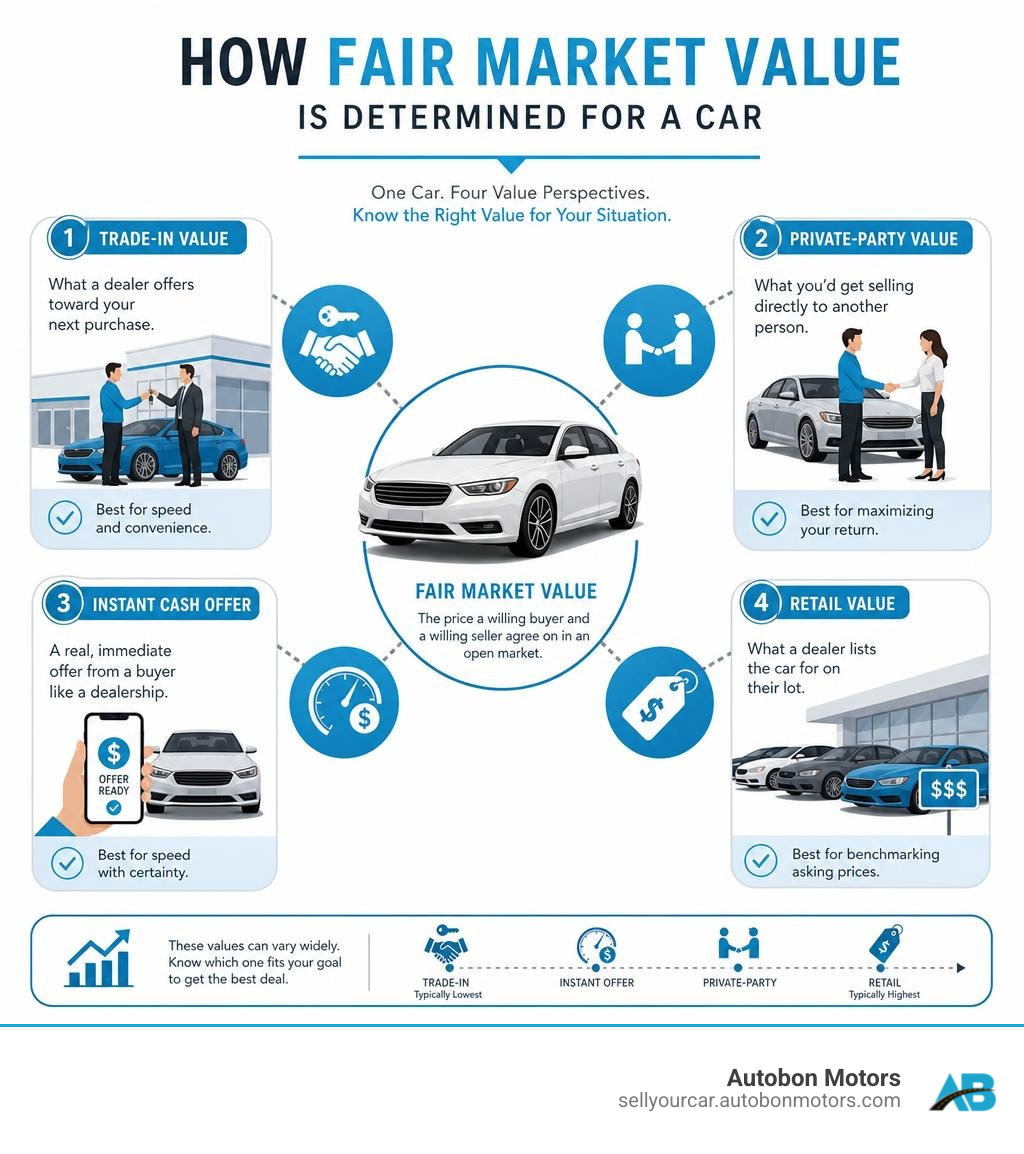
Here’s a quick breakdown of how car fair market value works:
| Value Type | What It Means | Best Used For |
|---|---|---|
| Trade-In Value | What a dealer offers toward your next purchase | Fast, convenient transactions |
| Private-Party Value | What you’d get selling directly to another person | Maximizing your return |
| Instant Cash Offer | A real, immediate offer from a buyer like a dealership | Speed + certainty |
| Retail Value | What a dealer lists the car for on their lot | Benchmarking asking prices |
The gap between these numbers can be significant — and knowing which one applies to your situation is the difference between leaving money on the table and getting a fair deal.
Understanding fair market value car pricing isn’t just for dealerships. As a South Florida car owner, you face a market shaped by local demand, seasonal trends, and regional economic conditions — all of which move weekly. Kelley Blue Book, for example, has been tracking vehicle values since 1926 and updates its pricing at least weekly across more than 100 geographic regions. That means the number you saw last month may already be outdated.
This guide walks you through everything — from how FMV is calculated to which valuation tools to trust, how to maximize what you get, and what fees or loan payoffs affect your actual proceeds.
I’m Marcos Bravo, a luxury and exotic automotive sales specialist with over 25 years of experience in South Florida’s competitive high-end car market, where determining an accurate fair market value car price is critical to every transaction. My experience across Fort Lauderdale, Miami, and beyond gives me a ground-level view of how regional demand, vehicle condition, and market timing all drive real-world valuations.
What is the Fair Market Value Car Definition and How is it Calculated?
To truly understand what your vehicle is worth, we must first establish a clear definition of fair market value (FMV). According to Publication 561 (12/2025), Determining the Value of Donated Property | Internal Revenue Service , fair market value is defined as the price that property would sell for on the open market between a willing buyer and a willing seller, with neither being required to act, and both having reasonable knowledge of the relevant facts.
When applied to the automotive industry, this means FMV is not a random number pulled out of thin air, nor is it simply the original manufacturer’s suggested retail price (MSRP). Instead, it represents a realistic transaction price based on real-world transaction history, current supply and demand, and the specific characteristics of your car.
Calculating a vehicle’s FMV requires analyzing massive amounts of data from wholesale auctions, retail transactions, and local market trends. Because no two vehicles are identical, appraisers and algorithmic valuation models look at historical sales of comparable vehicles that match your car’s year, make, model, and trim level. They then apply adjustments based on the physical condition, odometer reading, and regional factors to arrive at a highly accurate baseline.
Key Factors That Determine a Fair Market Value Car
When we evaluate a vehicle in South Florida, several core components dictate the final valuation.
- Mileage Impact: The odometer is one of the first things any appraiser looks at. Higher mileage generally correlates with greater wear and tear on mechanical components, which naturally lowers the fair market value. Conversely, exceptionally low mileage for a vehicle’s age can significantly boost its worth.
- Vehicle Condition: This goes far beyond whether the car runs. Appraisers evaluate the exterior paint for scratches or dents, the interior upholstery for tears or stains, and the overall mechanical health. Major vehicle damage or high reconditioning costs required to make the car ready for resale will directly reduce the overall value.
- Optional Equipment: Upgraded packages, premium sound systems, advanced safety features, and leather seating can add value, though their impact depreciates over time. Interestingly, some optional equipment may have less resale value than expected because used-car buyers often prioritize basic transportation needs and budget over high-end add-ons.
- Geographic Location: A car’s physical location heavily influences its desirability. Convertible models and fuel-efficient vehicles are highly sought after in warm coastal areas like Fort Lauderdale and Miami, whereas heavy-duty all-wheel-drive systems might command a premium in northern states.
- Seasonal Trends: The time of year you choose to sell or buy plays a subtle but important role. Dealerships and buyers adjust their offers based on seasonal demand, tax refund seasons, and the release cycles of newer model years.

How Local Markets and Seasonality Affect Your Vehicle’s Worth
The South Florida automotive market is highly unique. Our sub-tropical climate, tourism-driven economy, and regional lifestyle preferences create distinct valuation patterns that differ from national averages.
For instance, local supply and demand in Broward County and Miami-Dade County dictate that vehicles with strong air conditioning systems, sunroofs, and lighter exterior paint colors (which reflect our intense summer heat) are highly desirable. On the other hand, vehicles with noticeable rust or salt-air exposure can see their valuations suffer.
Furthermore, seasonality affects our local market in waves. During the winter months, South Florida experiences an influx of seasonal residents and tourists, which drives up demand for rental fleets, temporary transportation, and luxury cruisers. This seasonal surge can temporarily inflate the fair market value of clean, reliable used vehicles.
Because the market shifts so rapidly, relying on outdated pricing sheets is a mistake. Leading industry resources update their pricing models at least weekly to reflect the most current wholesale auction results and retail transactions, ensuring that local market fluctuations are accurately captured in real-time.
Understanding Industry Vehicle Valuation Standards
To navigate your car transaction successfully, you need to understand the tools and databases that industry professionals use. The automotive market relies on several distinct pricing sources, each tailored to different types of users—from everyday consumers to wholesale buyers.
| Valuation Source Type | Primary Purpose | Who Uses It? | Key Characteristics |
|---|---|---|---|
| Consumer-Facing Estimators | Educational research and pricing benchmarks | Buyers, sellers, and insurance agents | Easy-to-use interfaces, offering broad price ranges for trade-in and private party sales. |
| Wholesale & Dealer Books | Real-time transaction tracking and auction pricing | Dealerships, wholesale buyers, and lenders | Highly sensitive to rapid market shifts, focused heavily on auction data and reconditioning costs. |
| Real-Time Market Data | Localized inventory and competitive pricing | Advanced dealerships and digital platforms | Uses live local listings to find immediate supply and demand gaps in specific ZIP codes. |
Consumer-Facing Valuation Estimators
When most people begin researching their car’s worth, they turn to consumer-facing platforms. These tools are designed to translate complex market data into easy-to-understand price ranges.
Kelley Blue Book | New and Used Car Price Values, Expert Car Reviews has been the gold standard for vehicle values and pricing for over 90 years, since 1926. By leveraging massive amounts of actual transaction data, KBB provides users with a comprehensive look at what they should expect to pay or receive for a vehicle. To ensure accuracy, KBB updates its pricing at least weekly to reflect the market and give dealers and consumers the most up-to-date pricing.
To get an accurate estimate, you can visit New Car & Used Car Values | Get the Kelley Blue Book Value and input your vehicle’s details. These consumer-facing algorithms adjust for local conditions in over 100 different geographic regions, ensuring your estimate matches the reality of your specific ZIP code.
Another highly respected consumer tool is Edmunds, which utilizes its proprietary Tmv.html (True Market Value) pricing system. Edmunds calculates the average transaction price of vehicles in your area, giving you an excellent baseline for negotiations. These platforms are incredibly helpful for estimating retail ranges and understanding the difference between trade-in and private-party expectations.
Wholesale and Dealer Valuation Books
While consumer estimators are fantastic for research, professional car buyers and dealerships often rely on specialized wholesale databases. These tools focus on actual transactional data from wholesale auctions and dealer-to-dealer networks, making them highly sensitive to immediate market corrections.
One of the most prominent professional tools is Black Book. Black Book acquires its pricing data from wholesale auctions and retail transactions nationwide and updates pricing on a weekly basis. Because it reflects what dealers are actively paying for vehicles at auction, Black Book values are closely aligned with wholesale realities. When a dealer calculates your trade-in value, they are factoring in the immediate wholesale auction trends alongside the localized cost of reconditioning the vehicle for retail sale.
NADA (National Automobile Dealers Association) Guides are another critical industry standard, heavily utilized by credit unions, banks, and insurance companies to determine loan-to-value ratios and insurance payouts. These professional databases require paid access or dealer credentials, but they provide the raw, transaction-based data that keeps the automotive wholesale market moving smoothly.
Instant Cash Offer vs. Trade-In vs. Private-Party Value
When it comes to parting with your vehicle, you have several transaction pathways to choose from. Each route offers a different balance of convenience, speed, and financial return.

Understanding Instant Cash Offers and Trade-In Values
For those who value speed and simplicity, direct-to-dealer transactions are often the best choice.
An Instant Cash Offer is a firm, redeemable offer from a licensed buying center or dealership. By entering your vehicle’s VIN or license plate online, you can receive an immediate valuation based on real-time market data. This option provides absolute certainty, allowing you to walk away with a check on the spot without the hassle of listing the vehicle yourself.
A Trade-In, on the other hand, involves selling your vehicle to a dealership and applying that value directly toward the purchase of another car in their inventory. This is highly convenient because it allows you to complete both transactions in a single visit. Additionally, in many states, trading in a vehicle offers tax advantages, as you may only pay sales tax on the difference between your new car’s purchase price and your trade-in’s value.
While trade-in and instant cash offers are sometimes slightly lower than private-party values—reflecting the dealer’s need to cover reconditioning, marketing, and wholesale auction risks—the sheer speed and safety of the transaction make them highly popular.
The Reality of Private-Party Sales
Selling a car privately to another individual is often touted as the way to get the absolute maximum amount of money for your vehicle. Because you are selling directly to the end-user, you bypass the middleman. However, the reality of peer-to-peer sales involves significant personal effort, time, and risk.
To sell a car privately, you must handle all marketing, clean and detail the vehicle, schedule meetings with strangers, and negotiate with buyers who may not have secured financing. In busy metropolitan areas like Miami and Fort Lauderdale, safety and payment security are major concerns. Verifying bank drafts, avoiding online cashier’s check scams, and ensuring a legal transfer of the title can be incredibly stressful.
For many South Floridians, the convenience and safety of a guaranteed, professional dealer transaction far outweigh the potential extra funds of a private sale.
How to Get an Accurate Valuation and Maximize Your Return
To ensure you receive every dollar your vehicle is worth, you must approach the valuation process with preparation and organization.
How to Get an Accurate Fair Market Value Car Appraisal
Getting a precise appraisal starts with gathering the right information. To get started online, you can utilize tools like Instant Used Car Value & Trade-In Value | Kelley Blue Book to establish your baseline.
To maximize your car’s appraised value, follow these best practices:
- Gather Documentation: A vehicle with a documented history is always worth more. Collect your title, registration, and a complete folder of maintenance records. Showing that the oil was changed regularly and major services were completed on time proves the vehicle was cared for.
- Present All Original Items: Bring all sets of keys, the original owner’s manual, and any factory accessories (such as the cargo cover or floor mats). Replacing a modern smart key can cost several hundred dollars, so having both keys directly increases your offer.
- Clean the Vehicle Thoroughly: First impressions matter. While a dirty car doesn’t change its mechanical state, a clean, detailed interior and a shiny exterior signal to the appraiser that the vehicle has been pampered rather than neglected.
- Address Minor Repairs: Consider fixing minor cosmetic issues, such as small windshield chips or paintless dent removal for door dings. However, avoid spending money on major repairs before an appraisal, as dealerships can usually perform these repairs at a much lower wholesale cost than you can.
Taxes, Fees, and Loan Payoffs: Calculating Your Net Proceeds
When you complete a vehicle transaction, the “handshake price” is rarely the final amount that ends up in your bank account. You must account for several financial variables to calculate your true net proceeds.
If you currently have an outstanding auto loan, the buyer or dealership must pay off your lender to release the title. The dealership will contact your financial institution to obtain a 10-day payoff quote. If your car’s fair market value is higher than what you owe, you will receive a check for the difference (positive equity). If you owe more than the car is worth (negative equity), you will need to pay the difference to clear the title.
Additionally, state taxes and local dealer fees will impact your transaction. While some states regulate processing fees—for example, under Illinois law, a dealer may add a documentary fee up to a specific capped limit (adjusted annually by the Consumer Price Index)—Florida does not impose a legal cap on dealer pre-delivery service fees. It is crucial to review all closing documents carefully to understand how local dealer fees and registration transfer costs affect your final net proceeds.
Frequently Asked Questions about Fair Market Value
Navigating car valuations can bring up many questions. Here are some of the most common inquiries we receive from car owners.
What is the difference between MSRP and fair market value?
The Manufacturer’s Suggested Retail Price (MSRP) is the price the automaker recommends dealerships sell a new vehicle for. It is a static number printed on the window sticker. Fair market value, however, is a dynamic figure based on actual market transactions. Depending on supply, demand, and economic conditions, the FMV of a vehicle can be higher or lower than its MSRP.
How often do car values change?
Car values fluctuate constantly. In the wholesale market, prices change daily based on auction results, inventory levels, and economic shifts. Most major consumer valuation databases update their pricing models weekly to ensure that consumers have access to accurate, real-time market data.
Can vehicle modifications increase my car’s fair market value?
Generally, aftermarket modifications (such as custom wheels, exhaust systems, or body kits) do not add significant value to a vehicle, and in many cases, they can actually lower the fair market value. Most used-car shoppers are looking for reliable, basic transportation and prefer vehicles in their original factory condition.
Conclusion
Determining and securing the fair market value car price for your vehicle doesn’t have to be a complicated, stressful process. By understanding how the market operates, utilizing trusted valuation standards, and preparing your documentation, you can step into your next transaction with complete confidence.
At Autobon Motors, we are proud to be South Florida’s premier car buying service. Located conveniently in Fort Lauderdale, we serve Broward County, Miami, and the surrounding areas with a customer-first approach that takes the pressure out of selling your vehicle.
We buy used cars, trucks, and SUVs for top dollar, offering fast, fair, and completely transparent valuations. Our unique selling proposition is a higher offer guarantee than our competitors, featuring rapid 15-minute appraisals and a 3-day locked price to give you plenty of time to make your decision.
Ready to see what your car is truly worth? Our selling process is incredibly simple:
- 01. Book your Appointment Online: Schedule a time that works best for you.
- 02. Bring your Car: Visit our Fort Lauderdale location with your vehicle and documents.
- 03. Get an Instant Offer: One of our expert advisors will conduct a fast, transparent physical appraisal.
- 04. Get Paid on the Spot: Walk away with guaranteed cash in hand.
Stop wondering what your vehicle is worth in today’s active market. Get a fast cash offer for your car from the team at Autobon Motors today!