

Understanding the NADA Value Trade-In System
Finding the true nada value trade in for your vehicle is the smartest way to prepare for a hassle-free sale.
If you want a quick answer on what this value means and how to use it, here is what you need to know:
- The Industry Standard: NADA (National Automobile Dealers Association) values are powered by J.D. Power. They are heavily trusted by banks, insurance companies, and dealerships.
- Data-Driven Accuracy: Unlike other guides that guess based on wholesale auctions, NADA uses real retail transaction data from millions of actual car sales.
- Your Negotiation Shield: Knowing this number gives you a solid benchmark. It protects you from low offers when you decide to sell or trade.
Most car owners dread the selling process. They expect long waits, endless paperwork, and confusing numbers. It often feels like the dealer holds all the cards.
But it does not have to be that way. When you understand how professional buyers look at your car’s worth, you take back control of the deal.
I am Marcos Bravo, and over my 25-year career in the South Florida luxury car market, I have helped thousands of clients navigate the nada value trade in process to get the highest possible return for their vehicles. At Autobon Motors, we use this deep market expertise to skip the typical dealer games and offer you a simple, transparent path to cash.
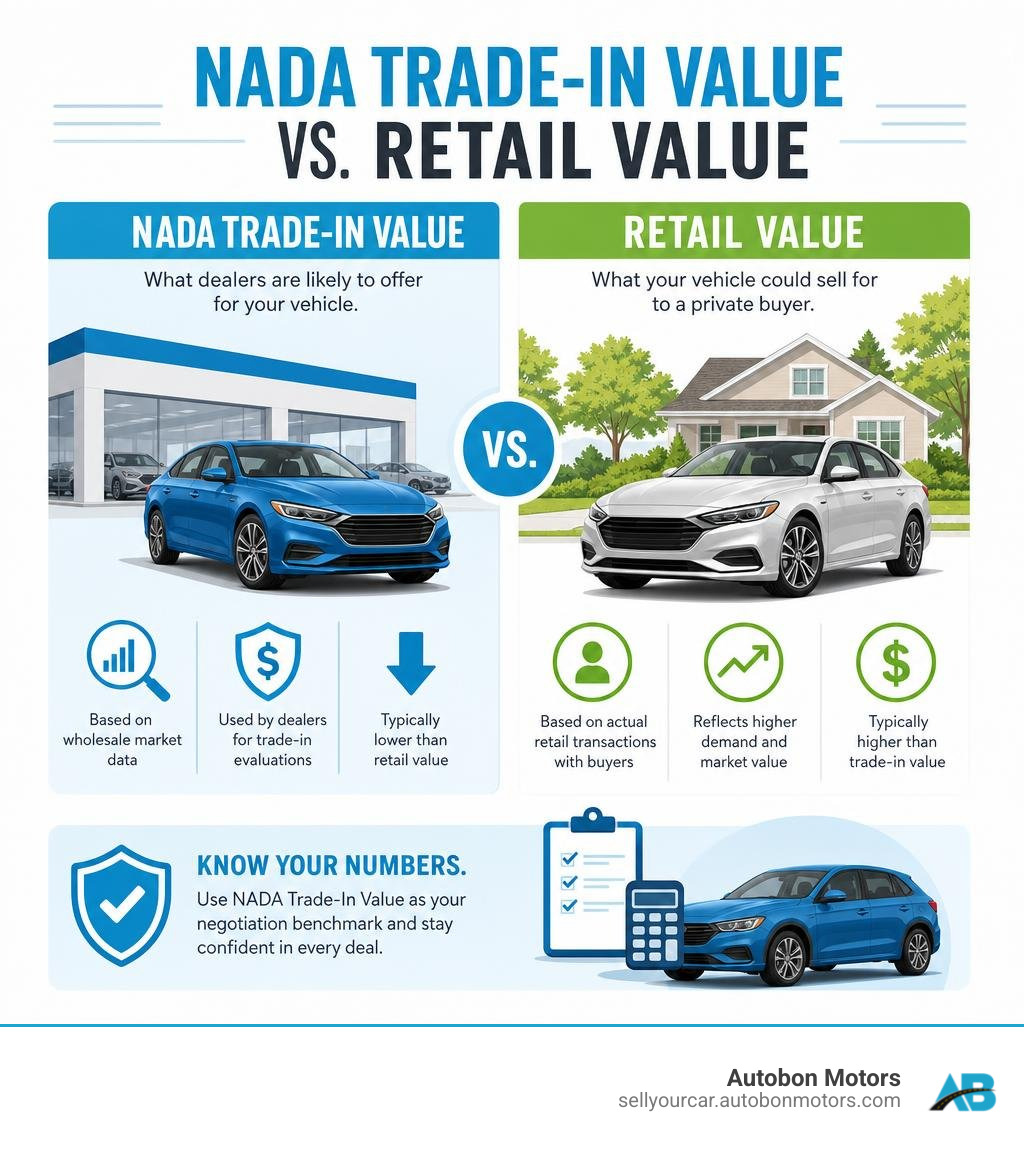
When you begin researching your car’s worth in South Florida, you will quickly realize that the industry speaks a slightly different language than the average consumer. To get the best offer in Fort Lauderdale or Miami, you must first understand the primary tool that professionals use to evaluate your vehicle: the NADA valuation system.
The National Automobile Dealers Association (NADA) guides do not just pull numbers out of thin air. Today, NADA values are fully integrated with and powered by J.D. Power. This integration means that every book value is backed by massive analytical power, consumer ratings, and real-world market intelligence.
When we perform a professional evaluation, we look at these guidebooks as a highly reliable baseline. If you want to learn more about how physical appraisals compare to these guidebooks, check out our Step-by-Step Guide to Car Appraisal and Value Estimation.
The data driving these values is incredibly robust. J.D. Power produces trade-in values based on more than 12 million retail vehicle transactions annually. This massive dataset is pulled directly from the Power Information Network (PIN), which processes actual sales data daily from more than 16,000 dealerships across North America. Rather than guessing what a car is worth based on what dealers hope to get, the system looks at what buyers actually paid.
For consumers looking to access these official numbers, the portal at NADA: Consumer Vehicle Values redirects to authorized third-party tools that let you see exactly what the market says about your car.
What is NADA and Who Uses It?
The NADA Official Used Car Guide has been a cornerstone of the automotive world since it was first published in 1933. Over nearly a century, NADA has grown from a simple physical booklet into a highly sophisticated digital database. Today, the organization represents more than 16,000 new-car dealers in the United States, advocating for their interests while providing the gold standard for vehicle valuation.
Because of its long history and unparalleled access to real dealership transaction data, the NADA guide is not just used by dealers looking to buy your car. It is also the primary tool used by:
- Banks and Credit Unions: When you apply for an auto loan in Broward County, the lender checks the NADA trade-in value to determine the maximum amount they are willing to finance.
- Insurance Companies: If your vehicle is unfortunately totaled in an accident on I-95, insurance adjusters rely heavily on NADA’s stable, transaction-based database to calculate your payout.
- Professional Car Buyers: Independent buyers use it as a highly stable wholesale benchmark.
If you want to dive deeper into how these values apply specifically to pre-owned vehicles, you can read more about NADA Trade-In Value on Used Cars.
NADA vs. Kelley Blue Book (KBB)
If you have ever tried to value your car online, you have undoubtedly run into both NADA and Kelley Blue Book (KBB). While both are household names, they are built on completely different foundations.
Kelley Blue Book, which is owned by Cox Automotive, generates an impressive 40 million unique pricing reports every month. KBB has been a trusted resource since 1926. However, its valuation algorithm relies heavily on analyzing wholesale auction prices and then extrapolating what a vehicle should be worth.
NADA, on the other hand, focuses on actual retail transactions from dealerships. This difference in data sourcing leads to a very consistent trend: NADA values tend to run 5% to 10% higher than KBB for the same vehicle.
Furthermore, KBB is highly consumer-centric, focusing heavily on private party transaction ranges. NADA focuses strictly on trade-in, clean retail, and Certified Pre-Owned (CPO) values—it does not provide private party values at all.
Here is a quick look at how the two valuation giants stack up against each other:
| Feature | NADA (J.D. Power) | Kelley Blue Book (KBB) |
|---|---|---|
| Primary Data Source | Real retail dealership transactions (12M+ annually) | Wholesale auction prices & predictive algorithms |
| Value Tendency | Typically 5% to 10% higher | Generally more conservative |
| Private Party Values | Not provided | Provided and highly detailed |
| Primary Audience | Dealers, lenders, and insurance companies | Consumers and retail car shoppers |
| Update Frequency | Constantly updated based on retail data | Updated at least weekly across 100+ regions |
To cross-reference your car’s estimated value on the alternative platform, you can visit Kelley Blue Book | New and Used Car Price Values, Expert Car Reviews.
How NADA Calculates Your Car’s Worth
To get the most out of your nada value trade in report, you need to understand how the system arrives at its final number. The valuation process is a science, combining historical data with real-time market adjustments.
Every car starts with a base wholesale value determined by its year, make, model, and trim. From there, the system applies several mathematical formulas to adjust the price based on your vehicle’s specific history.
If you want to run a quick calculation yourself using a formula-based system that weights these variables, you can play around with this Trade-In Value Calculator – VIN, Plate, Mileage, Condition.
For a deeper understanding of how these appraisals translate to actual cash in hand today, check out our guide on Sell My Car Appraisal Today the Most Effective Solution for Instant Value.
How to Calculate Your NADA Value Trade-In
To calculate an accurate NADA value, the system analyzes several key metrics:
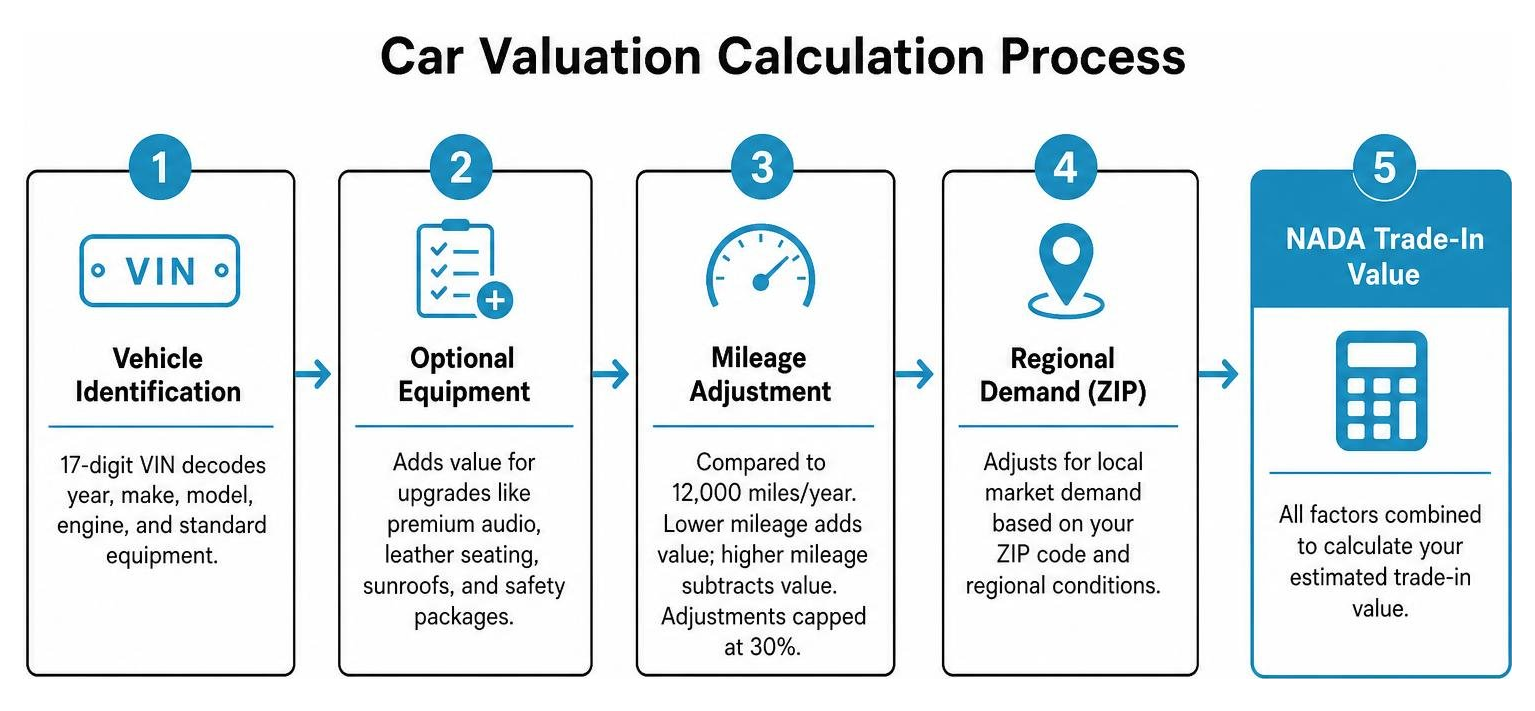
- The 17-Digit VIN: Standardized on all vehicles since 1980, your VIN is the ultimate key. It instantly decodes the exact model year, engine type, and standard equipment, preventing errors.
- Optional Equipment: Upgrades like premium audio, leather seating, panoramic sunroofs, and advanced safety packages add real value.
- The Mileage Adjustment: The average driver puts about 12,000 miles on a car per year. If your mileage is significantly lower, NADA applies a positive adjustment. If it is higher, a deduction is applied. In standard formulas, mileage adjustments are typically capped at 30% of the vehicle’s age-depreciated value to keep the numbers realistic.
- Regional Demand (ZIP Codes): Car values are highly regional. A convertible is worth far more in Miami than in a snowy northern state, while all-wheel-drive SUVs command a premium in colder climates. Entering your local South Florida ZIP code ensures the data reflects our local sunshine state demand.
To see a real-world example of how generation gaps, trim levels, and specific mechanical histories (like CVT transmission records) affect real-world trade-in values, read this detailed breakdown of the Nissan Sentra Trade in Value: Here’s What You Should Get and Why | AutoGuide.com.
NADA Vehicle Condition Categories Explained
One of the biggest mistakes car owners make is assuming their car is in “Excellent” or “Clean” condition. In the real world, very few cars actually meet this standard. NADA breaks down trade-in values into three distinct condition tiers:
- Clean Trade-In: The vehicle is in excellent mechanical and cosmetic condition. It has a clean title history, glossy paint, no rust, matching tires with great tread, and an interior with zero signs of wear.
- Average Trade-In: The car is free of major mechanical defects but has minor cosmetic blemishes, such as small paint chips or light seat wear. It requires some light reconditioning before it can be resold. Most well-maintained consumer vehicles fall into this category.
- Rough Trade-In: The vehicle has significant cosmetic damage, requires mechanical repairs, or has a branded title (such as salvage or flood damage). A branded title can instantly slash a vehicle’s trade-in value by 20% to 50%.
The financial impact of these categories is massive. A car in excellent, clean condition can be worth 30% to 40% more than the exact same car in poor or rough condition.
To self-assess your vehicle’s condition tier before getting an official quote, you can review the standards on NADA: Consumer Vehicle Values.
Maximizing Your Vehicle’s Value: Trade-In vs. Direct Cash Offer
Most cars lose about 14% of their value each year. After 5 years, a typical vehicle is worth roughly half of its original price. With depreciation constantly working against you, timing your sale and choosing the right method to cash out is critical.
If you want to make sure you are selling your car the smartest way possible, explore our comprehensive guide on How to Sell My Car the Right Way.
NADA Value Trade-In vs. Direct Cash Offer vs. Private Party Sale
When it is time to part ways with your vehicle, you have three primary paths. Understanding the financial and practical differences between them will save you thousands of dollars and hours of frustration.
The Private Party Sale
Selling your car yourself to another individual in South Florida typically yields the highest raw dollar amount—often $1,000 to $3,000 more than a traditional dealer trade-in. However, this method requires a massive amount of time. You have to clean the car, take photos, list it online, filter through scammers, and invite strangers to your home for test drives. For busy professionals in Fort Lauderdale and Miami, the extra cash rarely justifies the safety risks and massive headache.
The Traditional Dealership Trade-In
Trading your car in at a dealership where you are buying your next vehicle is highly convenient. It also offers great sales tax benefits in Florida. In our state, you only pay sales tax on the difference between your new car’s purchase price and your trade-in’s value.
For example, if you trade in a $15,000 vehicle toward a $30,000 purchase, you only pay Florida’s sales tax on the remaining $15,000. At a standard 7% tax rate, this saves you exactly $1,050!
The downside? Traditional dealers often “under-allow” on your trade-in, offering you a lowball price because they know you want the convenience of a single transaction.
The Direct Cash Offer from Autobon Motors
A direct cash offer from a specialized buying service like Autobon Motors gives you the absolute best of both worlds. We do not make you buy a car from us to get top dollar. As South Florida’s premier car buying service, we offer a transparent, no-pressure process designed to put the most money in your pocket.
We bypass the traditional dealer games by providing a higher offer guarantee than our competitors, complete with 15-minute appraisals and a 3-day locked price. To learn more about how this works, read The Complete Guide to Getting Cash for Your Car.
Actionable Steps to Boost Your Appraisal
You do not have to accept your car’s current condition as set in stone. With a little bit of preparation, you can easily bump your vehicle up a valuation tier and secure a much higher offer.
- Get a Professional Detail (or do a thorough DIY job): First impressions are everything to an appraiser. A clean, freshly detailed vehicle can appraise $300 to $800 higher than a dirty one, even when the mechanical condition is identical!
- Fix Cheap, Minor Issues: Replace worn-out wiper blades, clear up cloudy or yellowed headlights with a restoration kit, and fix any chipped paint. These low-cost cosmetic fixes prevent appraisers from assuming the car was neglected.
- Gather Your Service Records: A complete folder of oil changes, brake jobs, and transmission fluids proves you took care of the car. It gives buyers the confidence to offer top-tier book value.
- Bring Both Sets of Keys: Modern smart keys are highly expensive. If you are missing a spare key, dealers will deduct $200 to $500 from your offer to cover the cost of a replacement.
- Keep Mileage Under Milestones: If your odometer is sitting at 49,500 or 99,000 miles, try to trade it in before you cross those major psychological barriers (50k and 100k). Crossing these numbers can instantly drop your car’s book value by $500 to $1,500.
For more insider tips on how to prepare your car and survive the appraisal process with the most cash possible, read our Cash Car Offer Survival Guide.
Frequently Asked Questions about NADA Trade-In Values
Navigating car valuations can bring up plenty of questions. Here are the answers to the most common queries we hear from South Florida car owners.
Do car dealers actually use NADA or KBB?
Dealers use both, but they use them differently. Many dealerships prefer NADA because its retail-transaction-based data is highly stable and preferred by the financial institutions funding their floor plans.
However, some dealers will try to play a “double agent” game. They might use KBB (which tends to run lower) to value your trade-in, while using NADA (which runs higher) to price the used cars they are selling!
At Autobon Motors, we believe in complete transparency. We look at real-time South Florida market data alongside trusted guides to ensure you get a fair, top-dollar offer based on actual local demand.
How does negative equity affect my trade-in or cash sale?
Negative equity—often called being “underwater”—happens when you owe more on your auto loan than the car is actually worth. For example, if your NADA trade-in value is $15,000 but your loan payoff balance is $18,000, you have $3,000 of negative equity.
If you want to sell your car, you have a few options:
- Pay the Difference in Cash: You can pay the $3,000 difference directly to your lender to clear the title. This is often the smartest financial move because it prevents you from carrying debt forward.
- Roll the Debt Over: If you are buying a new car, some dealerships will let you roll that $3,000 balance into your new auto loan. Be careful with this option, as it immediately puts you underwater on your next vehicle and increases your monthly payments.
- Let us Handle the Payoff: At Autobon Motors, we make dealing with negative equity simple. We will contact your lender directly to get a 10-day payoff quote, handle all the confusing paperwork, and guide you through the transition smoothly.
How often are NADA trade-in values updated?
NADA values are updated regularly to reflect real-time market shifts. These updates account for:
- Seasonal Trends: Convertibles sell for more in the spring, while SUVs peak in late fall. (Though in South Florida, convertibles and luxury cars stay hot year-round!)
- Macroeconomic Factors: Shifting interest rates, inflation, and gas prices instantly impact what buyers want. When gas prices spike, small fuel-efficient cars rise in value, while large V8 SUVs take a hit.
- Tax Refund Season: Between February and April, consumer buying power surges, which often causes trade-in offers to rise as dealers scramble for inventory to meet demand.
Conclusion
Understanding your vehicle’s NADA trade-in value is the ultimate way to protect your wallet. But at the end of the day, a book value is just a number on a screen. To turn that value into real cash, you need a buyer you can trust.
At Autobon Motors, we have completely reimagined the car selling experience for South Florida. We skip the long waits, the endless negotiations, and the corporate bureaucracy. We are proud to be Fort Lauderdale’s premier car buying service, offering a fast, fair, and completely transparent process.
When you sell your car to us, you get:
- A higher offer guarantee than our competitors.
- A pressure-free, 15-minute physical appraisal.
- A 3-day locked price guarantee so you have time to think.
- Fast, guaranteed cash paid on the spot.
Our simple 4-step process makes selling your car in Broward County, Miami, or Palm Beach easier than ever:
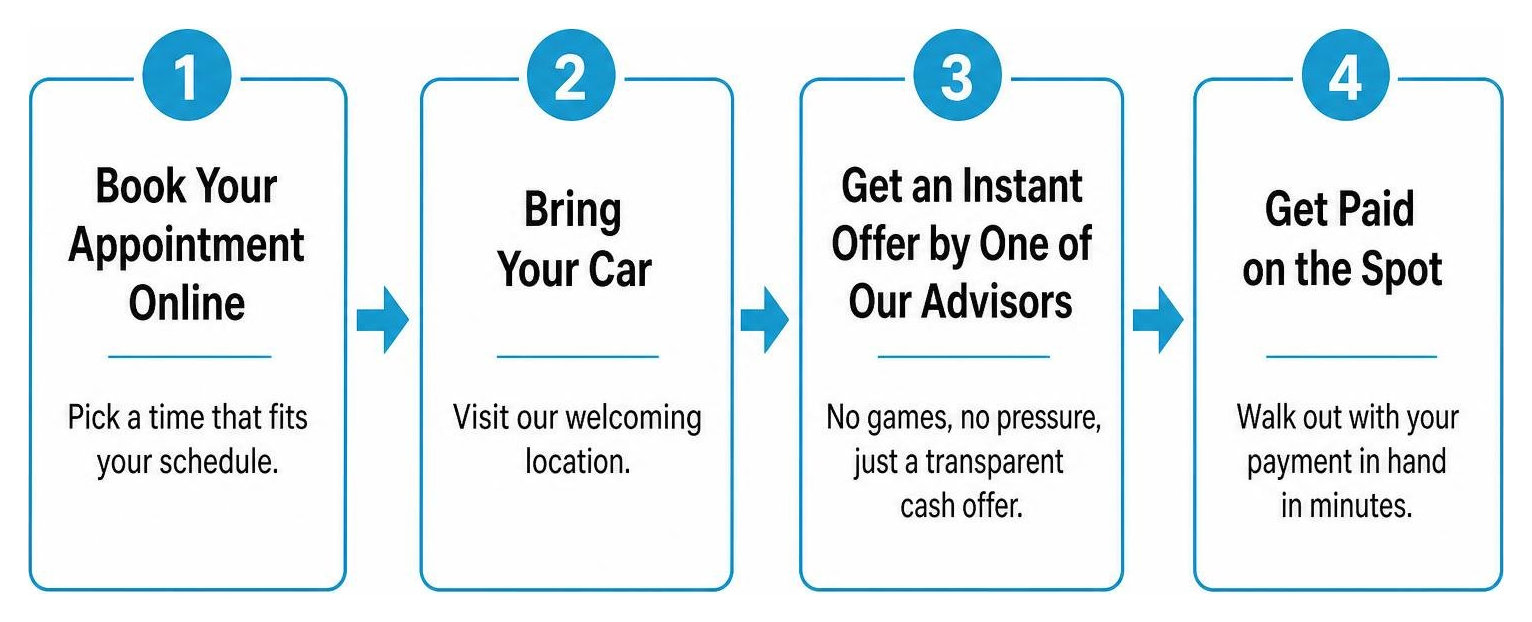
- Book your Appointment Online: Pick a time that fits your busy schedule.
- Bring your Car: Visit our welcoming Fort Lauderdale location.
- Get an instant Offer by one of our advisors: No games, no pressure, just a transparent cash offer.
- Get Paid on the Spot: Walk out with your payment in hand in minutes.
Ready to see how much your car is worth? Skip the stress of private listings and traditional dealer trade-ins. Get the best cash offer for your car in South Florida from the team at Autobon Motors today!