
What Is a Used Vehicle Price by VIN — and How Do You Find It Fast?
Finding the used vehicle price by VIN is simpler than most people think. Here’s the short answer:
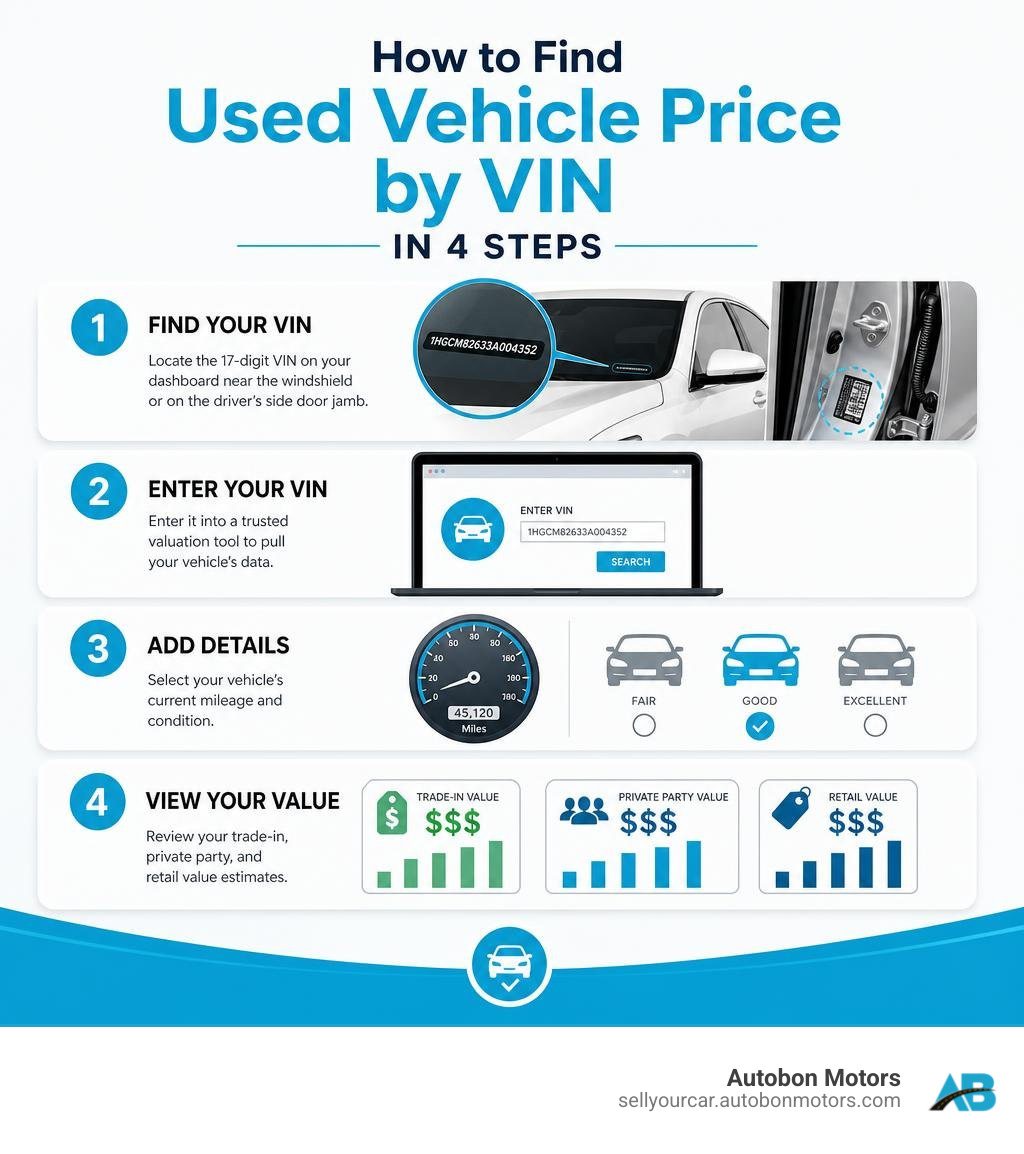
How to find your used vehicle’s value by VIN:
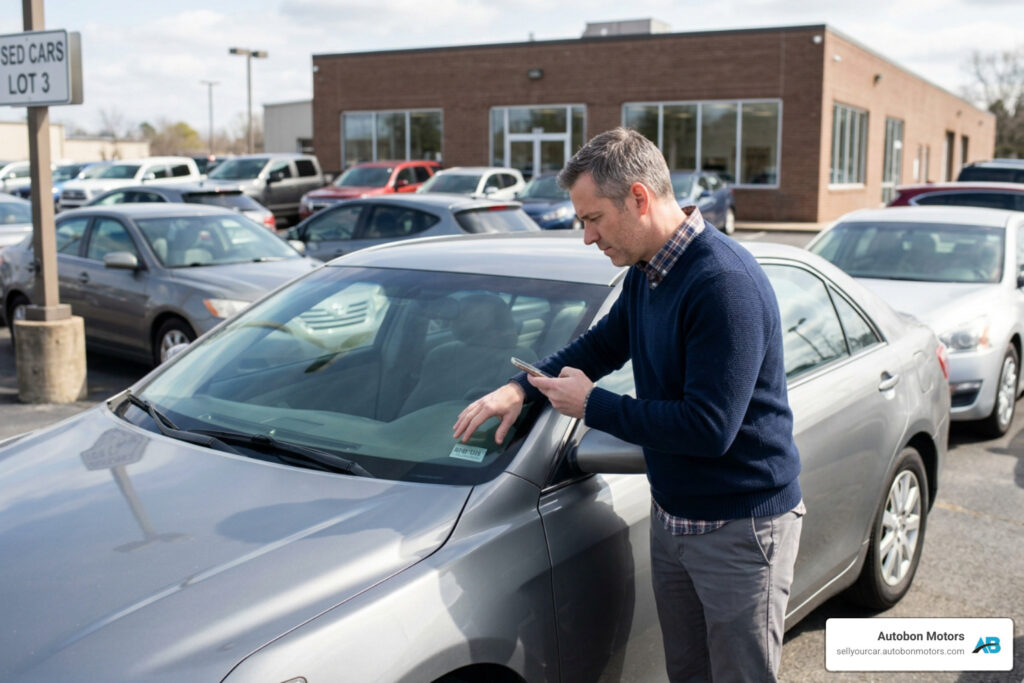
- Locate your 17-digit VIN (on your dashboard near the windshield, or on your driver’s side door jamb)
- Enter it into a valuation tool such as Kelley Blue Book, CARFAX, NADA, or CarGurus
- Select your vehicle’s current mileage and condition
- Review your trade-in, private party, and retail value estimates
That’s it. The VIN pulls your car’s exact specs, history, and market data — giving you a far more accurate number than a generic year/make/model search ever could.
A VIN is more than just a serial number. It’s essentially your car’s entire biography — factory specs, accident history, ownership changes, and market trajectory all tied to one 17-character code. As one industry source puts it: “A VIN is a vehicle’s identity document and its market history combined.”
Yet most South Florida car owners still guess at their vehicle’s value — or worse, they take the first number a dealer throws at them.
That’s a costly mistake. Whether you’re selling, trading in, or just curious what your car is worth today, a proper VIN-based valuation puts real data in your hands — and real leverage in your pocket.
My name is Marcos Bravo, and with over 25 years in South Florida’s luxury and exotic automotive market, I’ve seen how a quick used vehicle price by VIN check can mean the difference between a fair deal and leaving thousands on the table. In this guide, I’ll walk you through exactly how VIN-based pricing works, which tools to trust, and how to use that data to your advantage.
Why a VIN Is Key to Finding an Accurate Used Vehicle Price by VIN
When most people try to value their vehicle, they start with the basics: the year, make, model, and trim. While that gives you a ballpark estimate, it completely ignores the unique DNA of your specific car.
Every vehicle manufactured since 1981 is assigned a unique 17-digit Vehicle Identification Number (VIN). This string of numbers and letters acts as a digital fingerprint. It decodes everything from the engine type, assembly plant, and original paint code to the exact safety packages installed on the production line.
More importantly, the VIN acts as a key to the vehicle’s history database. This is why a VIN-based valuation is the absolute gold standard for establishing a vehicle’s true market worth. Without it, you are pricing a hypothetical car, not the real one sitting in your Broward County driveway.
How History and Specifications Determine Your Used Vehicle Price by VIN
A generic valuation tool assumes your car has lived a perfectly average life. In reality, every mile driven, every oil change logged, and every minor fender bender in South Florida traffic alters its depreciation curve.
Let’s look at the standard rules of vehicle depreciation:
- By the time you have owned a brand-new car for just one month, depreciation has already reduced its value by 10%.
- A new car typically loses 20% of its value in the first year.
- It then loses roughly 15% of its value each subsequent year.
- This leaves a car worth only about 40% of its original purchase price after five years.
However, these percentages are just averages. When you pull a Car Value by VIN – Vehicle Value Reports | VINSmart , the system cross-references real-world databases to adjust this curve based on:
- Accident History: Has the car been in a collision on I-95?
- Service Records: Was the car regularly maintained at certified local service centers?
- Number of Owners: Is it a highly desirable one-owner vehicle, or has it passed through five different hands in four years?
- Title Status: Is the title clean, or does it carry a salvage brand?
By analyzing these actual historical points via the VIN, the valuation tool shifts the pricing curve up or down to reflect reality.

The Impact of Condition and Damage on a Used Vehicle Price by VIN
Vehicle condition is highly subjective when you are just typing words into a search box. However, a VIN lookup anchors the condition rating in hard data. Valuation services typically categorize vehicles into three primary condition tiers:
- Clean: No major cosmetic or mechanical flaws, clean title, and a fully documented service history.
- Average: Normal wear and tear for its age, minor cosmetic blemishes, and standard maintenance records.
- Rough: Visible exterior or interior damage, mechanical issues, missing service history, or negative history reports.
Known damage heavily penalizes a vehicle’s value. For example, the average impact on retail price is just under $500 for a vehicle that has been in a minor accident. However, that impact jumps to an average of $2,100 for a vehicle that has sustained severe damage.
Furthermore, if a vehicle has been declared a total loss by an insurance company and carries a salvage or rebuilt title, its market value typically plummets by 40% to 60%. To understand how professionals weigh these factors during a physical inspection, you can read our Step-by-Step Guide to Car Appraisal and Value Estimation.
How Major Valuation Services Calculate Vehicle Values
Different valuation services use proprietary algorithms to analyze massive datasets. While they all aim to provide an accurate used market price, they rely on different primary data streams to get there.
- NADA (National Automobile Dealers Association): NADA represents more than 16,000 new-car dealers and provides vehicle valuation data used across the automotive industry. Their pricing heavily reflects wholesale transactions, dealer auctions, and retail sales data.
- Kelley Blue Book (KBB): Kelley Blue Book has been the trusted resource for used car values for over 90 years since 1926, updating pricing at least weekly. KBB focuses heavily on consumer-facing transactions, private party sales, and regional dealer listings.
- J.D. Power: J.D. Power calculates vehicle values based on over 12 million retail transactions each year from actual wholesale and retail transaction data, offering incredibly robust statistical reliability.
- Black Book: Black Book provides VIN-specific valuations by integrating vehicle history report data from AutoCheck and analyzing millions of vehicle transactions. It is a favorite among lenders and dealerships for real-time wholesale tracking.
- CarGurus: CarGurus analyzes data from over 4 million listings to generate estimated price ranges for vehicle valuations, focusing heavily on active retail listings to determine Instant Market Value (IMV).
Why Valuations Vary Across Different Platforms
It is incredibly common to look up the same VIN on three different websites and get three different numbers. This happens because each platform weighs data differently.
For instance, one service might place more weight on active dealer listing prices, while another focuses strictly on completed wholesale auction transactions. Some platforms adjust slower to rapid market shifts, whereas others update weekly to reflect immediate demand. You can explore how these differences play out by checking How Much Is Your Car Worth? Find Instant Trade In-Value – Carfax , which heavily factors documented history into its pricing algorithm.
The Role of Location and ZIP Codes in Market Value
A vehicle’s value is not uniform across the country. Where a car is registered and sold plays a massive role in its market demand.
In South Florida, for example, convertibles, sports cars, and fuel-efficient commuter cars are highly sought after year-round. Conversely, a heavy-duty 4×4 truck with a snowplow package will command a premium in New England but will sit unsold in Broward County.
Valuation algorithms use your ZIP code to anchor the VIN value to local supply and demand. If you want to see how local pricing trends behave in our specific market, you can browse active listings for Used Cars for Sale in Miami, FL | Edmunds to see what local buyers are actually paying.
Understanding Trade-In, Private Party, and Retail Values
When you retrieve a VIN valuation report, you will typically see three distinct pricing tiers. Understanding the differences between them is vital for any transaction:
| Value Type | What It Represents | Pros | Cons |
|---|---|---|---|
| Trade-In Value | What a dealership will offer to buy your car or apply toward a new purchase. | Fastest, safest, and most convenient option. | Typically the lowest value, as dealers must factor in reconditioning and profit margins. |
| Private Party Value | What you can expect to get if you sell the car yourself to an individual buyer. | Higher payout than trading in at a traditional dealership. | Requires significant time, marketing, meeting strangers, and handling paperwork. |
| Retail Value | The price a dealership asks for the vehicle on their lot. | Represents a fully reconditioned vehicle with dealer warranties. | Highest price tier; unrealistic for a private seller to expect. |
Decoding Listing History and Red Flags
A professional VIN lookup does more than spit out a single price; it uncovers the vehicle’s retail journey. Tools like MarketCheck compile a timeline of every time a VIN has been listed for sale online.
When we analyze a vehicle’s history, we look for critical red flags:
- Rapid Dealer Hops: If a vehicle was sold from one independent lot to another three times in six months, it often points to an underlying mechanical issue that dealers chose to pass along rather than fix.
- Steep Price Drops: A car that has seen repeated, significant price cuts indicates the local market has rejected its initial pricing, likely due to condition or lack of demand.
- Extended Days on Market (DOM): A high DOM means the car has been sitting unbought for months, giving you immense negotiation leverage.
These insights are highly valuable for wholesale buyers and savvy consumers alike. You can see how professional tools track this by exploring the /vin-lookup — Appraiser Plugin | MarketCheck Cowork documentation. If you are preparing to sell your car and want to avoid these common pitfalls, check out our guide on How to Sell My Car the Right Way.
How to Leverage a VIN Valuation Report as a Buyer or Seller
Whether you are standing on a dealership lot in Fort Lauderdale or listing your SUV online in Miami, a printed or digital VIN valuation report is your best tool for a fair deal.

Actionable Steps for Sellers to Maximize Value
If you are selling your vehicle privately or preparing to trade it in, do not just guess your asking price. Use these steps to secure top dollar:
- Pull the VIN Report Early: Know exactly what buyers will see when they look up your car.
- Resolve Open Recalls: Dealerships and private buyers hate safety recalls. Get them fixed for free at a local franchise dealer before listing.
- Gather Matching Receipts: If your VIN report shows a gap in service history, but you have a folder of receipts from your local Broward County mechanic, present them to prove the car was loved.
- Price Strategically: Use the market data to price your car competitively. If you want a quick cash offer without the hassle of private buyers, consider using our Sell My Car Appraisal Today: The Most Effective Solution for Instant Value service.
How Buyers Can Spot Negotiation Opportunities
As a buyer, a VIN valuation report is your shield against overpaying. When negotiating:
- Highlight Unreported Damage: If the VIN report shows a “clean” history, but your physical inspection reveals mismatched paint or overspray, you can negotiate a discount based on undocumented repairs.
- Use Odometer Discrepancies: If the mileage on the dashboard does not match the chronological mileage logged in the VIN history, walk away immediately or demand a massive price reduction.
- Leverage Days on Market: Point out how long the vehicle has been sitting on the seller’s lot to justify a lower, fast-cash offer.
To learn more about how to navigate this process smoothly, read The Complete Guide to Getting Cash for Your Car.
Frequently Asked Questions About VIN-Based Valuations
How often do used vehicle values change?
Used vehicle values fluctuate constantly based on wholesale auction data, regional demand, and economic conditions. Major pricing guides like Kelley Blue Book update their databases at least once a week. If you are tracking your car’s value to time a sale, it is wise to run a fresh VIN check once a month.
What additional data should accompany a VIN value check?
A comprehensive VIN check should always include:
- Active safety recalls that need to be addressed.
- Odometer brandings (to verify the mileage is actual and accurate).
- Title brands (such as salvage, rebuilt, or flood damage).
- Warranty status (to see if any original factory bumper-to-bumper or powertrain coverage remains).
Can I get an accurate valuation for a classic car using a VIN?
Standard VIN lookup tools are designed for modern passenger vehicles with 17-digit VINs (manufactured post-1981). Classic cars built before 1981 have shorter, non-standard serial numbers. To value a classic car, you should consult specialty appraisal services or dedicated classic car pricing guides rather than standard consumer VIN tools.
Conclusion: The Smartest Way to Value and Sell Your Car
At the end of the day, finding your used vehicle price by VIN is the single best way to protect your wallet. It strips away the guesswork, replaces emotion with hard data, and ensures you won’t get shortchanged.
But once you have that valuation report in your hand, you still face a choice: Do you want to spend weeks dealing with online tire-kickers, lowball private offers, and endless paperwork? Or would you prefer to turn that car into real cash today?
At Autobon Motors, we make selling your car in South Florida completely painless. We are Fort Lauderdale’s premier car-buying service, and we buy used cars, trucks, and SUVs for top dollar. We offer a higher offer guarantee than our competitors, with 15-minute appraisals and a 3-day locked price. No stress, no pressure, and absolutely no corporate runaround.
Here is our simple, 4-step process to get top dollar for your vehicle:
- Book your Appointment Online: Schedule a quick visit at our Fort Lauderdale location.
- Bring your Car: Drive on in with your vehicle, title, and keys.
- Get an Instant Offer: One of our expert advisors will appraise your vehicle in 15 minutes.
- Get Paid on the Spot: Walk away with guaranteed cash in hand.
Ready to see how much your car is really worth? Skip the automated online estimators and let our local experts give you a real, guaranteed offer. Book your appointment with Autobon Motors today!