

Your Car Lost Value the Moment It Was in an Accident – Here’s What to Do About It
Quick Answer: What Is a Car Appraisal for Diminished Value?
A car appraisal for diminished value is a professional assessment of how much market value your vehicle lost after an accident, even after quality repairs. In short:
- What it is: A documented estimate of the gap between pre-accident value and post-repair market value
- Who can file: Usually drivers who were not at fault
- How it is calculated: Through formulas like 17c or market-based appraisals using real sales data
- Why it matters: Accident history must often be disclosed, and buyers usually pay less for repaired vehicles
- What you need: Repair invoice, vehicle history report, photos, and an appraisal report
- Where to start: File a third-party claim against the at-fault driver’s insurer
Here is what many drivers miss: your car can be repaired correctly and still be worth less than before the accident.
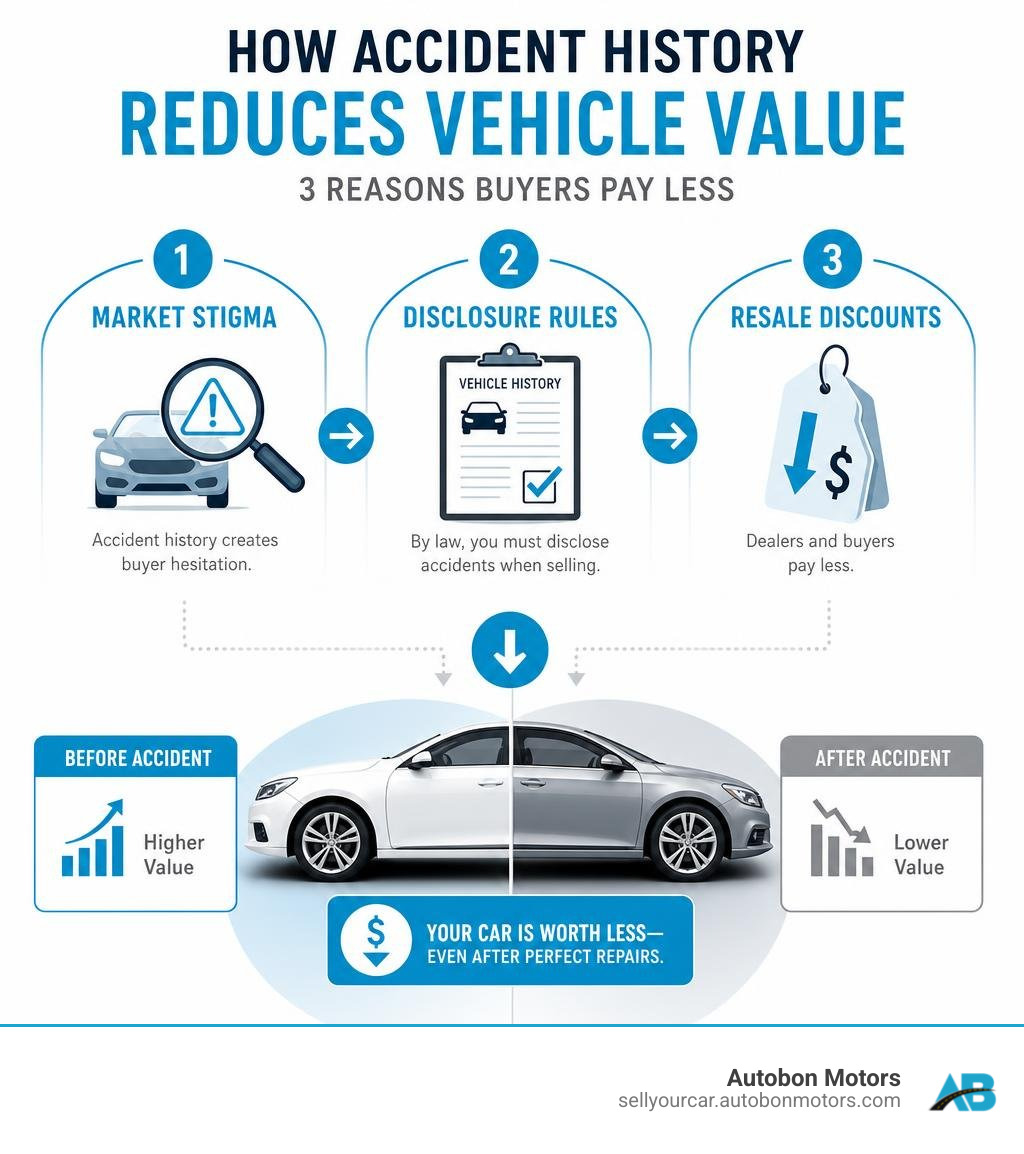
A vehicle with an accident on its history report carries a stigma in the used-car market. Buyers notice it. Dealers discount it. According to industry data, accident-history vehicles can sell for 10% to 33% less than comparable clean-history vehicles, even when the repairs were excellent.
Most insurance settlements cover repairs, but not always the value lost because of the accident record. That unpaid loss is what a diminished value claim is designed to recover.
I’m Marcos Bravo, a luxury and exotic automotive sales executive with over 25 years of experience in South Florida’s high-end car market. Across Fort Lauderdale, Miami, and beyond, I have seen how accident history quietly reduces resale value, which makes car appraisal for diminished value one of the most overlooked steps after a collision.
What Diminished Value Means After an Accident
Diminished value is the difference between what your vehicle was worth immediately before an accident and what it is worth after repairs are completed.
The key phrase is after repairs.
Repair bills are meant to restore the vehicle physically. Diminished value addresses the financial loss that remains because the vehicle now has an accident history. In the real used-car market, two identical vehicles rarely bring the same money if one has a clean history and the other has collision repairs on record.
That loss shows up in several places:
- A lower resale price from private buyers
- A lower trade-in value from dealers
- Buyer hesitation during negotiation
- More scrutiny of paintwork, panels, frame repairs, and airbags
- Accident disclosures on vehicle history reports
- Possible concerns from lenders, insurers, or lease companies
In simple terms: the car may drive fine, look fine, and pass inspection, but the market still says, “Hmm, what happened here?” That “hmm” costs money.
Diminished value is generally treated as part of property damage in a third-party insurance claim. In Florida, that usually means the not-at-fault owner pursues the at-fault driver’s liability insurance for the loss in value.
Inherent, Repair-Related, and Immediate Diminished Value
There are three main types of diminished value. Knowing the difference helps you understand what your appraisal is trying to prove.
1. Inherent diminished value
This is the most common type. It is the value loss caused simply by the vehicle having an accident history, even if the repairs were excellent.
Example: A buyer compares two similar SUVs in Fort Lauderdale. Same year, same mileage, same options. One has no accident history. The other had a repaired rear-end collision. Most buyers choose the clean-history SUV unless the repaired one is discounted.
That discount is inherent diminished value.
2. Repair-related diminished value
This applies when the repairs themselves reduce the vehicle’s value. It can happen because of:
- Mismatched paint
- Poor panel alignment
- Visible body filler
- Wind noise or water leaks
- Improper frame or structural repairs
- Warning lights or unresolved mechanical problems
- Incomplete advanced driver assistance system calibration
Repair-related diminished value is often easier to see but harder to fix. It can also overlap with a separate claim for poor repairs.
3. Immediate diminished value
This is the loss in value immediately after the accident, before repairs are completed. It is often used in theory or in certain claim discussions, but most consumer claims focus on the vehicle’s post-repair market value.
For practical purposes, most owners are trying to prove this question:
“What is my repaired vehicle worth now compared with what it would have been worth if the accident never happened?”
Why Diminished Value Matters Even After Quality Repairs
Quality repairs matter. They protect safety, appearance, and long-term reliability. But repairs do not erase the accident history.
In South Florida’s used-car market, buyers are often cautious. They may worry about hidden issues from:
- Structural or frame damage
- Airbag deployment
- Major panel replacement
- Flood or water exposure
- Repainted panels
- Repaired luxury, exotic, or performance vehicles
- Low-mileage vehicles that should have had a “cleaner” history
Newer and lower-mileage cars often suffer more diminished value because buyers expect them to be close to perfect. Luxury vehicles can also take a bigger hit because buyers in that segment tend to be pickier. And frankly, when someone is paying premium money, they usually do not want a mystery novel in the vehicle history report.
Accident history also affects how a dealer evaluates risk. A dealer may need to discount the vehicle to resell it, spend more time explaining the repair history, or wholesale it instead of retailing it. That reduced market confidence becomes part of the diminished value calculation.
How a car appraisal for diminished value Calculates Your Loss
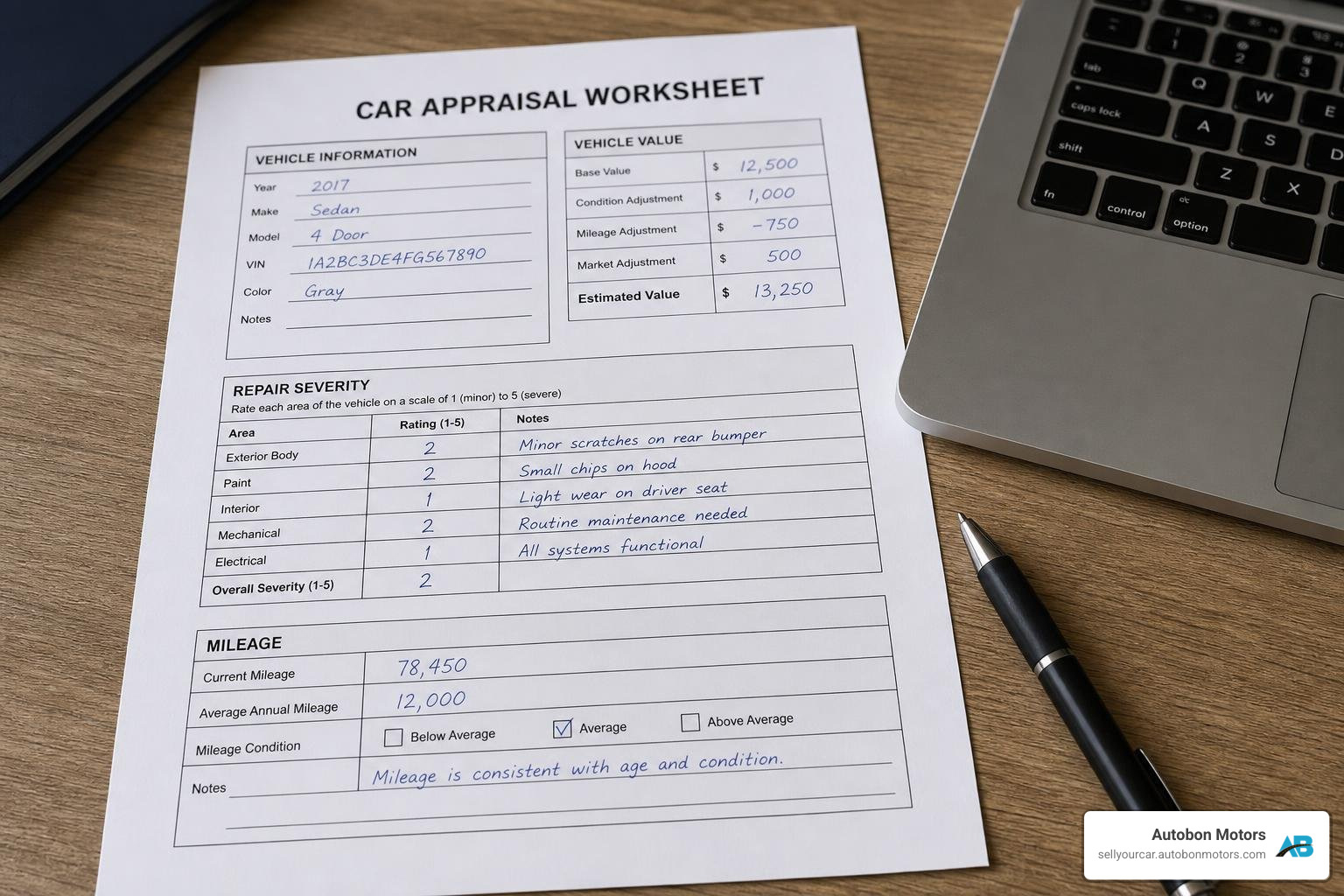
A car appraisal for diminished value estimates the difference between the vehicle’s pre-accident fair market value and its post-repair value with the accident history disclosed.
Most appraisals use one of two approaches:
- A formula estimate, often based on the 17c formula
- A market-based appraisal using real-world evidence
| Method | How It Works | Strengths | Weaknesses |
|---|---|---|---|
| Formula estimate | Starts with vehicle value, then applies caps and multipliers | Fast and easy to understand | Can understate real market loss |
| Market-based appraisal | Compares clean-history value with accident-history value using market data | More realistic and stronger for negotiation | Requires more documentation |
| Dealer or buyer feedback | Shows how market participants discount repaired vehicles | Practical and persuasive | Must be documented carefully |
| Insurance valuation | Uses internal formulas or claim software | Convenient for insurer | May produce a low offer |
Before calculating diminished value, it helps to know your car’s current market range. You can estimate your car’s current value with us if you are deciding whether to sell, trade, or keep the vehicle.
Step-by-Step 17c Formula Estimate
The 17c formula is one of the most commonly discussed diminished value formulas. Some insurers use it as a starting point.
The basic structure is:
- Start with the vehicle’s pre-accident market value
- Apply a base loss cap, often 10% of that value
- Apply a damage multiplier
- Apply a mileage multiplier
- Calculate the estimated diminished value
A simplified example:
| Step | Example |
|---|---|
| Pre-accident value | $30,000 |
| 10% base loss cap | $3,000 |
| Moderate damage multiplier | 0.50 |
| Mileage multiplier | 0.80 |
| Estimated diminished value | $1,200 |
Damage multipliers often range from 0.00 for no meaningful structural damage to 1.00 for severe structural damage. Mileage multipliers usually reduce the loss as mileage increases.
The problem is that the 10% cap can be arbitrary, and mileage may already be reflected in the market value. The formula may also miss local South Florida demand, brand sensitivity, airbag deployment, and the difference between minor cosmetic work and structural repair. Treat 17c as a rough estimate, not the final answer.
Market-Based Appraisal Method
A market-based appraisal asks a practical question:
“What would informed buyers pay for this repaired vehicle compared with a similar clean-history vehicle?”
It may consider:
- Pre-accident fair market value
- Local comparable listings and sales data
- Auction or wholesale trends
- Dealer input
- Repair invoices and supplements
- Damage photos
- Structural repairs or airbag deployment
- Panel replacement or refinishing
- Vehicle age, mileage, trim, options, and prior history
- Quality of completed repairs
A strong report may include inspection findings, paint depth readings, and a clear explanation of the final number. For newer vehicles, luxury cars, high-end SUVs, and vehicles with major repairs, this method is often more persuasive than a formula-only number.
Factors That Increase or Reduce Diminished Value
Not every accident creates the same loss. A small cosmetic repair on an older high-mileage vehicle is very different from structural damage on a nearly new luxury sedan.
Factors that can increase diminished value include:
- Newer model year
- Low mileage
- High pre-accident value
- Luxury, exotic, or performance brand
- Structural or frame damage
- Airbag deployment
- Multiple panel replacements
- Poor repair quality
- Accident showing on a vehicle history report
- Clean prior history
- Strong local demand for clean-history examples
Factors that can reduce diminished value include:
- Older vehicle age
- High mileage
- Prior accident history
- Existing body damage
- Branded title before the loss
- Minor cosmetic repair only
- Lower market demand
The strongest claims usually involve a not-at-fault owner, a clean prior history, clear repair documentation, and measurable market loss.
When and How to File a Diminished Value Claim
Most diminished value claims are filed after repairs are complete. That lets the appraiser review the final repair invoice and evaluate the vehicle in its post-repair condition.
A typical process looks like this:
- Complete the repair process
- Collect the final repair invoice and photos
- Order a diminished value appraisal
- Prepare a written demand letter
- Submit the claim to the at-fault driver’s insurance company
- Include the claim number and supporting documents
- Review the insurer’s offer
- Negotiate if the offer is too low
- Read any release carefully before signing
The demand letter should state the diminished value amount requested and explain why the evidence supports it. Keep communication in writing whenever possible.
In June 2026, Florida diminished value claims remain fact-specific. Deadlines can depend on the type of claim, policy language, and whether litigation becomes necessary. Florida owners can review general property damage limitation periods in Florida Statutes section 95.11, but if the amount is significant or the insurer denies the claim, speak with a Florida attorney.
Third-Party Claims, At-Fault Accidents, and Partial Fault
A third-party claim is made against the insurance company of the driver who caused the accident. This is the most common path for diminished value recovery.
If you were not at fault, your claim is usually stronger. If you were at fault, recovery is harder because many auto policies pay for repairs but limit or exclude first-party diminished value under collision coverage.
If both drivers share fault, recovery may be reduced under Florida’s comparative fault rules. Uninsured or underinsured motorist property damage coverage may also matter, depending on the policy. If an insurer denies the claim, ask it to identify the exact policy language it relies on.
Leased, Financed, and Previously Damaged Vehicles
Diminished value can also affect leased and financed vehicles.
If the vehicle is leased, the leasing company may have a financial interest in the car’s value, and the driver may still face end-of-lease or disposition issues. Review the lease before filing.
If the vehicle is financed, the loan balance does not disappear just because market value dropped. That can be painful if you planned to trade or sell soon.
Previously damaged vehicles are more complicated. If the car already had an accident history, the new loss may be smaller because the vehicle was already discounted. The appraisal must separate prior loss from new loss.
Key issues include:
- Prior body damage
- Prior insurance claims
- Existing title brands
- Prior paintwork
- Odometer accuracy
- Loan payoff
- Lease terms
- Whether the new accident caused additional stigma
State Rules That Can Affect Recovery
Because Autobon Motors serves Fort Lauderdale, Broward County, Miami, and South Florida, we focus on Florida drivers. Florida diminished value claims are usually pursued as third-party property damage claims against the at-fault party.
Florida owners should pay attention to:
- Who was legally at fault
- Whether the at-fault driver had liability coverage
- Whether the vehicle was properly repaired
- Whether the accident appears on a vehicle history report
- The statute of limitations for property damage claims
- Whether a settlement release includes all property damage claims
- Whether the insurer has denied or undervalued the claim
If your accident happened outside Florida, or another state’s law applies, the rules may differ. When in doubt, ask a qualified attorney in the state connected to the accident.
Evidence Needed for a Successful car appraisal for diminished value
A diminished value claim is only as strong as the evidence behind it. The burden is usually on the vehicle owner to prove the loss.
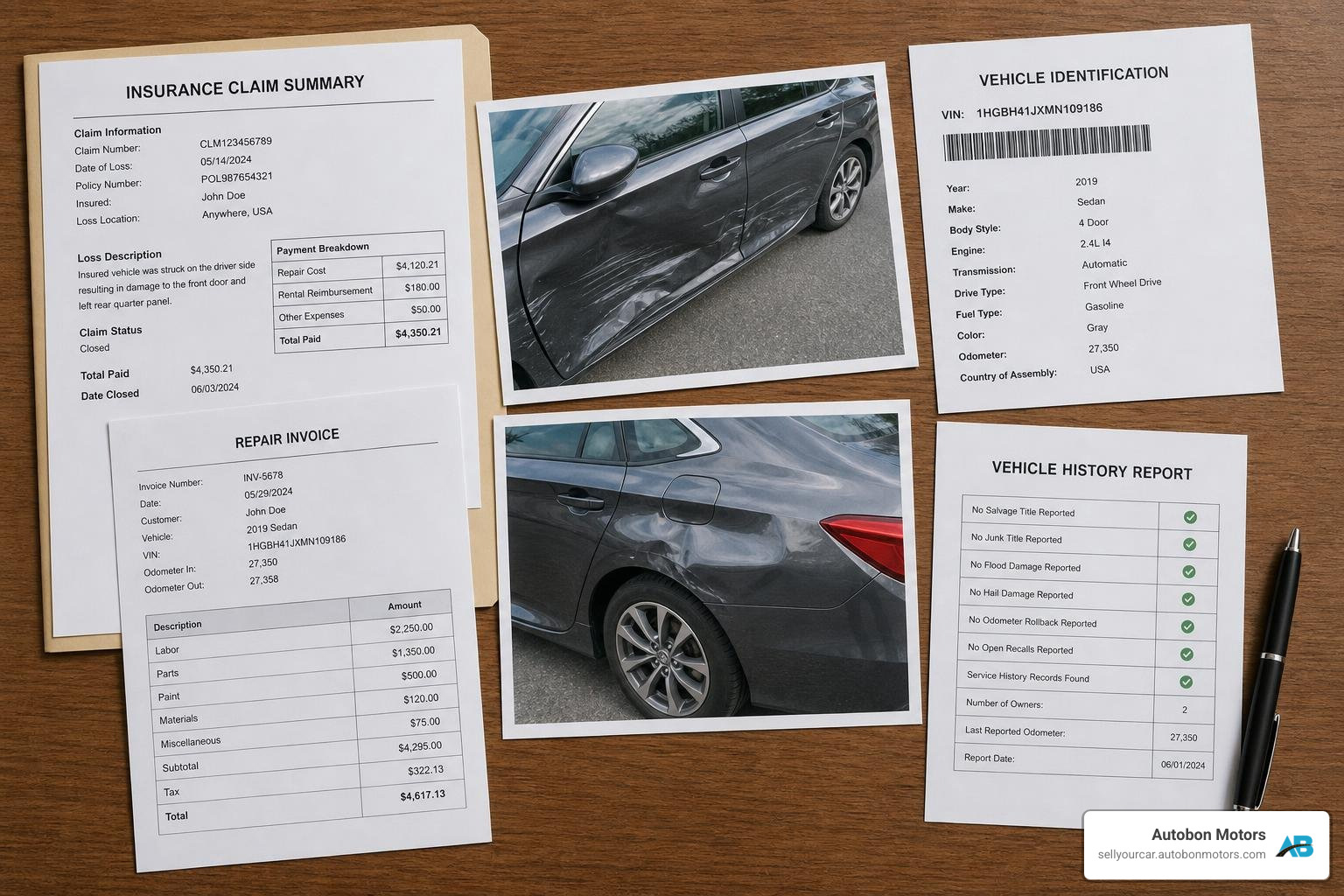
Useful evidence includes:
- Final repair invoice
- Original repair estimate
- Supplemental repair estimates
- Photos before repairs
- Photos during repairs, if available
- Photos after repairs
- Police or crash report
- Insurance claim number
- Vehicle identification number
- Exact mileage at the time of loss
- Current odometer reading
- Registration or proof of ownership
- Title status
- Vehicle history report
- Market listings for comparable vehicles
- Professional diminished value appraisal report
The more complete your file, the harder it is for an insurer to wave away the claim with a generic “we do not see a loss” response.
Documents to Gather Before Ordering a car appraisal for diminished value
Before ordering a car appraisal for diminished value, gather the documents that show what happened, how serious it was, and how the vehicle was repaired.
Start with:
-
Repair invoice
- This should show the final repair cost, labor, parts, paintwork, structural work, and any supplements.
-
Body shop estimate
- The original estimate helps show how the repair developed over time.
-
Photos
- Include accident-scene photos, close-ups of damage, and post-repair photos.
-
Crash report
- This helps establish fault and documents the accident.
-
Insurance correspondence
- Save emails, letters, claim notes, and settlement offers.
-
Vehicle details
- VIN, mileage, year, make, model, trim, options, and ownership history.
-
Title and registration
- These help prove ownership and title status.
-
Vehicle history report
- This shows whether the accident has been reported and how the market may see the vehicle.
If you do not have every document, do not panic. Appraisers work with imperfect files all the time. But the more you provide, the better the appraisal.
How Insurance Companies Dispute Diminished Value Claims
Insurance companies may accept a claim, deny it, or offer less than requested. Common dispute tactics include:
- Using a formula-only valuation
- Arguing the repairs restored the vehicle completely
- Claiming there is no proven market loss
- Blaming prior accidents or prior damage
- Reducing the claim because of mileage
- Saying the vehicle is too old
- Questioning the appraisal method
- Offering a low initial settlement
- Asking you to sign a broad release
- Arguing the damage was cosmetic only
- Disputing whether the accident will affect resale value
This is why documentation matters. A strong appraisal explains the “why” behind the number, not just the number itself.
Be especially careful with release forms. If you sign a property damage release too early, you may accidentally give up the right to pursue diminished value later. When the wording is unclear, get advice before signing.
What Professional Appraisers Add to Your Case
A professional appraiser adds independence, structure, and credibility.
A good diminished value report may include:
- Vehicle identification and condition
- Pre-accident value opinion
- Post-repair value opinion
- Repair invoice analysis
- Damage severity explanation
- Comparable market data
- Dealer or market feedback
- Photos and inspection notes
- Discussion of prior history
- Final diminished value conclusion
For higher-value vehicles, luxury cars, exotic vehicles, and newer SUVs, the appraisal can be especially important. These vehicles often suffer larger market penalties because buyers have more choices and higher expectations.
Professional appraisers may also help if the claim escalates. A well-supported report can be useful in negotiation, attorney review, or small claims court.
How to Maximize Your Diminished Value Recovery
Maximizing recovery is not about being aggressive. It is about being prepared, organized, and persistent. Also, coffee helps. But documentation helps more.
Here is the practical strategy:
- Do not rely only on the insurer’s first number.
- Get the repairs completed properly.
- Gather all documents.
- Get an independent appraisal when the potential loss justifies it.
- Submit a written demand with evidence.
- Keep communication professional and in writing.
- Ask for the basis of any low offer.
- Escalate if the response is unreasonable.
- Do not sign a final release until you understand what it covers.
- Compare the recovery effort with your real-world options, including selling.
If you are considering selling instead of fighting through a long claim, you can get a guaranteed cash appraisal from us and see where you stand.
Negotiate Before Accepting the Insurance Offer
The first offer is not always the final offer. If the insurer’s offer is low, respond with a clear counteroffer.
Your counter should include:
- The professional appraisal report
- Final repair invoice
- Photos
- Vehicle history report
- Market evidence
- A specific dollar demand
- A reasonable response deadline
- A request for written explanation if denied
Keep your tone calm. The goal is not to win an argument. The goal is to make it easier for the adjuster, supervisor, or claims department to justify paying a fair amount.
You can also ask whether the insurer will reimburse the appraisal expense as part of the property damage claim. Reimbursement is not guaranteed, but it may be negotiable depending on the circumstances.
If the insurer still refuses to pay a supported claim, options may include supervisor review, a regulatory complaint, mediation, small claims court, or attorney involvement.
Decide Whether to Claim, Escalate, or Sell
A diminished value claim takes time. Sometimes it is worth the effort. Sometimes the better move is to sell the vehicle and move forward.
Consider pursuing the claim if:
- Your vehicle is newer
- Your mileage is low
- Repairs were significant
- The vehicle had no prior accident history
- The accident appears on a history report
- You own a luxury, exotic, performance, or high-demand vehicle
- The expected recovery is meaningfully larger than the time and appraisal effort
Consider selling if:
- You do not want to manage the claim process
- The vehicle’s history now bothers you
- You were already planning to upgrade
- The insurer’s timeline is dragging
- The vehicle has multiple prior issues
- You want a clean, fast exit
At Autobon Motors, we help South Florida owners understand what their vehicle is worth in the real market, accident history and all. You can book a fast vehicle appraisal and get a clear cash offer without pressure.
Frequently Asked Questions About Car Appraisal for Diminished Value
Can I claim diminished value from my own insurance?
Usually, diminished value is easier to claim from the at-fault driver’s insurance company as a third-party claim.
Claiming diminished value from your own insurance is harder because many collision policies pay for repairs but exclude or limit payment for market value loss after repairs. That means if you caused the accident, your own insurer may not owe diminished value unless your policy or applicable law says otherwise.
Possible exceptions may involve:
- Specific policy language
- Uninsured or underinsured motorist property damage coverage
- Unique claim circumstances
- State-specific rules
For Florida drivers, the best first step is to review your policy and ask the insurer to point to the exact language supporting its position.
How much does a diminished value appraisal cost and is it worth it?
The cost varies by appraiser, vehicle type, claim complexity, and whether an inspection is needed. We do not recommend choosing an appraiser only by price. The better question is whether the report is credible, well-supported, and useful in negotiation.
A diminished value appraisal is more likely to be worth it when:
- The car is newer
- The vehicle is high-value
- The repair bill was substantial
- There was structural damage
- Airbags deployed
- The vehicle had a clean history before the accident
- The insurer’s offer seems low
- You plan to sell or trade soon
It may be less worthwhile for an older, high-mileage vehicle with prior accidents and minor cosmetic damage. In that case, the potential recovery may not justify the time and effort.
Will filing a diminished value claim raise my premiums?
A third-party diminished value claim against the at-fault driver’s insurer generally should not affect your premiums the same way an at-fault claim might. You are seeking compensation for property damage caused by someone else.
That said, insurance pricing is complicated. Insurers may consider claim history, location, vehicle type, driving record, and many other factors. If your own insurer is involved, ask how the claim will be recorded.
Keep strong documentation showing you were not at fault. That can help protect you if questions come up later.
Conclusion
Diminished value is real. A repaired vehicle with an accident history usually does not command the same price as a clean-history vehicle, even when the repairs are excellent. That difference can affect your insurance claim, trade-in value, private sale price, lease return, or decision to keep the car.
The smartest approach is simple:
- Understand the type of diminished value
- Calculate a rough estimate
- Gather your documents
- Get a professional appraisal when the numbers justify it
- Negotiate before accepting a low offer
- Know when selling may be the better path
At Autobon Motors, we buy used cars, trucks, and SUVs across Fort Lauderdale, Broward County, Miami, and South Florida with fast, fair, transparent offers. Our process is built for owners who want clarity without the runaround.
Here is how it works:
- Book your Appointment Online
- Bring your Car
- Get an instant Offer by one of our advisors
- Get Paid on the Spot
We offer 15-minute appraisals, a 3-day locked price, and a higher offer guarantee, so you can make your next move with confidence.
Ready to see what your car is worth today? Start with a fast cash offer.