What Is a Kelley Blue Book Trade-In and What Can You Expect?
A kelley blue book trade in value is the estimated amount a dealership will offer you for your current vehicle when you’re selling or trading up — and knowing this number before you walk into any dealership is one of the most powerful moves you can make.
Here’s a quick overview of how it works:
- Go to KBB.com and enter your vehicle’s VIN or license plate
- Select your trim, options, and condition honestly
- Enter your ZIP code so values reflect your local market
- Get your trade-in range — a weekly-updated estimate based on real transaction data
- Use that number as your baseline when negotiating with any dealer
Quick answer: Your KBB trade-in value is what dealers are likely to offer for your car. It’s typically lower than a private party sale price because dealers factor in reconditioning, inspections, and resale overhead. Use it as a starting point — not a final number.
KBB has been tracking vehicle prices since 1926 — that’s nearly 100 years of market data. Values are updated weekly across more than 100 geographic regions in the U.S., pulling from real auction results and actual sales transactions.
But here’s the frustrating reality for most South Florida car owners: even with a solid KBB estimate in hand, dealers frequently offer less — sometimes significantly less. Long waits, lowball quotes, and confusing back-and-forth negotiations are the norm, not the exception.
That’s why knowing how to use KBB data — and when to go beyond it — matters so much.
My name is Marcos Bravo, and with over 25 years in South Florida’s luxury and exotic automotive market, I’ve helped countless clients navigate the kelley blue book trade in process to get fair, transparent offers without the runaround. In this guide, I’ll walk you through five proven methods to make sure you’re getting every dollar your vehicle is worth.
Understanding the Kelley Blue Book Trade-In Process
To make the system work for you, you first have to understand how the system works. When you trade in a car in Fort Lauderdale or Miami, you aren’t just exchanging keys; you are participating in a massive wholesale and retail ecosystem.
Kelley Blue Book is the most recognized name in this ecosystem. However, KBB doesn’t actually buy cars directly from consumers. Instead, they act as a massive data aggregator. They track seasonal trends, historical auction transactions, regional supply and demand, and retail listings to generate a statistical model of what your car is worth.
Because local conditions vary wildly—a convertible sells much faster in sunny South Florida in June 2026 than a snow-plow-ready truck does—KBB divides the United States into over 100 distinct geographic regions. This regional adjustment is crucial. If you want to know what your vehicle is worth locally, you can use the Instant Used Car Value & Trade-In Value | Kelley Blue Book tool to get a localized starting point.
What is KBB and How Are Values Calculated?
At its core, Kelley Blue Book is a massive pricing engine backed by a century of automotive experience. KBB’s proprietary algorithm analyzes millions of data points every single week. These data points include:
- Wholesale Auctions: What are dealers currently paying for similar makes and models behind closed doors?
- Retail Transactions: What are consumers actually paying on dealership lots?
- Independent Listings: What are the current asking prices for vehicles advertised online?
- Historical Trends: How does this specific model depreciate over time?
By blending wholesale auction prices with retail transactions, KBB aims to provide a 360-degree view of the marketplace. This data is updated weekly to account for market volatility and seasonal changes.
Trade-In Value vs. Private Party and Retail Prices
One of the most common points of confusion for sellers in Broward County is the difference between Trade-In Value, Private Party Value, and Retail Price.
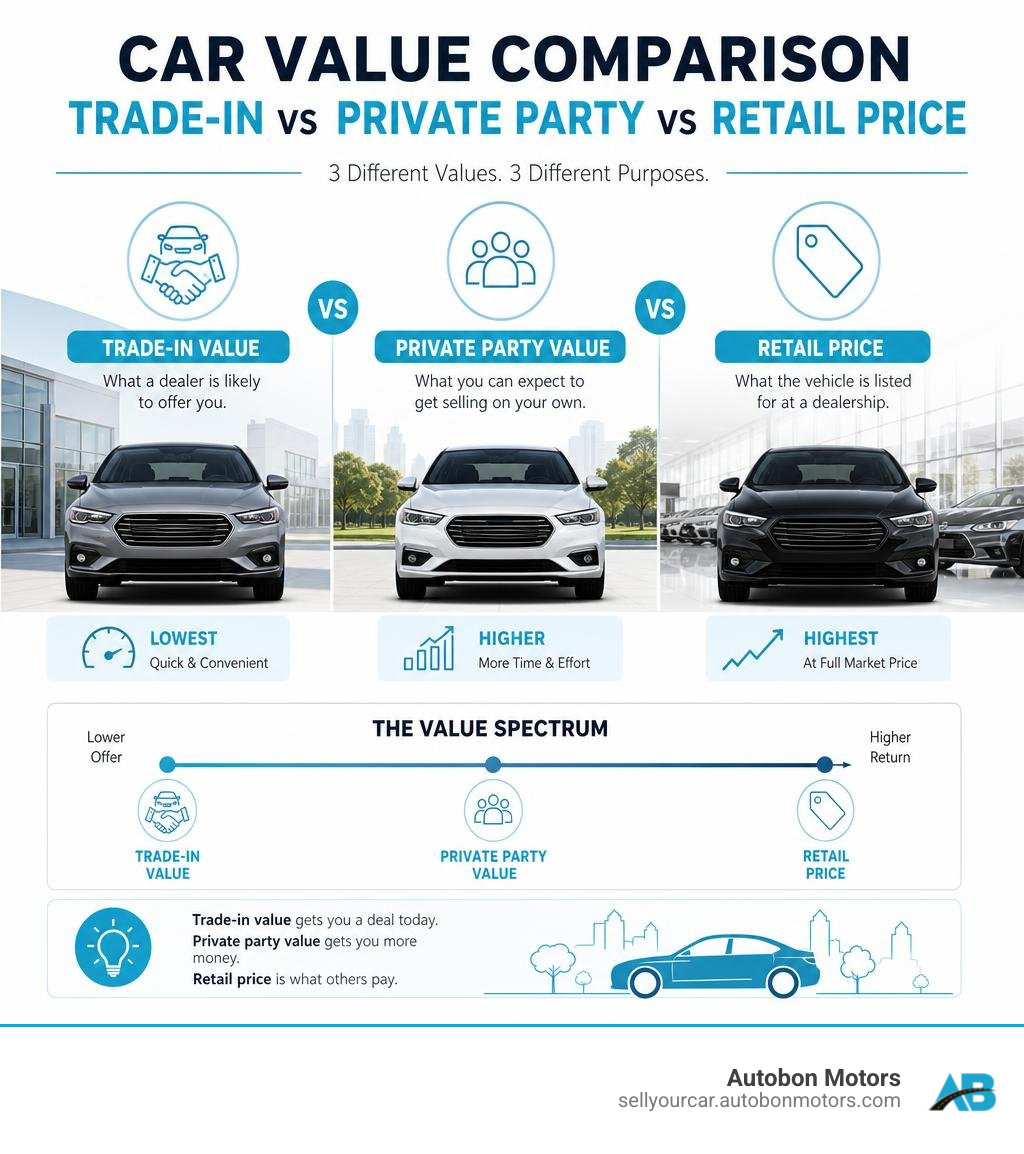
- Trade-In Value: This is what a dealership will offer you. It is always the lowest of the three numbers. Why? Because the dealer is taking on the convenience factor for you. They must pay to inspect, clean, repair, and market the vehicle, all while taking on the financial risk of it sitting on their lot.
- Private Party Value: This is what you can expect to get if you list the car yourself and sell it directly to another consumer. While this number is higher than the trade-in value, it requires you to deal with test drives, coordinate DMV paperwork, and handle secure payment.
- Retail Price (Typical Listing Price): This is what a dealership asks for the car once it is sitting on their showroom floor. It includes their profit margin, reconditioning costs, and dealer overhead.
| Valuation Type | Who It’s For | Effort Level | Relative Return |
|---|---|---|---|
| Trade-In Value | Dealerships | Very Low | Moderate |
| Private Party Value | Consumer-to-Consumer | Very High | Higher |
| Retail Price | Dealership to Consumer | N/A (Buying) | Highest |
5 Methods to Maximize Your Vehicle’s Value
Getting a high valuation isn’t just about luck. It’s about presentation, accuracy, and strategy.

Before you look up your vehicle on the New Car & Used Car Values | Get the Kelley Blue Book Value page, use these five proven methods to make sure you get the maximum value possible.
1. Use Your VIN for a Precise Valuation
When you search for a kelley blue book trade in value, you can search by year, make, and model. However, this general search often leaves room for error. It is easy to select the wrong trim level, miss standard factory equipment, or miscalculate packages.
To get the most accurate estimate:
- Locate your 17-digit Vehicle Identification Number (VIN). You can find it on the driver’s side dashboard near the windshield, on your driver’s side doorjamb, or on your registration card.
- Input the VIN directly into the KBB tool.
- Because every car manufactured after 1980 has a unique 17-digit VIN (which will never contain the letters I, O, or Q), this ensures the system pulls the exact trim, engine type, and factory-installed packages unique to your specific vehicle.
2. Be Honest About Your Vehicle’s Condition
We all love our cars, but overestimating your vehicle’s condition is the quickest way to get a disappointing offer at the dealership.
KBB uses a strict condition quiz to categorize cars into four brackets:
- Excellent (Less than 3% of cars): Looks brand new, has zero mechanical or cosmetic flaws, clean title history, and complete service records.
- Very Good: Extremely clean with only minor, easily restorable cosmetic wear.
- Good (Most cars fall here): Some minor cosmetic blemishes, but mechanically sound and free of major issues.
- Fair: Visible cosmetic defects, minor mechanical issues that need attention, or worn tires.
If your car has a salvage title, expect a permanent reduction of 20% to 40% of its book value. Be completely honest about broken equipment, like a non-functioning air conditioner (which is a big deal in Fort Lauderdale!). If you mark it as “Good” but the AC blows hot air, the dealer will immediately deduct the cost of a new compressor from their final offer.
3. Prepare Your Car and Gather Documentation
A clean car is a valuable car. Before getting an appraisal, invest some time or a little cash into preparation:
- Detail the Vehicle: A thorough wash, wax, and interior vacuum show the appraiser that you took pride in ownership.
- Gather Service History: Bring a folder containing all your oil change receipts, tire rotations, and major service records. This proves the car was mechanically maintained.
- Bring Both Sets of Keys: Modern key fobs are expensive to replace. Having both keys can save you a direct deduction from your trade-in offer.
4. Understand How Local Market Demand Affects Value
The price of a used car is heavily dependent on local demand. In South Florida, convertibles, fuel-efficient hybrids, and reliable family SUVs are always highly sought after.
Because KBB updates its data weekly to reflect real-time market volatility and regional demand, a car’s trade-in value might fluctuate from one week to the next. Keeping an eye on local inventory trends in Miami and Broward County helps you time your transaction perfectly when demand for your specific vehicle type is high.
5. Secure a Guaranteed Cash Offer from a Direct Buyer
Instead of guessing what a dealer might offer based on a range, the smartest method is to secure a guaranteed cash offer.
At Autobon Motors, we bypass the guesswork. We don’t just give you a loose estimate; we provide a professional, physical inspection in Fort Lauderdale and back it up with a 3-day locked price and a higher offer guarantee than our competitors. This gives you a concrete, guaranteed cash offer that you can take to the bank immediately, removing all the stress and negotiation from the process.
How to Navigate Dealer Offers and Negotiations
Redeeming your kelley blue book trade in value at a traditional dealership can sometimes feel like a chess match.
Understanding how dealers calculate their numbers helps you negotiate with confidence.
How to Get an Accurate Kelley Blue Book Trade-In Value
To ensure your baseline number is as accurate as possible:
- Double-check that you entered the correct South Florida ZIP code (such as a Fort Lauderdale or Miami ZIP).
- Carefully select every single option your vehicle has, from heated seats to premium sound systems.
- Take seasonal trends into account; convertibles may peak in value during dry, sunny months, while large SUVs might hold steadier year-round.
What to Do If a Dealer Offers Less Than the Book Value
If a traditional dealer looks at your car and offers you less than the KBB trade-in range, don’t panic.
- Ask for a Written Appraisal Report: Request a line-item breakdown of why they are deducting value. Is it because of tire wear, a scratch on the bumper, or local market saturation?
- Present Your Records: If they claim the engine sounds rough, pull out your detailed service history to prove it has been meticulously maintained.
- Know When to Walk Away: KBB values are estimates, but you are never obligated to accept a lowball offer. If a dealer won’t play fair, you have options.
Frequently Asked Questions About Vehicle Valuations
To help you make the best decision, here are the answers to the most common questions we hear from South Florida drivers.
Limitations of Relying Solely on a Kelley Blue Book Trade-In Estimate
While KBB is an incredible tool, it has its limitations. Because it relies on historical data, it can lag behind sudden market shifts. It also cannot physically inspect your vehicle to verify its condition. Furthermore, KBB does not assign value to aftermarket modifications (like custom wheels or custom suspension systems) because their value in the wholesale marketplace is highly inconsistent.
How often are vehicle valuation books updated?
Kelley Blue Book values are updated weekly. This frequent schedule is designed to capture rapid changes in wholesale auction pricing, consumer demand, and seasonal market shifts.
How does a salvage title affect my car’s trade-in value?
A salvage title indicates that an insurance company declared the vehicle a total loss. This carries a permanent negative effect, typically resulting in a 20% to 40% reduction in trade-in value. These vehicles usually require a specialized, case-by-case physical appraisal.
Conclusion: Get Top Dollar for Your Car Today
Navigating the kelley blue book trade in process doesn’t have to be a headache. By using your VIN, being honest about your car’s condition, presenting it beautifully, and understanding local South Florida demand, you can secure a fantastic return on your investment.
But if you want to skip the traditional dealership runaround, the endless negotiations, and the lowball offers, Autobon Motors is here to help. As South Florida’s premier car buying service, we offer fast, fair, and transparent cash offers for your used cars, trucks, and SUVs.
We make the process incredibly simple:
- Book your Appointment Online
- Bring your Car to our Fort Lauderdale location
- Get an instant Offer by one of our expert advisors (completed in just 15 minutes!)
- Get Paid on the Spot with our higher offer guarantee and 3-day locked price
Ready to see how easy selling your car can be? Get a guaranteed cash offer today and let us put top dollar in your pocket!