
What Is Car Black Book Value — and Why Does It Matter?
Car Black Book value is the wholesale market price of a used vehicle, based on real auction sales and actual transactions happening across the country right now.
Here’s a quick breakdown of what you need to know:
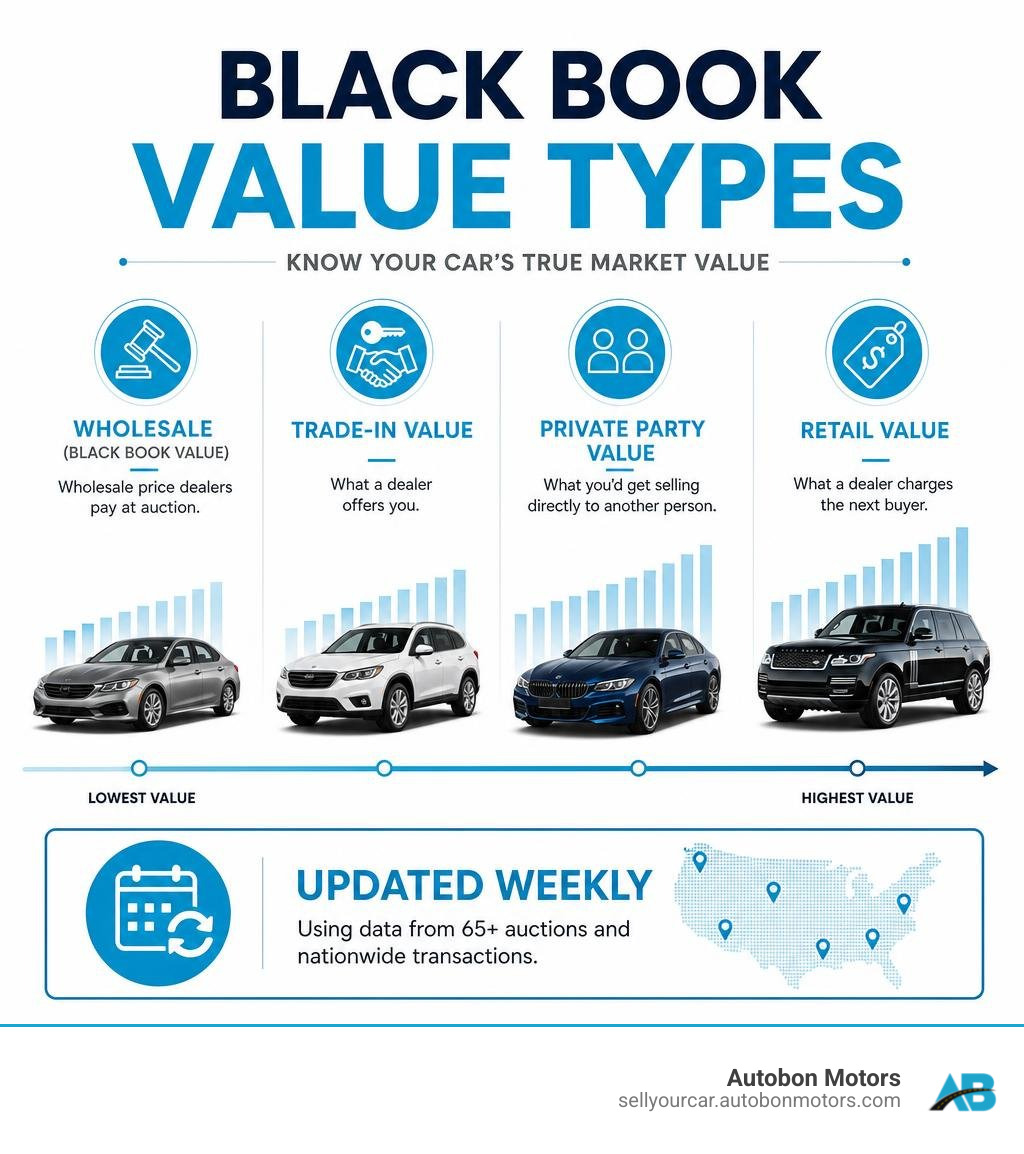
| Term | What It Means |
|---|---|
| Black Book Value | Wholesale price dealers pay at auction — the closest number to real market value |
| Trade-In Value | What a dealer offers you — aligned with auction/wholesale prices |
| Private Party Value | What you’d get selling directly to another person — between wholesale and retail |
| Retail Value | What a dealer charges the next buyer — the highest of the three |
| Updated | Weekly, using data from 65+ auctions and nationwide transactions |
Black Book values are not the same as the price you see on a window sticker. They reflect what vehicles are actually selling for in the wholesale market — the data dealers use behind the scenes when deciding what to offer you.
That gap between what a dealer offers and what you think your car is worth? Black Book is often the reason.
I’m Marcos Bravo, a luxury and exotic automotive sales specialist with over 25 years of experience in South Florida’s high-end car market, and car Black Book value is one of the most misunderstood — and most important — numbers in any vehicle transaction. Understanding it can mean the difference between leaving money on the table and walking away with a truly fair deal.
Understanding Your Car Black Book Value

When you stroll into a dealership in Fort Lauderdale or Miami to trade in your vehicle, the dealer doesn’t just guess what your car is worth. They consult highly specialized data. While most everyday consumers are familiar with public-facing valuation sites, automotive professionals rely on a different standard: Black Book Vehicle Values.
Originally published as a physical, pocket-sized black book for dealers, Black Book has provided timely, independent, and highly accurate vehicle pricing information since 1955. Today, it is a digital powerhouse used by over 30,000 dealerships nationwide to determine real-time, VIN-specific wholesale values.
Unlike consumer guides that estimate what a car might sell for on a retail lot, Black Book focuses heavily on the wholesale market. It represents the actual cash value of a vehicle on the open auction floor. If you want to know what a dealer will realistically offer you for your trade-in, you must look at the vehicle through the lens of its wholesale value.
How is Car Black Book Value Determined?
To understand how a car Black Book value is calculated, you have to look at where the data comes from. Black Book doesn’t rely on predictive guessing or list prices from online classifieds. Instead, it goes straight to the source of truth: wholesale auto auctions.
Black Book has proprietary relationships with the National Auto Auction Association (NAAA) member auctions and upstream feeds, allowing them to cover more than 95% of all wholesale auction sales across the country. To ensure this data is grounded in real-world human behavior, Black Book’s professional survey personnel and analysts personally attend and report on over 65 live auctions every single week.
Once this massive mountain of raw transaction data is collected, Black Book’s team of data scientists and automotive analysts—who boast over 250 years of combined industry experience—get to work. They combine advanced machine learning algorithms with hands-on market experience to filter out anomalies, adjust for seasonal demand, and calculate highly precise valuations.
Whether you want to check a domestic sedan or a high-end luxury SUV, you can get a clear picture of your vehicle’s market position through the Black Book Car Value tool, which tracks over 32,000 used vehicles spanning model years 1981 to the present.
The History Adjusted Valuation (HAV) Advantage
One of the most innovations in modern vehicle valuation is Black Book’s History Adjusted Valuation (HAV) feature.
Traditionally, a car valuation tool would ask you for the year, make, model, mileage, and general condition of your vehicle. But two identical cars with the exact same mileage can have wildly different values if one was pampered in a garage and the other was involved in a major fender-bender on I-95.
To solve this problem, Black Book became the first to integrate real-time vehicle history reports into its valuation system. By partnering with AutoCheck, Black Book automatically pulls the vehicle history report based on the specific Vehicle Identification Number (VIN).
The HAV system analyzes over 1,200 unique history data elements, including:
- Previous accidents and structural damage
- Number of past owners
- Fleet, rental, or commercial use history
- Title brands (such as salvage, rebuilt, or water damage)
- Consistent service and maintenance records
By running this history data through advanced machine learning models, Black Book provides a VIN-specific, history-adjusted value. This eliminates the guesswork for dealers and ensures that you get an incredibly precise appraisal that reflects your car’s true, documented background.
Black Book vs. Standard Consumer Valuation Guides
To understand why dealers prefer Black Book over standard consumer guides, it helps to see how they stack up side-by-side.
| Feature | Black Book | Generic Consumer Estimators (e.g., KBB) |
|---|---|---|
| Primary Target Audience | Car dealers, lenders, and fleet managers | Everyday consumers and private sellers |
| Primary Value Focus | Wholesale auction transactions (real-time cash value) | Retail listing prices and consumer-to-consumer sales |
| Update Frequency | Weekly (with daily VIN-specific data feeds) | Weekly to monthly |
| Data Methodology | Actual transaction tracking from 95%+ of US auctions | Predictive analytics using retail listings and historical trends |
| History Integration | Automated VIN-specific History Adjusted Valuations (HAV) | Manual user input for accident history |
| Condition Grading | Strict 4-tier wholesale scale (Extra Clean to Rough) | Broad 4-tier consumer scale (Excellent to Poor) |
Key Differences in Valuation Methodology
The core difference between Black Book and generic consumer estimators lies in their underlying data philosophies.
Popular consumer sites often use predictive analytics and massive databases containing trillions of data points to estimate retail pricing. Because their primary audience consists of consumers looking to buy or sell privately, they focus on regionalized retail values across over 100 different U.S. areas. They generate tens of millions of pricing reports monthly, but these reports are heavily weighted toward what cars are listed for, rather than what dealers are actually paying in cash at wholesale.
Black Book, on the other hand, tracks actual, closed transactions. It doesn’t care what a dealer hopes to get for a car on their lot; it cares what dealers are actively bidding on at wholesale auctions. Because wholesale markets move rapidly based on economic shifts, fuel prices, and seasonal trends, Black Book’s weekly updates reflect the immediate reality of the automotive market.
Why Dealers Rely on Car Black Book Value
Dealers operate on tight margins and face real financial risks when buying inventory. If a dealer pays too much for a trade-in, they risk losing money when they try to resell it or run it through an auction. This is why more than 30,000 dealers trust Black Book for Powering the Auto Industry with precise, real-time data.
Dealers rely on Black Book because it gives them weekly updates on actual dealer invoice prices, MSRPs, and wholesale fluctuations. This real-time data allows them to:
- Accurately Price Trade-Ins: Dealers can offer a competitive price that aligns with current auction values, protecting their bottom line while keeping offers fair.
- Source Inventory Safely: When buying cars from wholesale auctions, dealers use Black Book to know exactly how much to bid.
- Assess Risk: By using History Adjusted Valuations, dealers can instantly flag vehicles with hidden history issues, saving them from costly mistakes.
How Black Book Calculates Vehicle Worth

Calculating the value of a vehicle is a highly structured process. Black Book doesn’t just throw a single number at a car; it breaks the value down into specific categories based on market demand, condition, and location. You can learn more about how these calculations are structured by visiting Black Book’s Wholesale Value page.
Wholesale, Retail, and Trade-In Value Types
To provide a complete 360-degree view of the market, Black Book offers several distinct valuation tiers.
For wholesale values, Black Book divides vehicles into four strict condition categories:
- Extra Clean: A vehicle in pristine condition, looking and driving like new, with no cosmetic or mechanical flaws, and possessing highly desirable options.
- Clean: A well-maintained vehicle with minimal wear and tear, requiring very little reconditioning before it can be resold.
- Average: A car with normal wear and tear for its age and mileage. It might have minor cosmetic blemishes or require light reconditioning.
- Rough: A vehicle with obvious signs of heavy use, cosmetic damage, or mechanical issues that will require significant reconditioning costs to make retail-ready.
For trade-in values (which represent what a dealer will offer a consumer), Black Book simplifies the scale into three tiers: Clean, Average, and Rough.
Because a trade-in value is closely aligned with wholesale auction prices, understanding these categories helps you set realistic expectations before you visit a dealership.
Key Factors: Condition, Mileage, and Regional Data
When Black Book calculates a vehicle’s worth, several critical variables are adjusted in real-time:
- Mileage Adjustments: Every vehicle has an expected mileage based on its age. Black Book applies precise mathematical curves to adjust a vehicle’s value downward for high mileage or upward for exceptionally low mileage.
- Reconditioning Costs: Dealers must spend money to detail, repair, and safety-inspect used cars before selling them. Black Book’s values account for these average reconditioning costs based on the vehicle’s condition tier.
- Regional Demand: Location plays a massive role in car values. In South Florida—including Fort Lauderdale, Miami, and Broward County—convertibles, luxury SUVs, and clean sports cars are always in high demand. Conversely, all-wheel-drive vehicles with heavy snow packages do not command a premium in our warm, tropical climate. Black Book adjusts its valuations to reflect these regional realities.
- Optional Equipment: While you might have spent thousands on aftermarket modifications or high-end optional packages when the car was new, Black Book’s data shows that used-car shoppers focus primarily on basic transportation needs. Therefore, many optional packages add very little to a vehicle’s actual resale value.
Why Black Book Offers More Accurate Market Insights Than Generic Estimators
The used car market is incredibly dynamic. Values fluctuate constantly due to economic shifts, supply chain changes, and consumer demand. To keep track of these movements, industry experts look to Black Book’s weekly Market Insights.
To give you an idea of how precise this tracking is, consider how Black Book measures market trends:
- Used Vehicle Retention Index: Black Book calculates this index using wholesale average values on 2- to 6-year-old vehicles as a percentage of their original MSRP. This acts as a thermometer for the entire used car industry.
- Days-to-Turn Tracking: Black Book monitors how long used cars sit on retail lots before selling (historically hovering around 38 to 40 days during normal market conditions).
- Auction Conversion Rates: By tracking what percentage of vehicles actually sell at auction (for example, a typical conversion rate might be around 57%), Black Book can detect when demand is slowing down or heating up.
Because Black Book updates its pricing weekly, it captures sudden market shifts immediately. If wholesale car segments decline by 0.30% or truck segments drop by 0.40% in a single week, Black Book’s database reflects that change instantly. Generic consumer estimators that update less frequently often lag behind, leaving buyers and sellers with outdated information.
Frequently Asked Questions about Black Book Values
How often are Black Book values updated?
Black Book values are updated weekly. Because they pull data directly from live wholesale auctions and actual transactions occurring across the country, their database is constantly refreshed to reflect real-time market fluctuations.
Can consumers access Black Book values directly?
While Black Book is primarily a business-to-business service designed for dealers, lenders, and insurance companies, consumers can access Black Book data indirectly. Many reputable vehicle valuation sites, consumer reports, and dealership websites license Black Book’s data to power their online trade-in calculators.
Why does a dealer’s offer differ from Black Book?
No valuation tool can provide an absolute, unchangeable price. A dealer’s actual offer may differ from your calculated Black Book value due to highly localized factors, such as:
- The dealer’s current inventory (if they already have three identical models on their lot, they won’t pay a premium for a fourth).
- Specific local market demand in South Florida.
- The physical inspection of your vehicle, which might reveal mechanical issues, paint damage from the Florida sun, or reconditioning needs not captured online.
Conclusion
If you want to get the absolute most for your vehicle in South Florida, you need to work with a partner who understands real-time market data.
At Autobon Motors, we are South Florida’s premier car buying service, serving Fort Lauderdale, Miami, and Broward County. We buy used cars, trucks, and SUVs for top dollar with fast, fair, and transparent offers.
Unlike traditional dealerships that use outdated estimators to lowball your trade-in, we leverage real-time wholesale market insights to give you the best cash offer in South Florida. We back this up with our higher offer guarantee, fast 15-minute appraisals, and a 3-day locked price. Our customer-first, no-pressure process makes selling your vehicle quick and painless.
Ready to see how easy it is? Here is our simple, stress-free process:
- Book your Appointment Online: Pick a time that works for you.
- Bring your Car: Visit our convenient Fort Lauderdale location.
- Get an Instant Offer: One of our expert advisors will appraise your vehicle in just 15 minutes.
- Get Paid on the Spot: Walk away with fast, guaranteed cash.
Don’t leave money on the table. Sell Your Car to Autobon Motors today and experience a faster, fairer way to sell your car in South Florida!