

Selling a Financed Car Starts With the Payoff
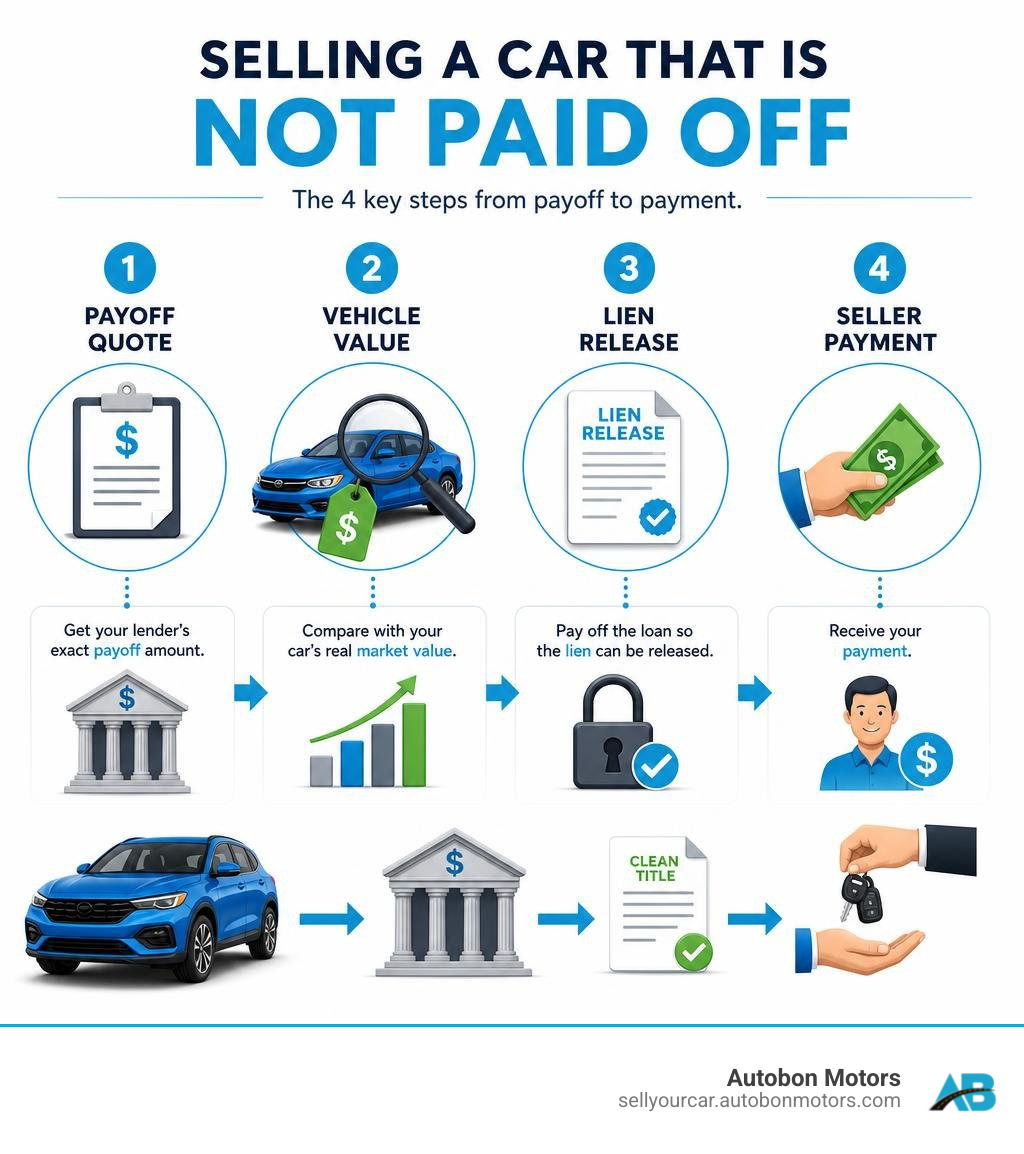
Yes, you can sell a car that is not paid off. The key is to pay the lender’s exact payoff amount so it can release its lien and allow the title to move to the new owner.
Start with these four actions:
- Request a current payoff quote from your lender.
- Compare that amount with your car’s real market value.
- Tell the buyer or car-buying service that a lien is active.
- Arrange for the sale proceeds – plus any shortfall you owe – to pay off the loan.
If your vehicle is worth more than the payoff, you have positive equity and keep the difference. If you owe more than it is worth, you can still sell, but you must cover the gap before the lien can be released.
For South Florida owners who want less paperwork and fewer delays, Autobon Motors offers a personalized local process: book your appointment online, bring your car, get an instant offer from an advisor, and get paid on the spot. The lender payoff and title details still matter, but a professional buyer can help make the transaction far less bureaucratic than coordinating everything with a private buyer.
I’m Marcos Bravo, a luxury and exotic automotive sales professional with more than 25 years of experience helping South Florida owners make confident vehicle decisions. If you are asking, can you sell a car that is not paid off, this guide will walk you through the payoff, lien, equity, and title-transfer steps clearly.
Can You Sell a Car That Is Not Paid Off? Understanding Liens and Equity
When you finance a vehicle, your lender holds a security interest perfected under the Uniform Commercial Code (UCC). While you possess the vehicle and your name is listed on the registration, the lienholder maintains a legal claim against the title until the debt is satisfied in full.
Understanding your legal standing requires knowing whether your title is governed by a title-holding or non-title-holding structure. In roughly 41 states, the lender or an electronic system holds the title certificate until the balance reaches zero. Conversely, nine title-holding states issue the physical certificate directly to the registered owner with the lienholder’s name explicitly annotated. Regardless of who holds the paper, no vehicle can be legally transferred with a clear title until that lien is officially released.
Your selling strategy hinges entirely on your equity position—the difference between your car’s fair market value and your total payoff balance:
- Positive Equity: The vehicle is worth more than the remaining payoff balance. When sold, the proceeds clear the loan completely, and you pocket the remaining cash.
- Negative Equity (“Underwater” or “Upside-Down”): The loan payoff exceeds the current market value. A significant percentage of car owners face negative equity during the first two to three years of ownership due to high initial prices, steep early depreciation, and extended loan terms ranging from 72 to 84 months.
| Equity Scenario | Market Value | Loan Payoff | Financial Outcome |
|---|---|---|---|
| Positive Equity | $22,000 | $17,000 | Seller receives $5,000 cash at closing |
| Break-Even | $18,000 | $18,000 | Loan satisfied; $0 out-of-pocket, $0 cash back |
| Negative Equity | $14,000 | $17,500 | Seller must provide $3,500 to clear the lien |
To navigate these scenarios effectively, you must estimate vehicle market value accurately before entering negotiations.
How to Calculate Your Loan Payoff Amount vs. Current Market Value

A common mistake sellers make is looking at their latest monthly financing statement and assuming that number is what they owe. Your monthly statement balance only reflects the principal and interest billed up to that specific billing cycle.
Because auto loans accrue interest on a per-diem (daily) basis, your real payoff number changes every single day. To get an accurate figure, you must contact your financing institution or log into your portal to request an official 10-day payoff quote. This document provides the exact dollar amount required to satisfy the loan completely through a specified calendar date, accounting for all daily interest accrued up to that point.
When requesting this quote, check your contract for early prepayment penalties. While prepayment penalties are rare on modern standard consumer auto loans, verifying this ensures no surprise administrative fees are tacked on.
Once you have your payoff quote, compare it against your vehicle’s market value. As outlined in Experian insights on auto loans, consumer vehicle values are segmented into private party resale values and wholesale trade-in values. Getting a clear picture requires a comprehensive vehicle appraisal process to see exactly where your car stands against current local transaction data.
Step-by-Step Selling Options for a Financed Vehicle

When you decide to part ways with a financed car, you have several primary pathways. Choosing the right one depends on your tolerance for administrative legwork versus your timeline:
- Trade-In at a Dealership: The dealer contacts your lender directly, obtains the payoff figure, remits the funds, and handles all DMV title documentation. Any positive equity is applied directly toward your replacement vehicle.
- Private Sale via Lender Branch: If your lender maintains local brick-and-mortar branches, you can meet the buyer inside the branch. The buyer pays the lender directly with certified funds, the bank initiates the lien release, and any surplus equity is handed to you on the spot.
- Private Sale via Escrow Services: When dealing with an online lender lacking local branches, third-party automotive escrow platforms facilitate the exchange of title and funds securely for a fee (typically $100 to $200 per party).
To ensure every detail is handled correctly from start to finish, review how to sell a car the right way and utilize a reliable trade-in car price calculator to weigh your options.
Can You Sell a Car That Is Not Paid Off With Negative Equity?
Selling an underwater vehicle requires extra planning because the lien cannot be lifted until the lender receives 100% of the payoff amount. You have three primary methods to solve this shortfall:
- Pay Out-of-Pocket: Bring certified funds or cash to closing to cover the deficit between the purchase price and the payoff quote.
- Unsecured Personal Loan: If you lack immediate liquid savings, you can take out an unsecured personal loan to bridge the gap. In 2026, average personal loan rates for good-credit borrowers sit around 12% APR, allowing you to extinguish the vehicle lien while paying off the smaller unsecured balance over time.
- Rolling Negative Equity: Dealerships often allow you to roll the unpaid deficit into a new auto loan. However, this practice is financially risky, as it immediately puts you upside-down on the next car, compounding interest costs over a new 72- or 84-month term.
Gap insurance offers no protection here. Gap policies are strictly designed to cover the difference between actual cash value and loan balance in the event of a total loss or unrecovered theft—they explicitly exclude voluntary sales.
Selling Privately vs. Selling to a Professional Car Buying Service
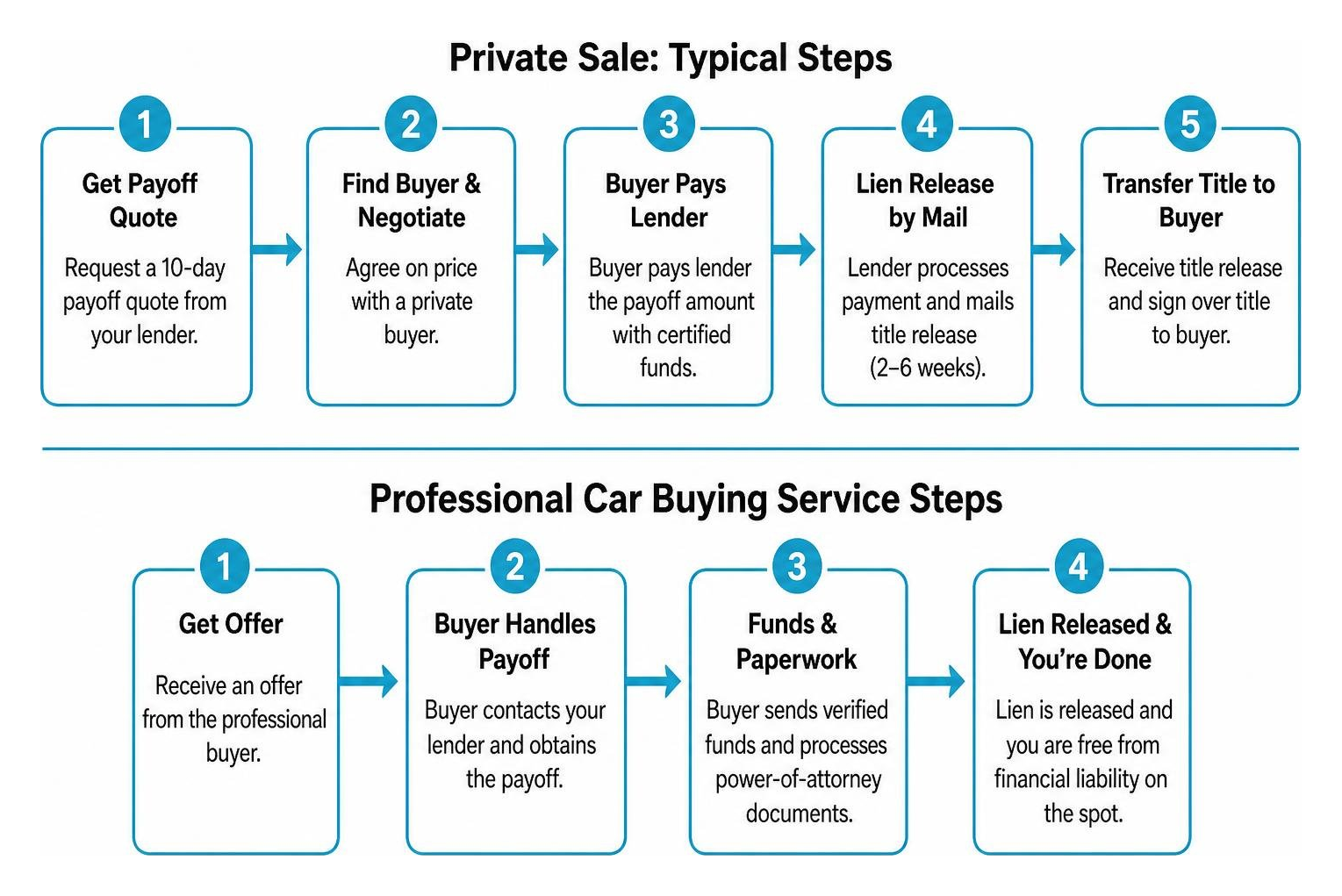
Selling a financed vehicle privately can turn into a drawn-out administrative headache. Most private buyers are hesitant to hand over thousands of dollars in cash or cashier’s checks without walking away with a clean physical title in hand. Because paper title releases and mailings can take two to six weeks, transactions frequently collapse due to buyer skepticism or verification delays.
Working with a dedicated, professional car buying service eliminates these friction points. Professional buyers communicate directly with your lienholder, transfer verified funds via electronic networks, process power-of-attorney documentation, and release you from financial liability on the spot—freeing you from weeks of stressful coordination.
Title Transfer and Lien Release: Navigating State Regulations in 2026
In 2026, over 35 states use electronic lien recording, which has reduced title fraud cases significantly compared to a decade ago. Through Electronic Lien and Title (ELT) frameworks, state motor vehicle agencies communicate digitally with authorized lenders. When a payoff posts, the lender sends an electronic lien satisfaction signal directly to the state database.
When completing a transfer on a vehicle that was financed:
- ELT States: The digital release typically clears in 3 to 5 business days, after which the state DMV can print or electronically reassign a clear certificate of title.
- Paper Title States: The lender manually signs a physical lien release certificate and mails the paper title to the owner or new purchaser, taking anywhere from 10 to 20 business days.
- DMV Filings: Sellers must immediately file a Notice of Sale / Release of Liability with their state motor vehicle agency to ensure they are not held liable for future toll violations, parking tickets, or accidents involving the buyer.
- Fees: Most state DMVs charge nominal administrative fees for updating records. Title reissuance fees generally run $10 to $30, while standard transfer fees across states range from $5 to over $150 (typically averaging $15 to $50).
For specific regional requirements, consult official resources like the Florida Department of Highway Safety and Motor Vehicles guidelines. If your paperwork has been misplaced during financing, learn how to sell a car without a title in hand safely and legally.
Legal Risks: Can You Sell a Car That Is Not Paid Off Without Disclosing the Lien?
Concealing an active lien during a vehicle sale is not simply a breach of contract—it is a serious criminal offense. Under the Uniform Commercial Code, the lender’s security interest remains attached to the vehicle itself. If a seller pockets a buyer’s money without paying off the loan, the lender retains the absolute legal right to repossess the car from the unsuspecting buyer’s driveway.
State laws enforce severe penalties for title fraud and failure to disclose liens as outlined by state legal standards on vehicle liens:
- Florida: Under Florida Statute 319.33, selling a motor vehicle with an altered, fraudulent, or undisclosed title is classified as a third-degree felony, punishable by up to 5 years in state prison and a $5,000 fine per offense.
- Texas: Under Texas Penal Code 32.46, securing the execution of a document by deception involving vehicle liens is a state jail felony, carrying penalties of 180 days to 2 years in jail and fines up to $10,000.
Beyond criminal prosecution, defrauded buyers can pursue civil litigation for full purchase restitution, treble damages, and attorney fees. Transparency is mandatory: always disclose the lienholder and coordinate the payoff openly.
Frequently Asked Questions About Selling a Financed Car
How long does it take to receive the title after paying off the loan?
The full timeline to complete a financed car transaction and issue a clear title ranges from two to six weeks depending on the payment method and state infrastructure. In states utilizing Electronic Lien and Title (ELT) systems, lenders submit digital lien satisfactions within 24 to 48 hours of receiving verified funds, allowing the DMV to update records within 3 to 5 business days. If the lender issues a physical paper title from an out-of-state vault, expect delivery via certified mail within 10 to 20 business days. Paying with a cashier’s check or direct wire transfer ensures the fastest processing, whereas personal checks introduce an administrative hold while funds clear.
Does selling a financed car hurt my credit score?
Selling a financed car generally has a neutral to positive effect on your personal finances, though you may see a minor, temporary fluctuation in your credit score. When the loan balance is satisfied, your overall debt-to-income (DTI) ratio improves immediately. However, closing an active installment loan account can slightly reduce your active credit mix—a category that accounts for roughly 10% of a FICO Score. If you apply for a new loan shortly after, the lender’s credit check will create a temporary hard inquiry, which typically impacts your score by only a few points for a short period.
Can gap insurance cover negative equity when selling a car?
No. Guaranteed Asset Protection (gap) insurance is designed exclusively for catastrophic loss scenarios where a vehicle is declared a total loss following an accident, fire, or unrecovered theft. Gap contracts contain explicit exclusions for voluntary sales, private party transfers, or dealer trade-ins. If you voluntarily sell an upside-down vehicle, you must fund the negative equity yourself. On a positive note, when you pay off your financed auto loan early, you are generally entitled to a prorated refund of any unused, prepaid gap insurance premiums from your policy administrator.
Conclusion
Selling a car that still has an outstanding loan balance doesn’t have to be overwhelming. As long as you secure an accurate 10-day payoff quote, understand your equity position, and follow proper lien release protocols, you can smoothly transition out of your vehicle without financial or legal headaches.
At Autobon Motors in Fort Lauderdale, we believe selling your car should be transparent, straightforward, and entirely pressure-free. While private sales often lead to weeks of buyer hesitation, scheduling runarounds, and complex bank coordination, our streamlined local process is designed to save you time and eliminate unnecessary bureaucracy.
Our local car buying process is simple:
- Book your Appointment Online: Pick a time that fits your schedule.
- Bring your Car: Visit our Fort Lauderdale location for a fast evaluation.
- Get an instant Offer by one of our advisors: Receive a transparent, top-dollar appraisal in 15 minutes with a 3-day price lock guarantee.
- Get Paid on the Spot: We handle all the lender payoff calls, title paperwork, and DMV filings directly while you walk away with verified funds.
Ready to clear your loan and pocket your equity without the wait? Connect with our team to get instant cash for your vehicle today.