
Understanding Diminished Value and Claim Eligibility
What Is Diminished Value vs. Standard Repair Claims?
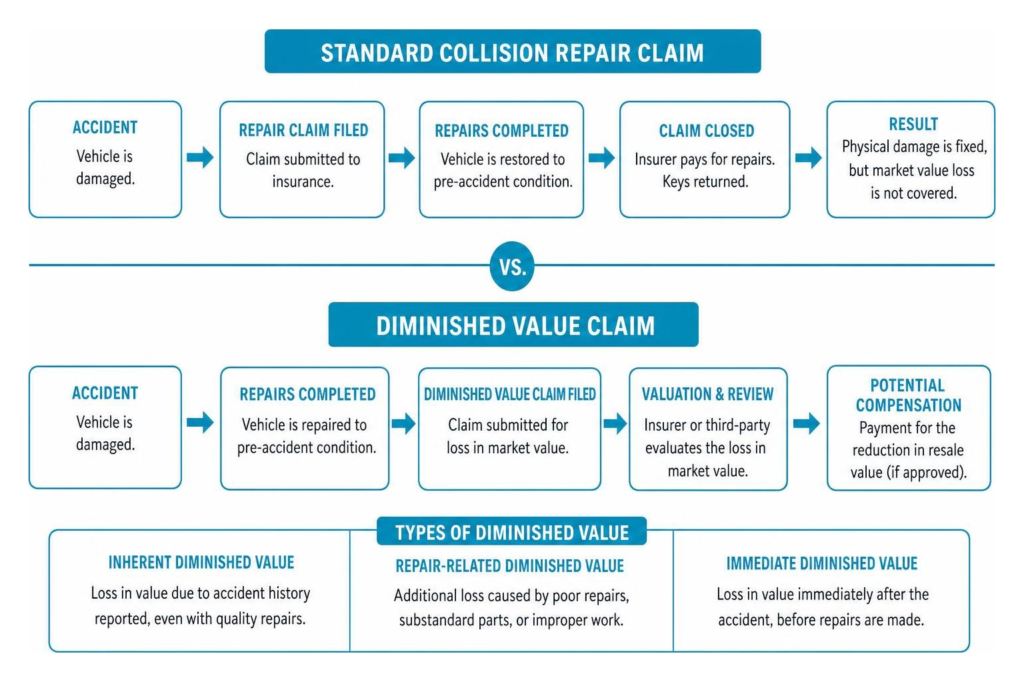
When you take your car to a collision repair shop after an accident, standard property damage coverage pays the shop to fix physical damage. The body shop replaces crushed body panels, straightens bent bumpers, matches paint, and replaces broken mechanical components. Once the body shop hands your keys back, your repair claim is closed.
However, a repair bill only restores physical appearance and mechanical function; it does not protect open-market resale value. Buyers and dealerships check history reports before making an offer. When an accident report pops up, the market price drops instantly. A diminished value auto claim seeks to recover this uncompensated market loss. Learn more about What Is a Diminished Value Claim? to understand how this differs from traditional body shop repair coverage.
Industry valuation experts categorize vehicle loss of value into three distinct types:
- Inherent Diminished Value: This is the most common form of diminished value. It represents the automatic loss in resale value that occurs simply because a vehicle has a documented collision history on its vehicle history report. Even if the car is restored to factory specifications using original equipment manufacturer (OEM) parts, future buyers will pay less for it compared to an identical car with a clean record.
- Repair-Related Diminished Value: This loss occurs when a repair shop performs substandard work. Examples include mismatched paint colors, uneven panel gaps, structural frame misalignment, or using low-grade aftermarket parts instead of OEM components.
- Immediate Diminished Value: This refers to the loss of value that exists right after a crash occurs, before any physical repairs take place. Because insurance carriers almost universally require vehicles to undergo complete repairs before evaluating market loss, immediate diminished value claims are rarely pursued.
Who Qualifies to File a Diminished Value Auto Claim?
Not every vehicle owner or collision scenario qualifies for a diminished value payout. To file a successful claim, your situation generally must meet specific baseline criteria:
- You must not be at fault: In most states (including Florida), diminished value claims must be filed as third-party claims against the at-fault driver’s insurance carrier. Standard auto collision policies almost universally exclude first-party diminished value claims when you cause the accident.
- You must own or finance the vehicle: You must hold legal title to the car or be financing it through a lender. Leased vehicles do not qualify because the leasing company—not the driver—retains the residual asset risk.
- Vehicle age and mileage thresholds: Because older or high-mileage cars experience standard annual depreciation, insurance companies routinely reject claims for vehicles older than 8 to 10 years or those with over 100,000 miles, unless the car is a rare, high-value classic or luxury model.
- Comparative fault rules: If you share partial responsibility for the collision, your state’s comparative negligence laws will apply. For instance, under Florida’s modified comparative fault system, if you are found 20% at fault for a crash, your final diminished value payout will be reduced by 20%.
How Insurance Companies Calculate Diminished Value Loss
The 17c Formula and Its Limitations
When you file a claim, the insurance adjuster will likely use a standardized calculation method known as the 17c Formula. Derived from a 2001 Georgia class-action lawsuit settlement (State Farm v. Mabry), insurers frequently treat this formula as an absolute cap on payouts, even though it consistently understates actual market loss.
Here is how adjusters run the 17c equation:
- Determine Pre-Accident Fair Market Value: The adjuster looks up your vehicle’s pre-accident value using valuation databases such as NADA or Kelley Blue Book.
- Apply a 10% Base Loss Cap: The formula assumes the absolute maximum market loss a vehicle can sustain from a crash is capped at 10% of its pre-accident fair market value.
- Apply a Damage Multiplier: The adjuster multiplies the capped value by a structural damage rating ranging from 0.00 to 1.00:
- 1.00: Severe structural damage
- 0.75: Major damage to structure and panels
- 0.50: Moderate damage to multiple panels
- 0.25: Minor panel and cosmetic damage
- 0.00: No structural damage or simple glass/panel replacement
- Apply a Mileage Multiplier: The result is then multiplied by a mileage factor:
- 1.00: 0 – 19,999 miles
- 0.80: 20,000 – 39,999 miles
- 0.60: 40,000 – 59,999 miles
- 0.40: 60,000 – 79,999 miles
- 0.20: 80,000 – 99,999 miles
- 0.00: 100,000+ miles
The main flaw of the 17c formula is its arbitrary 10% cap. It also double-counts mileage (which was already factored into the car’s pre-accident valuation). If you want to dive deeper into alternative calculation models, read our guide on How to Calculate Diminished Value Loss.
Vehicle Factors That Impact Your Final Payout
Real-world buyers do not evaluate cars using insurance company formulas. High-end sports cars, luxury SUVs, and low-mileage electric vehicles suffer massive drops in open-market resale value after a documented crash.
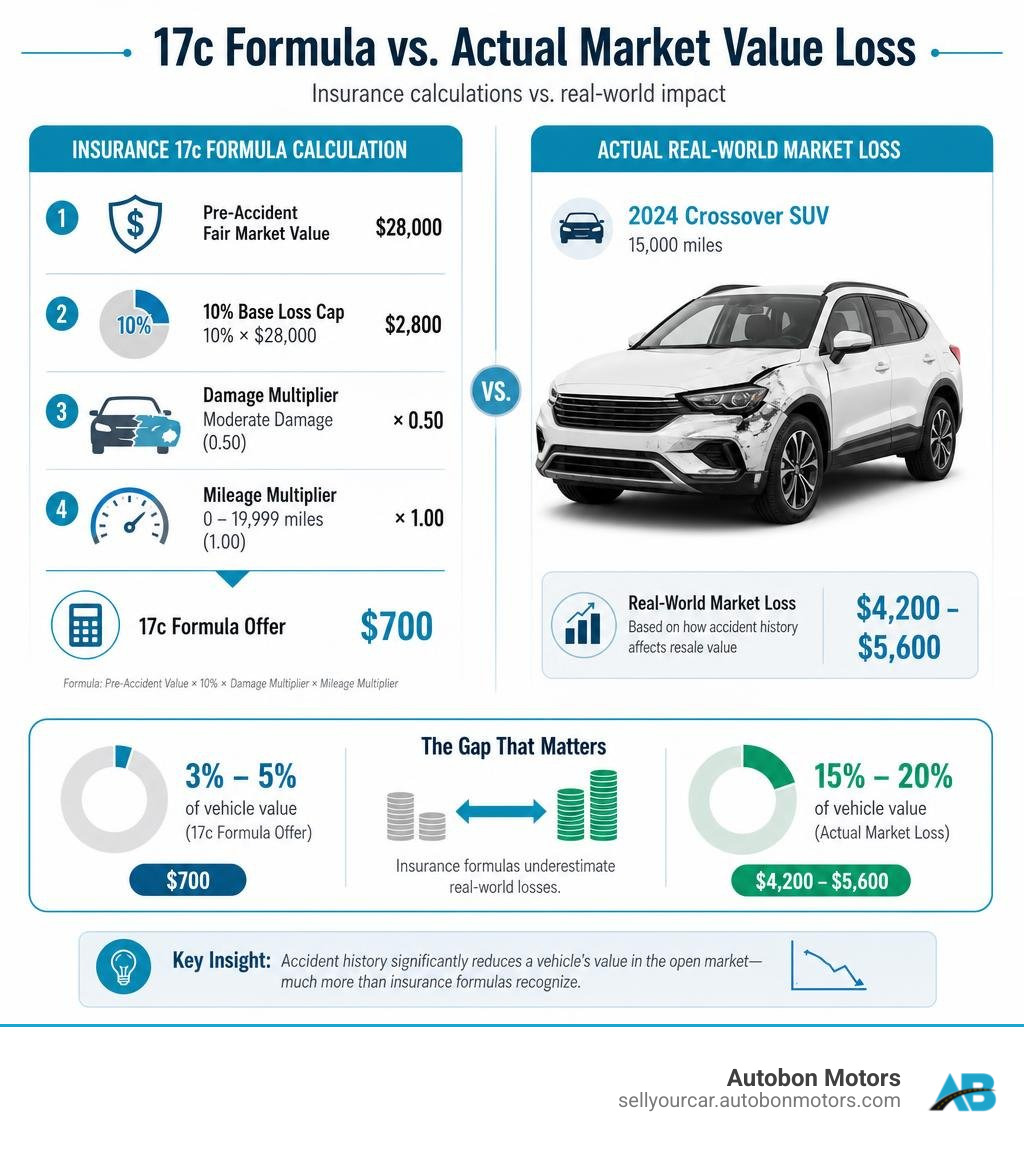
A car with an accident entry on its vehicle history report sells for 15% to 30% less than an identical clean-history vehicle. This gap is especially wide for high-value automobiles. Consider how the 17c formula compares against actual open-market losses in real-world scenarios:
| Vehicle Model & Details | Pre-Accident Value | Damage Severity | Insurer 17c Formula Offer | Actual Real-World Market Loss |
|---|---|---|---|---|
| 2024 Crossover SUV (15k mi) | $28,000 | Moderate panel & bumper | $700 | $4,200 – $5,600 |
| 2025 Luxury EV (15k mi) | $45,000 | Moderate frame & suspension | $2,250 | $6,000+ |
| 2022 Full-Size Pickup (50k mi) | $38,000 | Severe structural frame | $2,280 | $7,500+ |
Because an estimated 90% of drivers do not know diminished value coverage exists, auto insurance carriers save billions of dollars every year by remaining silent about these severe market losses.
4 Steps to File a Diminished Value Auto Claim
If another driver caused your crash, follow these four clear steps to build your case and negotiate a fair settlement.
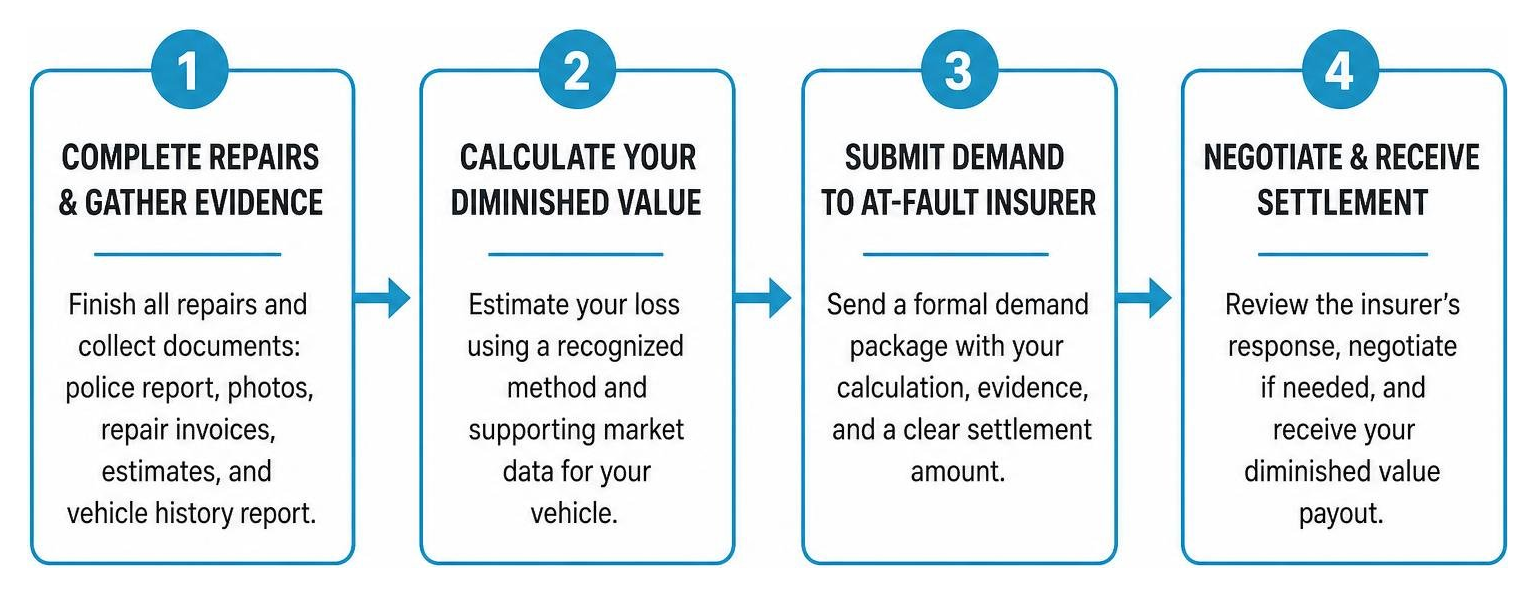
Step 1: Complete Repairs and Gather Critical Evidence
Before you can claim loss of market value, your vehicle must undergo complete collision repairs. Do not file a diminished value demand while your car is still sitting in the body shop, because post-repair quality cannot be verified until all repair operations are finished.
Once you pick up your vehicle, collect every document related to the incident and repair process:
- Final Body Shop Estimate of Record: Make sure you obtain the itemized final invoice detailing all structural, mechanical, paint, and panel labor hours, along with part numbers (OEM vs. aftermarket).
- High-Resolution Photos: Gather clear pre-repair photos of the collision damage, progress photos from the body shop, and final post-repair photos showing the completed vehicle.
- Police Crash Report: Ensure the official report documents that the other driver was 100% at fault.
- Pre-Accident Vehicle History Report: Download a clean Carfax or AutoCheck report showing your vehicle had no prior collision history before this crash.
- Detailed Maintenance Logs: Show that the vehicle was in top maintenance condition prior to the crash.
Reviewing our Step-by-Step Guide to Car Appraisal and Value Estimation will help you organize these files effectively.
Step 2: Establish True Market Loss with an Independent Appraisal
Relying on an insurance adjuster to tell you how much market value your car lost is like asking a tax auditor how much you should pay. To establish actual financial loss, hire a professional, certified vehicle appraiser.
An independent appraisal should be compliant with Uniform Standards of Professional Appraisal Practice (USPAP). The appraiser will evaluate your vehicle’s exact make, model, trim, options, mileage, and structural repair records, comparing your car against real-world auction data and comparable dealer sales of accident-history vehicles.
Professional appraisal reports generally cost between $250 and $600. If your estimated diminished value loss is $1,500 or more, paying for an independent appraisal gives you the written authority needed to reject lowball insurance offers. Check out the comprehensive Diminished Value Claim Guide: 17c Formula, Evidence & States for details on appraiser accreditation standards.
Step 3: Submit a Formal Written Demand Letter
Once your evidence file and independent appraisal report are ready, draft a formal written demand letter to the at-fault driver’s insurance adjuster.
Your demand package should be sent via certified mail with return receipt requested or uploaded through the insurer’s official online claims portal. Your demand package must include:
- Incident Details: Claim number, date of collision, policyholder name, and your vehicle details (year, make, model, VIN).
- Statement of Liability: Clear statement establishing that their insured driver was at fault for the accident.
- Calculation Breakdown: The total pre-accident fair market value, post-repair open market value, and the resulting financial difference demanded.
- Enclosed Documentation: Copies of the independent appraisal report, body shop repair records, police report, and pre/post-repair photos.
- Response Deadline: A firm, reasonable deadline (typically 14 to 30 calendar days) for the insurance company to respond in writing with a settlement check or formal response.
Step 4: Negotiate the Settlement Offer

Do not be surprised if the insurance adjuster rejects your initial demand letter or responds with an offer equal to a fraction of your appraiser’s calculation. Insurers often claim that their internal calculation tool is non-negotiable or that minor body repairs do not cause real loss of market value.
To negotiate effectively:
- Rebut the 17c Formula in Writing: Explain that the 17c formula was created as a minimum calculation framework for a specific court settlement, not a universal cap for open-market retail values.
- Provide Real Market Comparisons: Send the adjuster active vehicle listings showing clean-history models selling for significantly more than repaired accident-history vehicles of the same year and mileage.
- Escalate to a Supervisor: If the adjuster refuses to adjust their initial offer, ask to speak directly with a claims supervisor or manager.
- Keep Everything in Writing: Conduct negotiations via written email or certified letters to maintain a clear record of all communications.
Overcoming Insurer Tactics and Navigating State Rules
What to Do If Your Diminished Value Auto Claim Is Denied
Insurance adjusters use predictable delay and denial tactics to protect their bottom line. Common responses include:
- “Your car was repaired to like-new condition, so there is no diminished value.”
- “We do not recognize independent appraisal reports.”
- “You haven’t sold your vehicle yet, so your loss is only hypothetical.”
If the adjuster issues a outright denial or refuses to offer a reasonable settlement, you have several effective ways to escalate your claim:
- File a Complaint with Your State Insurance Department: In Florida, you can file an official regulatory complaint with the Florida Office of Insurance Regulation. Insurance carriers must respond to state insurance department inquiries within strict statutory timelines.
- File a Lawsuit in Small Claims Court: If the settlement gap is worth pursuing, file a lawsuit in local Small Claims Court. You do not file the lawsuit against the insurance company directly—you file it against the at-fault driver personally. Because the driver’s liability policy obligates the insurance company to defend them, the insurer will be forced to hire legal counsel or pay the settlement to avoid court litigation.
- Avoid General Release Traps: Never sign a general liability or property damage release form from an insurer until you have secured your final diminished value payout check. Signing a blanket release waives your legal right to pursue lost vehicle market value permanently.
State-Specific Regulations and Exceptions
Diminished value laws vary by state jurisdiction. Depending on where your accident occurs, distinct legal rules apply:
- Florida: Third-party diminished value claims are legally recognized under state tort laws. The at-fault driver’s liability insurance is required to compensate injured victims for lost property value. Read more about state rules with these insights on Florida Diminished Value Claim Lawyers.
- Georgia: Georgia is unique because state law mandates that insurance companies calculate and pay diminished value on first-party claims (your own policy) as well as third-party claims (State Farm v. Mabry).
- Michigan: Michigan operates under a strict no-fault legal system that explicitly prohibits traditional third-party diminished value claims against at-fault drivers. Instead, drivers must rely on a “mini-tort” legal provision, which limits property damage recovery against at-fault drivers to a strict statutory cap of $3,000.
- Kansas: Recognized under broad statutory property damage indemnity principles, Kansas permits first-party diminished value recovery under collision coverage duties, establishing strong policyholder protections.
Frequently Asked Questions About Diminished Value Claims
Can I file a diminished value claim if I was at fault?
In almost all states (including Florida), you cannot file a diminished value claim if you caused the collision. Standard collision insurance policies contain explicit exclusions that prevent policyholders from making first-party diminished value claims against their own insurance company. Georgia remains the primary exception to this rule. However, if an uninsured or underinsured driver hits your vehicle, you may be able to file a claim under your own policy if you carry optional Uninsured/Underinsured Motorist Property Damage (UMPD) coverage.
How long do I have to file a diminished value claim?
Your timeline is governed by your state’s statutory property damage limits. In Florida, the statute of limitations for filing a property damage tort claim is generally two years from the date of the collision. Despite having a multi-year window, you should gather evidence, complete repairs, and submit your demand letter as quickly as possible while body shop records, repair photos, and market listings are fresh.
Are diminished value settlement payouts taxable?
In most cases, diminished value settlement checks are not taxable income. The Internal Revenue Service (IRS) treats a diminished value settlement payout as a financial reimbursement that reduces your adjusted tax basis in the vehicle rather than new taxable income. For example, if you bought a car for $35,000 and receive a $4,000 diminished value settlement, the IRS simply adjusts your vehicle’s cost basis down to $31,000. You only owe taxes if your total insurance recovery exceeds the original purchase price of the vehicle.
Conclusion: Maximize Your Vehicle’s Resale Value

Filing a diminished value auto claim takes patience, clear documentation, and persistent negotiation. By obtaining an independent appraisal, rejecting lowball 17c formula calculations, and following up on your demand package, you can recover thousands of dollars in lost equity that insurance adjusters try to keep.
If you are dealing with a vehicle that has an accident record and want to avoid the stress of private buyers questioning its Carfax report, we can help.
At Autobon Motors, our car selling process consists of four simple steps:
- Book your Appointment Online
- Bring your Car
- Get an instant Offer by one of our advisors
- Get Paid on the Spot
Instead of dealing with endless back-and-forth negotiations, red tape, and lowball trade-in offers, South Florida drivers can choose our personalized, hassle-free approach. We provide fast, transparent, guaranteed cash appraisals for luxury cars, trucks, and SUVs—delivering a straightforward experience catered directly to local buyers and sellers.
To explore more high-end selling strategies, check out The Definitive Guide to Luxury Car Sales or review our breakdown on how to Calculate Your Vehicle Loss with Autobon Motors today!