
Why Diminished Value Loss Matters After a Crash
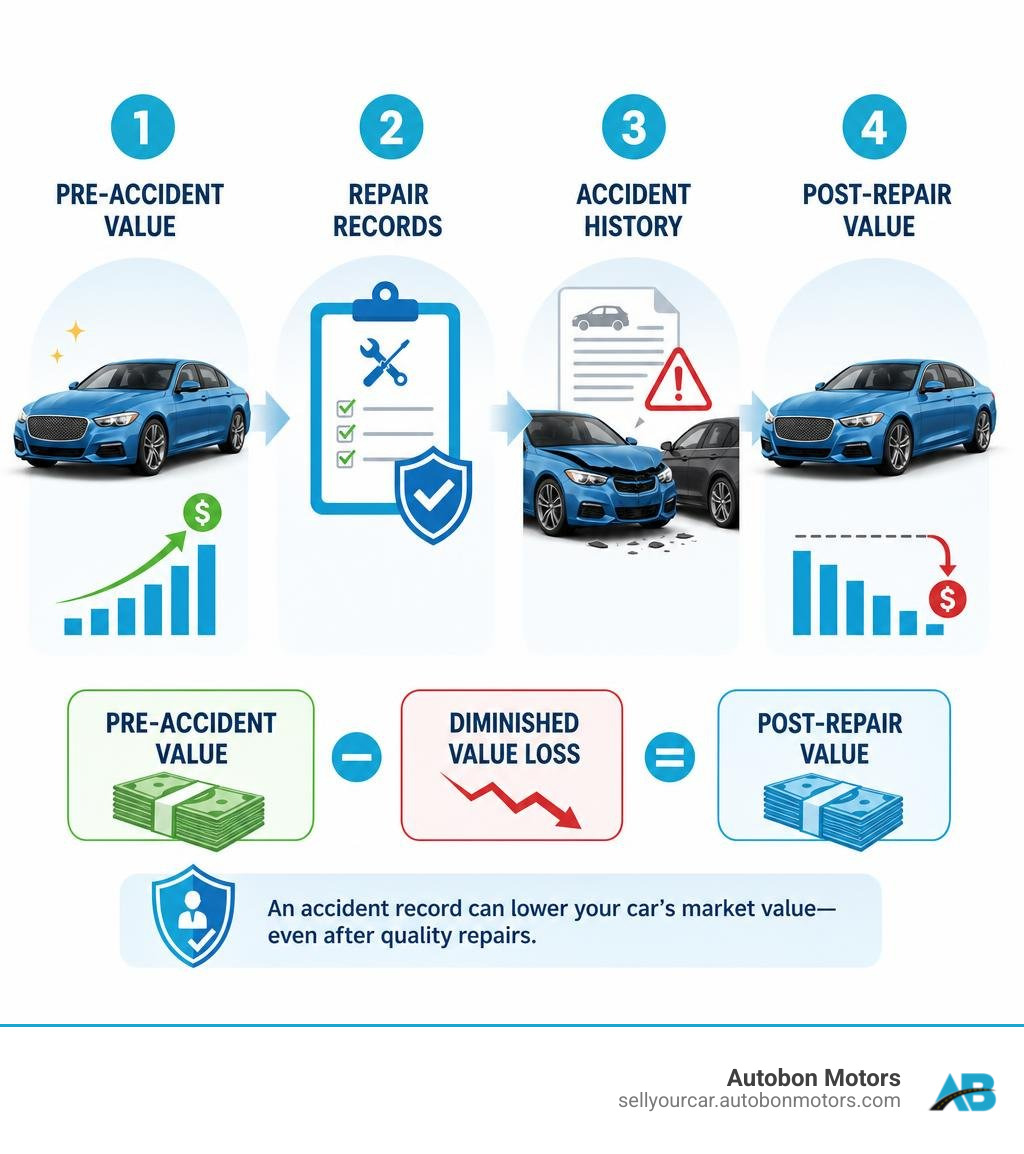
Diminished value loss is the drop in your car’s resale value after an accident, even when repairs look perfect. To estimate and support a claim, document the vehicle’s pre-accident condition and value, save every repair record, check its accident history report, and compare it with similar clean-history vehicles. If another driver caused the crash, their liability insurer may owe this loss in addition to repair costs, subject to your state’s rules.
Buyers, dealers, and online vehicle-history reports can all see an accident record. That record can make a repaired vehicle less appealing than an identical car with no reported damage. The effect is often larger for newer, low-mileage, luxury, electric, or structurally damaged vehicles.
For South Florida owners, this matters when an insurer’s payment does not match what the market will actually pay for the car afterward. A clear claim file can help you challenge a formula-based offer and understand the real gap between your car’s pre-crash and post-repair value.
I’m Marcos Bravo, a luxury and exotic automotive sales and marketing professional with more than 25 years of experience in South Florida’s high-value vehicle market. My work with buyers and sellers in Fort Lauderdale and Miami has given me insight into how accident history affects diminished value loss and real-world offers.
Understanding Diminished Value Loss After an Accident
When your vehicle gets damaged in an accident, your immediate focus is naturally on safety and physical repairs. However, the financial damage extends beyond fixing crumpled sheet metal or replacing a cracked bumper. The moment an incident is logged into national databases like Carfax, AutoCheck, or NMVTIS, the market resale value of your vehicle permanently drops.
Even if a certified collision repair facility restores your car to factory-level aesthetic and mechanical standards, buyers will almost always pick an accident-free vehicle over a repaired one unless given a steep discount. This post-repair drop in fair market value is known as diminished value. In property damage law, tort recovery principles exist to make the non-fault victim “whole” again, which means restoring not just the car’s function, but also its full monetary worth.
Understanding the full financial impact of accident claims helps you recognize that accepting a standard repair check leaves thousands of unrecovered dollars on the table. Learning how to calculate diminished value loss gives you the power to hold insurance companies accountable for the real financial penalty attached to your title history.
Inherent, Repair-Related, and Immediate Diminished Value Loss
Diminution of value falls into three distinct legal and appraisal categories:
- Inherent Diminished Value: This is the most common form of loss. It represents the immediate market stigma attached to a vehicle simply because an accident appears on its permanent history record. Even if the car has been rebuilt flawlessly using original equipment manufacturer (OEM) parts, future buyers and dealerships will offer less money solely because of that incident record.
- Repair-Related Diminished Value: This occurs when the body shop fails to restore the vehicle perfectly. Examples include mismatched paint tones, uneven panel gaps, aftermarket or generic parts installation, frame misalignment, or compromised electronic sensors. This loss is directly tied to repair flaws and cosmetic defects.
- Immediate Diminished Value: This represents the gap between a vehicle’s pre-accident market worth and its salvage value immediately after the collision before any repairs take place. It is rarely claimed because most non-totaled vehicles undergo repairs before resale.
Eligibility: First-Party vs. Third-Party Claims
Whether you can legally pursue a diminished value recovery depends largely on who caused the accident and the terms of your auto policy:
- Third-Party Claims: If another motorist caused the collision, you can file a property damage liability claim directly against the at-fault driver’s insurance carrier. Tort law in Florida requires the negligent party to compensate you for all measurable property losses, including inherent market diminution.
- First-Party Claims: If you caused the accident yourself, standard collision policies almost universally exclude first-party diminished value coverage. Unless your specific contract contains an explicit endorsement, your own insurer is only contractually obligated to pay for physical repairs or actual cash value in a total loss.
- Uninsured/Underinsured Motorist Coverage: If you are hit by an uninsured driver or a hit-and-run motorist, your ability to collect diminished value through your own Uninsured Motorist Property Damage (UMPD) policy depends on state statutory rules and specific policy definitions.
How Insurance Companies Calculate Value Loss: The 17c Formula
When you submit a claim to an insurance adjuster, they rarely start by analyzing real-world dealer sales data. Instead, most major insurance carriers rely on a standardized mathematical shortcut known in the auto industry as the “17c formula.”
The formula originated from a 2001 Georgia legal class-action suit (State Farm Mutual Automobile Insurance Co. v. Mabry). While designed specifically for that single judicial proceeding, insurers quickly adopted it across multiple states as an internal administrative guideline to limit payouts.
Calculating Diminished Value Loss Using Formula Multipliers
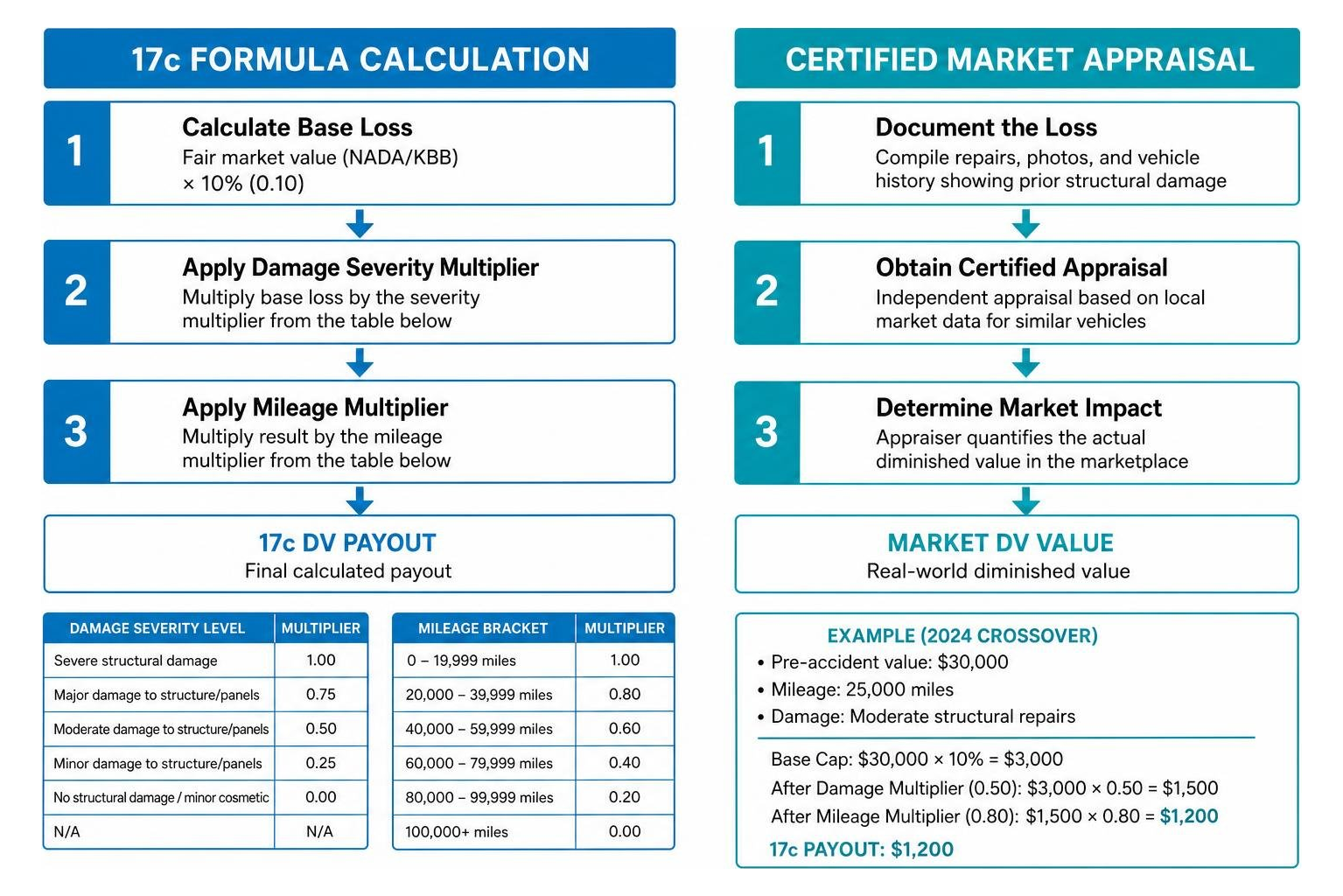
The 17c formula establishes an initial base cap equal to 10% of the vehicle’s pre-accident market value, and then reduces that number further using two cascading modifiers: a damage severity multiplier and a mileage modifier.
Here is how the insurance calculation framework operates step by step:
- Calculate Base Loss: Take the National Automobile Dealers Association (NADA) or Kelley Blue Book (KBB) fair market value and multiply it by 10% (0.10).
- Apply Damage Severity Multiplier: Multiply the base loss by the severity bracket corresponding to the physical repairs.
- Apply Mileage Multiplier: Multiply the result by the mileage bracket corresponding to the odometer reading at the time of the crash.
| Damage Severity Level | Multiplier | Mileage Bracket | Multiplier |
|---|---|---|---|
| Severe structural damage | 1.00 | 0 – 19,999 miles | 1.00 |
| Major damage to structure/panels | 0.75 | 20,000 – 39,999 miles | 0.80 |
| Moderate damage to structure/panels | 0.50 | 40,000 – 59,999 miles | 0.60 |
| Minor damage to structure/panels | 0.25 | 60,000 – 79,999 miles | 0.40 |
| No structural damage / minor cosmetic | 0.00 | 80,000 – 99,999 miles | 0.20 |
| N/A | N/A | 100,000+ miles | 0.00 |
For example, consider a 2024 crossover valued at $30,000 prior to an accident. If it has 25,000 miles and sustained moderate structural repairs:
- Base Cap: $30,000 × 10% = $3,000
- After Damage Multiplier: $3,000 × 0.50 = $1,500
- Final 17c Payout: $1,500 × 0.80 = $1,200
Reviewing a standard calculation methodology breakdown shows why insurance offers calculated this way are often significantly lower than real-world market losses.
Why the 17c Formula Fails Vehicle Owners
The 17c formula heavily favors the insurer over the vehicle owner for several clear reasons:
- Arbitrary 10% Ceiling: Real-world automotive sales demonstrate that severe frame damage, compromised crumple zones, or deployed airbags can easily reduce a late-model car’s market value by 20% to 40%—far beyond the insurer’s artificial 10% cap.
- Automatic 100k Disqualification: The formula assigns a 0.00 multiplier to any vehicle with over 100,000 miles, automatically zeroing out the claim regardless of whether the car is a pristine luxury vehicle or well-maintained truck that lost substantial value.
- Ignoring High-Value Segments: Electric vehicles (EVs) with compromised battery integrity or exotic sports cars experience market depreciation that standard formulas cannot accurately capture.
Step-by-Step Process to File and Negotiate Your DV Claim
Recovering a fair settlement requires a proactive strategy that relies on verifiable local market evidence rather than automated insurer tables.
Following our step by step guide to car appraisal and value estimation will help you organize the necessary baseline figures. Using proven guidelines on negotiating insurance settlements helps you counter common insurance adjuster pushback.
Essential Evidence and Certified Appraisals
To prove your claim, compile a complete evidence binder before submitting your demand. Your submission should include:
- Comprehensive Repair Documentation: Final itemized body shop invoices detailing labor, structural pulling, scanning records, and part numbers (confirming whether OEM or aftermarket parts were installed).
- Pre- and Post-Accident Photos: High-resolution images of the initial collision scene, vehicle damage before teardown, and photos of the repaired vehicle.
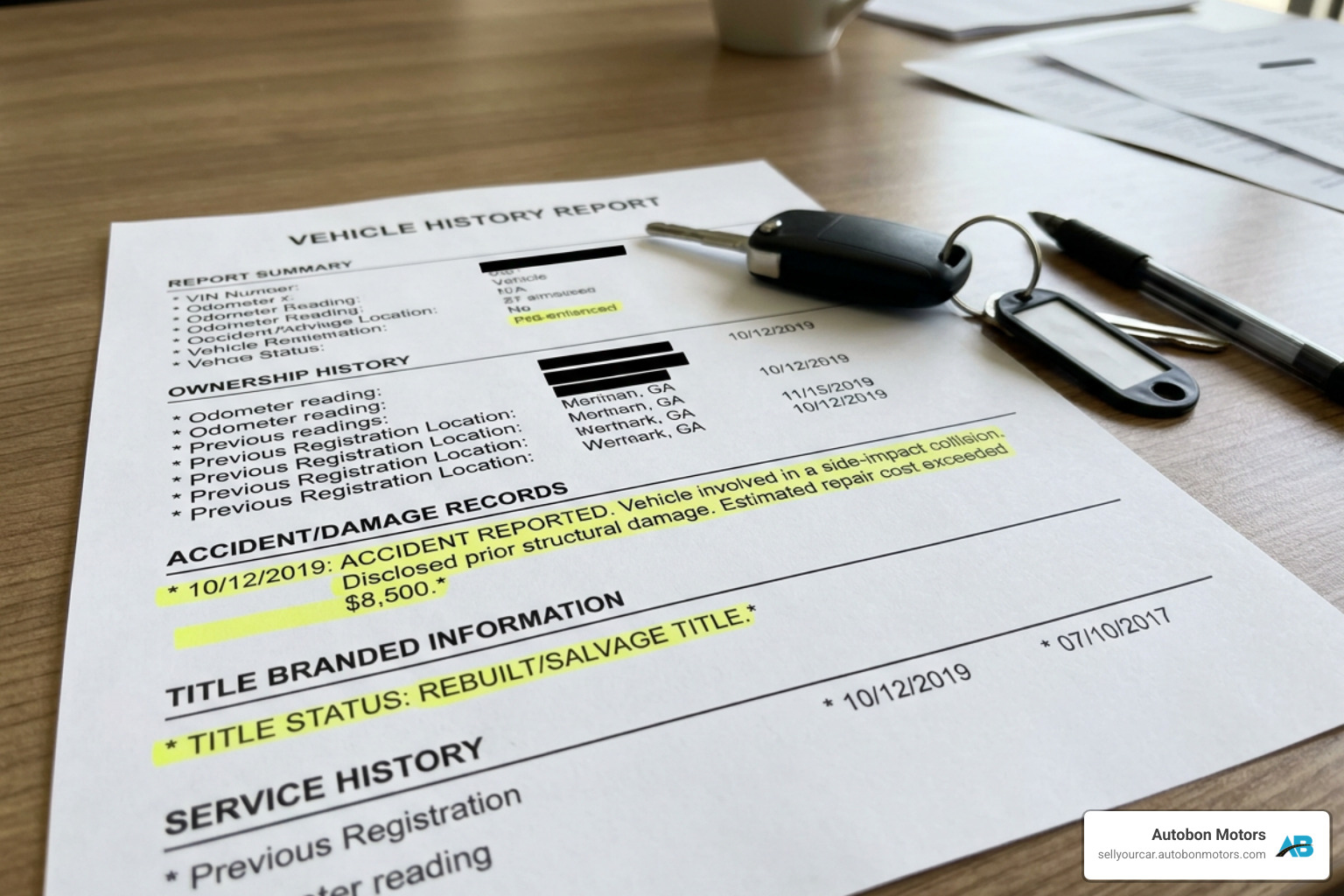
- Vehicle History Reports: A fresh copy of the Carfax or AutoCheck report showing the newly registered collision entry.
- Independent Certified Appraisal: A comprehensive report prepared by a licensed, certified vehicle appraiser documenting actual comparable local sales.
- Written Dealership Quotes: Written trade-in or cash buyback offers from local licensed dealers explicitly stating the deduction amount attributable to the accident history.
Demand Letters and Settlement Negotiations
Once your repair work is finished and your evidence is organized, draft a formal property damage demand letter to the at-fault driver’s insurance adjuster.
Send the demand packet via certified mail with a return receipt requested to create an official paper trail and trigger statutory response timelines. State the exact pre-accident fair market value, the substantiated post-repair market value, and the resulting financial gap. Set a firm 15- to 30-day deadline for a formal written response.
Expect the adjuster to initially push back with common tactics, claiming that “modern collision technology returns vehicles to pristine condition” or offering a quick 17c-based settlement. Counter their arguments with your independent appraisal data and dealer trade-in comparisons. Most importantly, never sign a property damage release of liability until your diminished value payout is agreed upon in writing.
State Laws, Statutes of Limitations, and Legal Action
The legal landscape governing property damage claims varies by jurisdiction, dictating how long you have to file and how comparative negligence affects your recovery.
Statutory Filing Deadlines by Jurisdiction
If informal negotiations fail, your claim is bound by the state’s property damage statute of limitations:
- Florida: Under Florida law, vehicle owners must file third-party property damage and diminished value claims within 2 years from the date of the collision.
- California: Under California Code of Civil Procedure Section 338(c), claimants have 3 years from the accident date to file.
- Washington: Washington State similarly provides a 3-year statute of limitations for personal property claims.
Failing to settle the claim or file a lawsuit before the statutory deadline permanently forfeits your right to recover value loss.
Small Claims Court vs. Legal Representation
If the insurance carrier refuses to provide a fair settlement, you have two primary paths for escalation:
- Small Claims Court: For disputes falling within local small claims monetary limits, you can file directly against the at-fault driver without hiring an attorney. Presenting your itemized repair records, photos, and certified appraisal directly to a judge is often an efficient way to resolve lowball offers.
- Hiring an Attorney: If your vehicle suffered severe structural damage, is a high-end luxury or exotic model, or if total property losses exceed small claims limits, retaining an attorney may be beneficial. Attorneys typically handle substantial property damage disputes on a contingency basis or alongside personal injury claims.
Frequently Asked Questions About Post-Accident Vehicle Value
Can you recover diminished value if you were at fault?
In almost all cases, no. Standard first-party collision coverage contracts explicitly exclude inherent diminished value when you are at fault for the crash. First-party recovery is generally only available if your policy includes a rare diminished value endorsement or if state contract statutes specifically mandate it.
How much does an independent vehicle appraisal cost?
A certified independent vehicle appraisal typically costs between $350 and $650, depending on the make, model, and complexity of the damage. In many third-party property damage negotiations, you can submit the appraisal invoice to the at-fault insurer and request full reimbursement as a necessary claim expense.
What is the statute of limitations for filing a diminished value claim?
Deadlines depend strictly on the state where the collision occurred. In Florida, the window is 2 years from the date of the accident. In states like California and Washington, the window is 3 years. It is best practice to submit your claim package within a few months of completing repairs while market comparison data is fresh.
Conclusion
Car collisions are stressful, and discovering that your vehicle lost thousands of dollars in resale value after repairs adds insult to injury. By documenting your damages, avoiding automated insurer formulas, and backing your demand with certified market data, you can protect your vehicle equity and recover what you are owed.
If you are dealing with a repaired vehicle and want to avoid lengthy insurance negotiations or lowball trade-in offers, learning how to sell my car the right way makes a significant difference. Choosing an efficient sell my car appraisal today the most effective solution for instant value allows you to unlock your car’s true equity quickly and transparently.
At Autobon Motors, we provide South Florida drivers with a convenient, personalized, and straightforward car selling experience without the typical dealership red tape. Our simple four-step process is built entirely around local sellers:
- Book your Appointment Online
- Bring your Car
- Get an instant Offer by one of our advisors
- Get Paid on the Spot
Whether your vehicle has a clean title or an accident history on record, our team in Fort Lauderdale is ready to deliver a fast, fair cash appraisal on the spot.