
Understanding Bank Finance Cars for Sale: Direct Lending vs. Dealership Financing
Bank finance cars for sale refer to vehicles purchased using direct auto loans secured through a retail bank or credit union rather than in-house dealership financing. Through direct bank lending, buyers obtain pre-approved funds and competitive fixed interest rates upfront, giving them the flexibility to shop across licensed dealerships with the negotiating power of a cash buyer.
To choose the right funding method for your purchase, it helps to understand the structural differences between direct lending from a financial institution and dealership-arranged indirect financing.
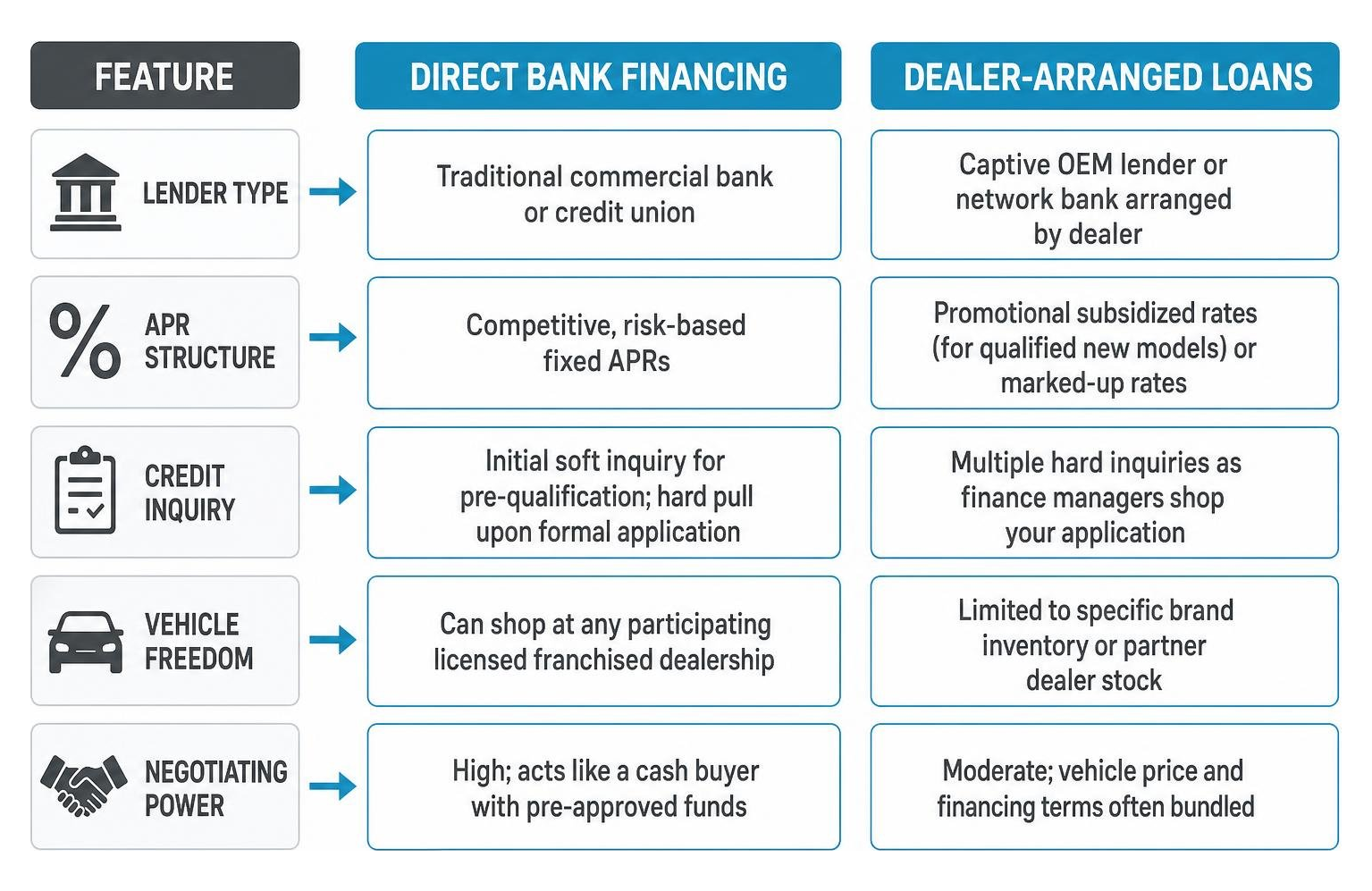
| Feature | Direct Bank Financing | Indirect Dealership Financing | Buy-Here-Pay-Here (BHPH) |
|---|---|---|---|
| Lender Type | Traditional commercial bank or credit union | Captive OEM lender or network bank arranged by dealer | In-house dealership acting as both seller and lender |
| APR Structure | Competitive, risk-based fixed APRs | Promotional subsidized rates (for qualified new models) or marked-up rates | Typically higher interest rates based on credit risk |
| Credit Inquiry | Initial soft inquiry for pre-qualification; hard pull upon formal application | Multiple hard inquiries as finance managers shop your application | Focuses on income and job stability rather than credit score |
| Vehicle Freedom | Can shop at any participating licensed franchised dealership | Limited to specific brand inventory or partner dealer stock | Restricted strictly to the dealer’s specific lot inventory |
| Negotiating Power | High; acts like a cash buyer with pre-approved funds | Moderate; vehicle price and financing terms often bundled | Low; financing terms and purchase prices are rigid |
For a comprehensive breakdown of budgeting and loan structures, explore our Car Financing Survival Guide to avoid common retail pitfalls.
Evaluating Direct Bank Financing Against Dealership Financing Options
Direct bank financing involves applying for an auto loan directly through a retail bank or credit union before shopping for a vehicle. Once approved, the bank establishes a maximum borrowing limit, an Annual Percentage Rate (APR), and a defined loan term based on your credit score, income, and debt profile.
In contrast, dealership financing (indirect lending) happens when a dealership’s finance department submits your credit application across a network of lenders. While captive manufacturer financing can sometimes offer promotional incentives on select new vehicles, dealership financing may also include discretionary dealer reserve markups on the interest rate.
When evaluating in-house or Buy-Here-Pay-Here options, the difference becomes even more pronounced. In-house lenders often accommodate buyers with credit setbacks or past repossessions by reviewing proof of income and employment stability instead of traditional credit scores. However, these arrangements typically carry significantly higher interest rates and bi-weekly payment schedules. Direct bank loans, on the other hand, offer predictable monthly payments and report consistently to major credit bureaus, helping you build positive credit history over time.
How Direct Lending Compares to Indirect Financing
Direct lending separates the vehicle price negotiation from the loan negotiation. When you arrive at a dealership with pre-arranged bank financing, you know your interest rate and loan ceiling upfront. This structure prevents dealers from shifting numbers between the trade-in value, purchase price, and financing rate to make a deal seem more attractive than it actually is.
Indirect financing relies heavily on the dealer acting as the middleman between you and several third-party lenders. While this can provide access to specialized manufacturer incentives, it can also lead to multiple hard credit inquiries within a short window. Securing pre-approved bank financing gives you a reliable baseline that dealerships must beat to earn your financing business.
Step-by-Step Guide to Securing Bank Financing for a Vehicle
Navigating the bank loan process is straightforward when approached systematically. By organizing your documentation and understanding credit thresholds beforehand, you can secure favorable borrowing terms without unnecessary friction.
To build a solid financing foundation, follow our 5 Critical Steps to Find the Best Local Auto Loans before submitting formal credit applications.
How to Pre-Qualify Without Hurting Your Credit Score
Securing auto financing starts with pre-qualification. During this preliminary stage, banks use a soft credit inquiry to evaluate your basic financial profile.
Unlike a formal credit application, a soft credit pull does not impact your credit score. It allows you to:
- Estimate your qualified APR band across multiple loan tiers.
- Establish a firm purchase budget ceiling without committing to a loan.
- Adjust variables like down payment amounts and loan tenure to model realistic monthly payments.
Once you find a vehicle that fits your parameters, you can transition from pre-qualification to a formal pre-approval. This final step involves a hard credit check and document verification, resulting in a firm, conditional loan commitment.
Essential Documents Required for Bank Auto Loan Approval
To accelerate your bank loan approval, compile your paperwork before applying. Having these documents ready ensures quick turnaround times and prevents processing delays:
- Proof of Identification: A valid government-issued photo ID or passport verifying your identity, age (must be at least 18), and legal residence.
- Proof of Income: Recent pay stubs (covering the last 30 to 60 days), W-2 tax forms, or 1099 statements. If you are self-employed, gather the last two to three months of complete personal and business bank statements.
- Proof of Residence: A recent utility bill (electric, water, or gas), lease agreement, or property mortgage statement dated within the last 30 to 60 days matching your application address.
- Credit Information: Disclosure of existing monthly debt obligations to allow lenders to calculate your overall debt-to-income (DTI) ratio.
- Vehicle Information: Once a car is selected, provide the Vehicle Identification Number (VIN), exact mileage, year, make, model, and the dealer’s bill of sale or purchase order.
You can streamline this entire workflow by reviewing our guide to Apply for Auto Loan in 5 Easy Steps before heading to the financing desk.
Key Factors That Dictate Your Auto Loan APR and Terms
Banks determine your auto loan terms using structured risk models. Knowing how lenders calculate your Annual Percentage Rate (APR) allows you to position your profile for the lowest possible cost of borrowing.
Maximizing Relationship Discounts and Loyalty Rate Reductions
Many financial institutions provide relationship-based discounts that lower your approved interest rate. Taking advantage of these perks can save you substantial money over the life of a 48- to 72-month loan.
- Automated Payment Discounts: Most commercial lenders offer an automatic rate deduction—typically a 0.25% APR discount—when you set up recurring auto-debit payments from an associated checking or savings account.
- Tiered Banking Rewards: National and regional banks often feature tiered loyalty programs for existing depositors. Depending on your qualifying balance tier, relationship programs can reduce your auto loan APR by 0.10% for baseline tiers up to 0.50% for premier account holders.
- Manufacturer Loyalty and Special Programs: If you are exploring captive financing options, manufacturers frequently provide stackable loyalty credits, military incentives, or recent college graduate discounts on qualifying models.
Vehicle Restrictions: Age, Mileage, and Title Conditions
Banks secure auto loans against the vehicle itself. Because the car serves as collateral, lenders enforce specific eligibility rules regarding the vehicles they will finance:
- Mileage Thresholds: Most traditional banks set mileage limits between 100,000 and 125,000 miles. Vehicles exceeding these figures present elevated mechanical risk, making them ineligible for standard auto financing.
- Vehicle Age Restrictions: Conventional bank loans are generally restricted to vehicles within the last 5 to 10 model years. Older vehicles often require specialized classic car financing or personal unsecured loans.
- Title Requirements: Banks mandate clean title history. Vehicles carrying salvage, rebuilt, flood-damaged, or lemon-law buyback titles are ineligible for standard bank auto loans.
- Commercial and Usage Exclusions: Standard consumer auto loans prohibit vehicles intended for commercial delivery fleets, heavy-duty hauling, or livery services.
How to Complete Your Vehicle Purchase at the Dealership
Armed with your bank pre-approval or draft check, visiting the dealership becomes an organized, transparent experience. You can focus entirely on selecting the right vehicle, testing its condition, and finalizing the purchase agreement.
When looking for the right dealer to work with, check our curated directory of the Best Fort Lauderdale Car Dealers for Buyers across South Florida.
How to Purchase Bank Finance Cars for Sale at the Dealership
Purchasing a vehicle using direct bank financing follows an established administrative workflow:
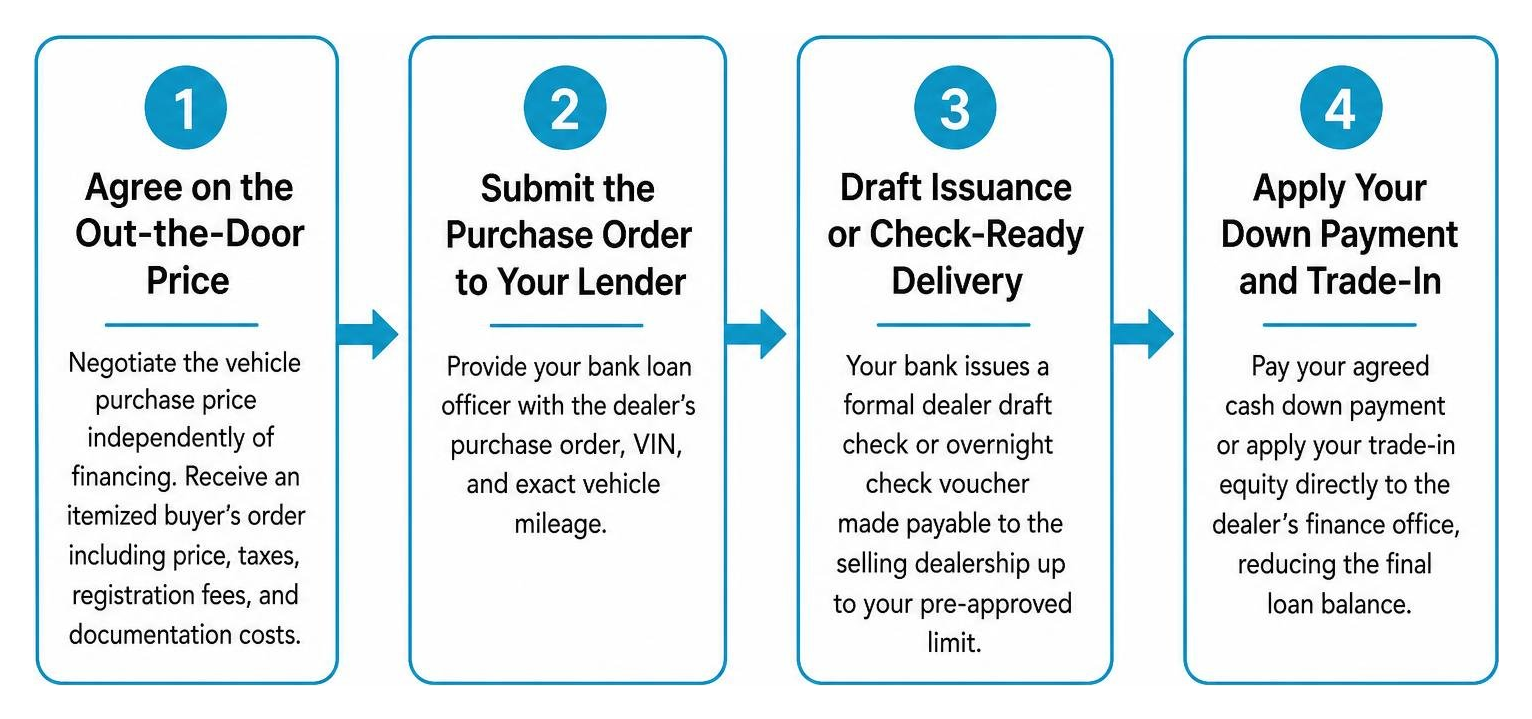
- Agree on the Out-the-Door Price: Negotiate the vehicle purchase price independently of any financing discussions. Ensure you receive an itemized buyer’s order reflecting the vehicle price, state sales taxes, registration fees, and documentation costs.
- Submit the Purchase Order to Your Lender: Provide your bank loan officer with the dealer’s purchase order, VIN, and exact vehicle mileage.
- Draft Issuance or Check-Ready Delivery: Your bank issues a formal dealer draft check or overnight check voucher made payable to the selling dealership up to your pre-approved limit.
- Apply Your Down Payment and Trade-In: Pay your agreed cash down payment or apply your trade-in equity directly to the dealer’s finance office, reducing the final loan balance.
Finalizing Dealer Purchase Paperwork and Lien Registration
After handing over your bank draft, the dealership’s business office finalizes the state transfer paperwork. As the borrower, you must ensure that ownership and lien details are recorded accurately.
- Bill of Sale Execution: You and the dealer sign the final bill of sale and purchase contract confirming the agreed figures.
- Lien Recording: The dealership submits title documentation to the state motor vehicle department, naming you as the registered owner and recording your lending bank as the primary lienholder.
- Title Custody: In title-holding states, the state licensing department sends the physical title directly to your lending bank. Once you make your final loan payment, the bank issues a lien release and sends you the clean, unencumbered title.
Frequently Asked Questions About Bank Car Financing
Can I get a bank auto loan with bad credit or past repossessions?
Yes, though approval terms differ from prime borrowers. Major banks often require higher minimum credit scores, but specialized lending divisions, credit unions, and subprime auto lenders work with borrowers rebuilding their credit.
To improve your approval odds with past credit issues, consider:
- Making a larger down payment to lower the lender’s exposure.
- Adding a creditworthy co-signer or co-buyer to the application.
- Providing verified proof of stable, continuous employment and income.
- Selecting a reliable, lower-cost vehicle that keeps your total debt burden ratio under 40% of your net income.
How much down payment is recommended for a bank car loan?
Financial experts generally recommend a down payment of at least 10% to 20% on new and used vehicles. An adequate down payment immediately creates positive equity, protects against vehicle depreciation, and lowers your monthly payment.
A larger down payment also improves your Loan-to-Value (LTV) ratio, which often helps you qualify for lower APR interest rate tiers from your lender.
How does a check-ready auto loan work at participating dealerships?
A check-ready auto loan provides approved borrowers with a physical draft check or secure digital certificate up to a pre-set maximum loan limit before they visit a dealership lot.
You take this check directly to any licensed, participating franchised dealer. Once you agree on a vehicle and purchase price, the dealer fills out their portion of the draft, provides vehicle title details, and deposits the check directly with your bank to receive payment.
Conclusion
Securing direct bank auto financing puts you in control of your car buying experience. By locking in a pre-qualification, understanding vehicle eligibility criteria, and establishing your borrowing ceiling before setting foot on a dealership lot, you can negotiate transparently and avoid unnecessary dealer finance markups.
If you are planning to sell your existing vehicle to fund your next down payment, our local team at Autobon Motors provides a straightforward alternative to corporate trade-in desks. We offer a simple, personalized four-step process: 01. Book your Appointment Online, 02. Bring your Car, 03. Get an instant Offer by one of our advisors, 04. Get Paid on the Spot.
Ready to upgrade your driving experience with confidence? Explore our current selection of bank finance cars for sale or schedule your appraisal in Fort Lauderdale today.