

How to Apply for an Auto Loan With Confidence
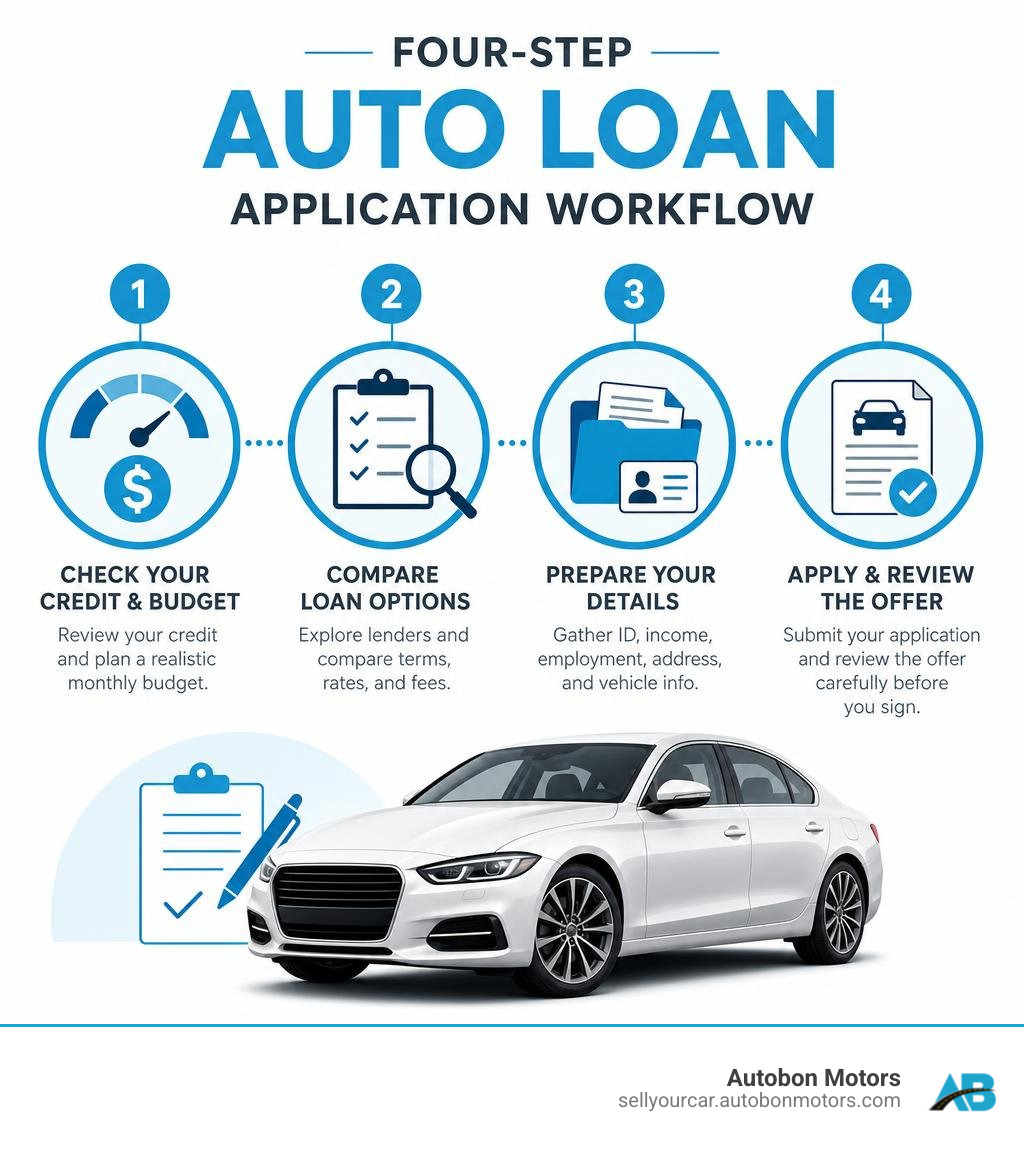
To apply for auto loan financing, check your credit and budget, compare lenders, gather your documents, and submit an application for the vehicle you choose. You can often start with prequalification or preapproval before finding a car, which helps you shop with a clearer price range and less pressure.
- Check your credit and monthly budget. Include insurance, taxes, fuel, and upkeep – not just the loan payment.
- Compare loan options. Credit unions, banks, and dealership financing can have different terms, approval rules, and application steps.
- Prepare your details. Most lenders request identification, income and employment information, address history, and vehicle details when available.
- Apply and review the offer. Read the APR, loan length, payment amount, and total cost before signing.
Online car shopping is now normal: research shows that much of the vehicle-buying journey happens online. A digital application can be quick, but it is still worth slowing down long enough to confirm the lender is legitimate, understand whether the credit check is soft or hard, and choose a payment that leaves room in your budget.
For South Florida drivers replacing a vehicle, selling first can also simplify the numbers. Autobon Motors offers a more convenient, personalized local selling experience: book your appointment online, bring your car, receive an instant offer from an advisor, and get paid on the spot – without the usual haggling or drawn-out process.
I’m Marcos Bravo, a South Florida luxury and exotic auto sales professional with more than 25 years of experience helping clients navigate vehicle purchases, trade-ins, and the decisions that come before they apply for auto loan financing. Next, we’ll start with the financial checks that can make the rest of the process easier.
Step 1: Check Your Credit Score and Establish Your Budget
Before filling out an application or falling in love with a vehicle on a showroom floor in Fort Lauderdale, taking a close look at your financial baseline is essential. When you apply for auto loan financing, financial institutions evaluate your credit history and overall financial health to determine whether you qualify and what interest rate you will be offered.
Your credit score directly drives your interest rate tier. Borrowers with excellent credit generally secure lower Annual Percentage Rates (APRs), while those with lower credit scores are assigned higher interest rates to balance the lender’s risk. However, your credit score is only one piece of the puzzle. Lenders also examine your credit history, looking for consistent on-time payment habits, current total debt obligations, and overall credit utilization.
Lenders establish strict underwriting standards that govern vehicle eligibility alongside your credit profile. Major financial institutions often enforce vehicle age limits and mileage caps. For instance, many bank financing programs restrict funding to vehicles that are no older than 10 calendar years and have fewer than 125,000 miles on the odometer. Vehicles over 20 years old typically fall into classic or antique categories, which require specialized loan structures. Understanding these boundaries prevents unexpected roadblocks when selecting a car.
Loan terms usually span anywhere from 36 to 84 months (and in select cases up to 96 months for high-value purchases). Selecting a longer term spreads payments into smaller monthly amounts, but it increases the total interest paid over the life of the loan. Conversely, shorter terms require higher monthly payments but minimize total interest costs.
Beyond the loan principal and interest rate, a complete budget accounts for every aspect of vehicle ownership:
- State sales tax and county registration fees
- Comprehensive and collision insurance coverage
- Routine vehicle maintenance and repairs
- Monthly fuel or charging costs
To gain deeper strategies on structuring your vehicle budget, read our detailed Car Financing Survival Guide.

Prequalification vs. Preapproval Differences
As you prepare to shop across Broward County or Miami, understanding the structural difference between prequalification and preapproval will protect your credit score and strengthen your position.
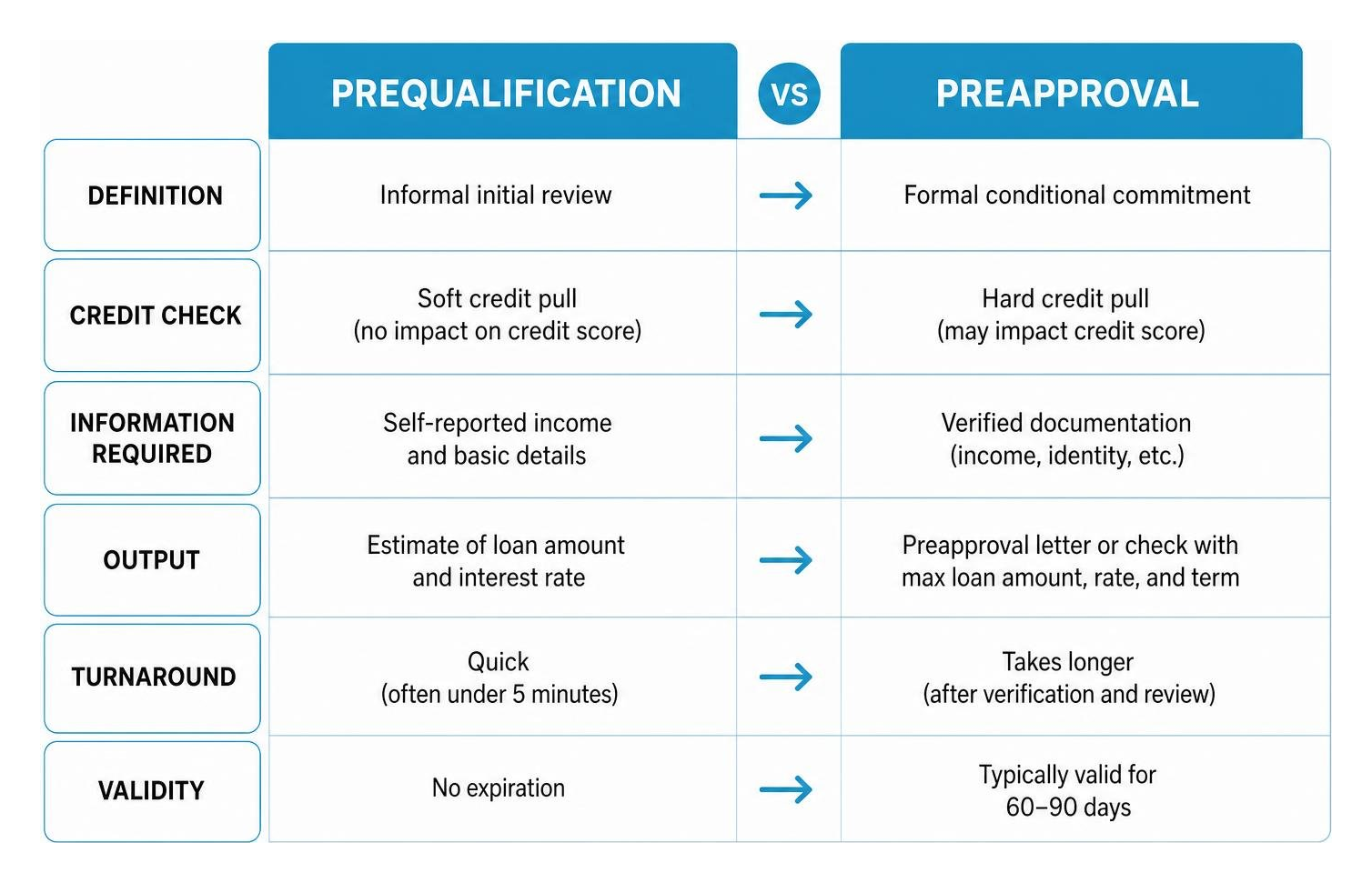
Prequalification is an informal initial review. Lenders evaluate self-reported income and run a soft credit inquiry, which does not impact your credit score. Prequalification delivers a quick estimate of your potential loan amount and interest rate, allowing you to establish a preliminary budget baseline. Soft-pull online tools provide quick answers—often in under five minutes—making them useful for initial exploratory estimates.
Preapproval is a formal conditional commitment. To grant preapproval, the lender executes a hard credit inquiry (a hard credit pull), which temporarily impacts your credit score by a few points. You must provide verified documentation, including proof of income and identity. In return, the lender issues a formal preapproval check or offer letter specifying your maximum borrowing limit, exact interest rate, and term length.
Preapproval offers remain valid for a limited period, typically ranging between 60 to 90 calendar days depending on the institution. Possessing a formal preapproval gives you significant leverage when negotiating at a dealership. It allows you to shop like a cash buyer, keeping negotiations focused purely on the vehicle price rather than confusing monthly payment bundling.
Step 2: Compare Lenders (Credit Unions, Banks, and Dealerships)
Not all auto financing paths are created equal. Finding the best loan terms requires comparing three primary lending channels: credit unions, traditional banks, and dealership finance departments.
Credit unions operate as non-profit member-owned cooperatives, allowing them to pass savings directly to members through lower interest rates and reduced fee structures. Options like Apply for an Auto Loan through local institutions like Florida Credit Union or New & Used Auto Loans | Community First Credit Union often feature flexible terms. Credit unions frequently offer unique perks such as 100% financing (eliminating down payment requirements) and initial loan payment deferral options up to 90 days. Furthermore, regional credit unions such as Auto Loans provide localized member support across South Florida.
Traditional commercial banks offer broad accessibility and fully integrated digital banking platforms. National institutions like Bank of America – Auto Loans Prequalification permit prospective buyers to complete digital prequalification and monitor loan statements alongside checking or savings accounts. For existing bank customers, prefilling applications through online banking speeds up approval decisions down to seconds.
Dealership financing represents indirect lending. When you arrange credit at a vehicle dealership, the finance department submits your information across a network of third-party lenders. While convenient, dealership financing can carry interest rate markups unless you hold a direct preapproval letter in hand. However, manufacturers occasionally run zero-percent or low-APR promotional financing on new inventory that independent lenders cannot match.
When evaluating lenders, submit all formal applications within a tight 14-to-45-day window. Credit scoring formulas recognize this as rate shopping for a single vehicle purchase and collapse multiple hard credit inquiries into a single inquiry event, protecting your credit score from compounding drops.

Step 3: Gather Documents and Apply for Auto Loan Approval
Once you select your preferred lender and find the right car, submitting your formal application requires organizing your paperwork. Having all documentation organized speeds up verification and prevents unexpected underwriting delays.
When completing an online application via portals such as Your Application | Bank of America or direct institutional forms like WHO CAN APPLY , most platforms take under 10 minutes to complete. Online workflows guide you through entering personal, employment, financial, and vehicle-specific information.
Essential Documents to Collect Before You Apply for Auto Loan
To ensure a seamless loan submission, prepare the following items:
- Proof of Identity: A valid driver’s license, state photo ID, or passport. Lenders verify your full legal name, date of birth, and Social Security Number (SSN) under federal identity protocols.
- Proof of Income: Recent pay stubs showing year-to-date earnings, W-2 forms, or tax returns (if self-employed). If you receive non-taxable income—such as disability or supplemental benefits—underwriting rules often allow grossing up that amount by 25% to account for tax equivalency.
- Proof of Residence: Recent utility bills, lease agreements, or mortgage statements establishing your physical residential address in Florida USA.
- Vehicle Details: Specific vehicle information including the Vehicle Identification Number (VIN), exact mileage, year, make, model, trim package, and purchase agreement price.
- Trade-In Documentation: If trading in a current car, bring the original vehicle title, current registration, and an official payoff quote from your existing lienholder.
To better calculate trade-in values and streamline your total financing calculations, explore our guides on the Step-by-Step Guide to Trade-In Car Price Calculator and The Complete Guide to Vehicle Trade-In.
How to Apply for Auto Loan Financing with Bad or No Credit
Borrowers entering the market with limited or subprime credit scores can still successfully qualify for auto financing. Lenders perform holistic application evaluations, weighing multiple factors alongside credit scores.
Applying with a creditworthy co-signer is one of the most effective ways to secure approval and lower your interest rate. A co-signer legally agrees to assume responsibility for loan repayment if the primary borrower defaults. Their established credit history provides underwriters with the security needed to issue competitive terms.
Submitting a sizeable down payment significantly improves loan approval odds. A substantial down payment reduces the overall loan amount, lowering the lender’s Loan-to-Value (LTV) ratio and mitigating financial risk. Additionally, keeping your Debt-to-Income (DTI) ratio low—ideally keeping total monthly debt obligations under 36% to 45% of gross income—demonstrates to underwriters that you have enough disposable cash flow to manage vehicle payments comfortably.
If you have active credit freezes placed across Equifax, Experian, or TransUnion to prevent fraud, remember to temporarily lift those freezes before submitting your application. Lenders cannot pull your credit files while freezes remain active.
Step 4: Finalize Your Loan, Submit Insurance, and Set Up Payments
After receiving formal loan approval, the final stage involves reviewing loan covenants, fulfilling insurance requirements, and establishing recurring payment routines.
Before funds are disbursed to a seller or dealership—whether applying via regional lenders or local financial institutions—your lender requires proof of comprehensive auto insurance. Insurance declaration pages must list the funding institution as the primary lienholder and reflect deductibles that comply with lender limits (typically a maximum deductible cap of $1,000 for collision and comprehensive coverages).
Review the finalized loan disclosures thoroughly before signing. Pay close attention to key terms:
- Annual Percentage Rate (APR) and total finance charges
- Repayment schedule and precise payment due dates
- Prepayment clauses (reputable auto loans carry zero prepayment penalties)
- Optional coverage additions like Guaranteed Asset Protection (GAP) insurance or Mechanical Breakdown Protection
Once the contract is active, set up automatic ACH payments through your lender’s digital banking platform. Establishing automated transfers ensures payments clear on time, avoiding late payment fees. Most lenders offer a grace period—commonly 10 calendar days past the due date—before charging late fees. However, payments that remain past due beyond 30 days are formally reported to major credit bureaus, negatively impacting your credit score.
Refinancing Requirements and Managing Monthly Auto Payments
If you previously financed a car under sub-optimal terms, auto loan refinancing offers an opportunity to lower your monthly payments or reduce your overall interest rate.
Refinancing involves replacing your existing auto loan with a new loan built on better terms. To submit a refinance application, you must provide your current lender’s exact payoff statement, loan account number, vehicle VIN, and current registration. Borrowers often explore refinance options after improving their credit scores or when market interest rates decrease.
Some financial institutions offer cash-out refinancing, allowing qualified borrowers to leverage existing vehicle equity for liquid cash while restructuring their vehicle loan. Additionally, lenders frequently offer incentives—such as cash bonuses or paperless account discounts—for transferring an auto loan from an outside institution. However, note that some credit unions enforce policies restricting direct refinancing of loans originally arranged through their direct partner dealership networks.
Review general industry guidelines to stay informed on servicing standards.
Frequently Asked Questions About Auto Financing
How long does it take to get approved for an auto loan?
Approval timing depends on the lender and application channel. Online applications submitted with complete documentation through automated bank or credit union systems often yield decisions within seconds to a few minutes. If an application requires manual underwriting review—such as self-employed income verification or complex credit histories—approval processing typically takes between 24 and 48 hours.
Can I get pre-approved for an auto loan before finding a car?
Yes, obtaining preapproval before shopping for a vehicle is highly recommended. Preapproval provides a firm spending limit, specifies your interest rate, and establishes your estimated monthly payment. Armed with a preapproval check or approval letter valid for 60 to 90 days, you can negotiate directly on the vehicle purchase price with full financial confidence.
What documents are required for a refinance auto loan?
To refinance an existing vehicle loan, you need to provide:
- A formal payoff statement from your current lender showing the exact payoff balance and daily interest accrual rate
- Your current vehicle registration and Vehicle Identification Number (VIN)
- Proof of income (pay stubs or tax returns)
- Proof of identity (driver’s license)
- Current insurance declaration page listing the new lender as lienholder
Conclusion
Securing vehicle financing does not have to be a stressful or confusing experience. By checking your credit early, comparing lenders across credit unions and banks, organizing required documentation, and finalizing loan covenants carefully, you maintain complete control over your budget and buying process. For more step-by-step strategies, read our full breakdown on how to Apply for Auto Loan in 5 Easy Steps.
If you are replacing your current car, managing a trade-in balance while applying for a new loan can complicate your financing terms. At Autobon Motors, we offer a personalized, convenient alternative designed specifically for South Florida drivers in Fort Lauderdale, Broward County, and Miami.
Autobon Motors’ car selling process consists of four simple steps:
- 01. Book your Appointment Online
- 02. Bring your Car
- 03. Get an instant Offer by one of our advisors
- 04. Get Paid on the Spot
We eliminate corporate red tape, corporate games, and stressful trade-in haggling. Whether you want to clear an existing loan balance or secure cash to increase your down payment before you apply for auto loan financing, visit Autobon Motors today for a transparent, customer-first selling experience.